
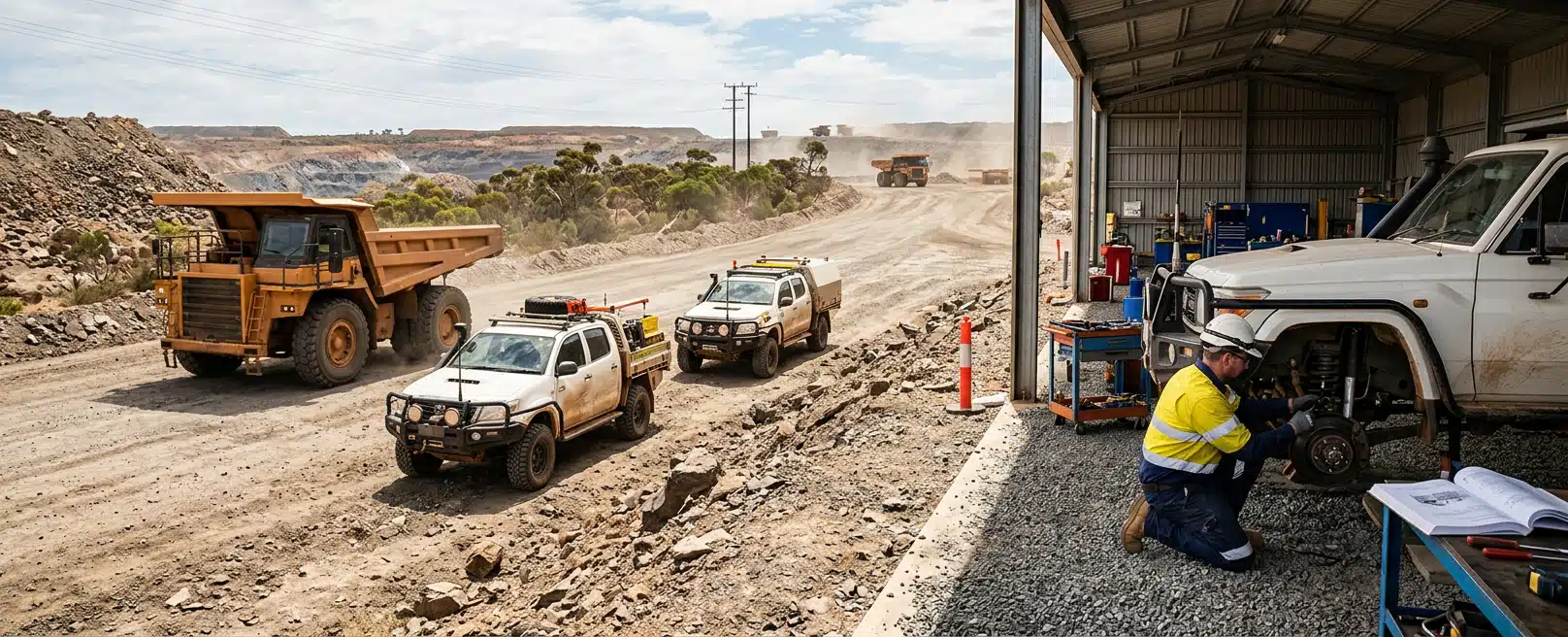
Light and heavy mine-site vehicles can carry the same mobile terrain system by product name. The work still changes with the chassis. Mounts, harness routing, power, and connections into existing circuits differ between a light commercial and a heavy machine.
The site then needs a file that shows what was fitted, how it was mounted and powered, and which connections were made. That file is what site acceptance usually rests on. It is not the same thing as every legal duty that applies to the vehicle.
We design electrical schematics and harness documentation for machinery, heavy vehicles, and mobile equipment. We also install vehicle systems through workshop and on-site work. Our role is the engineering and the fitment of a nominated product on a defined chassis. Mechanical mounts and electrical routing belong together at Engineered Installations Group, not as two unrelated jobs on the same vehicle.
What Has To Be Locked Before Fitout
A purchase order that only names mobile terrain systems leaves module size, cable specification, display type, and power method undefined. Those gaps show up as a loom that cannot be traced, a mount that fights a guard, or a disagreement about what working was supposed to mean.
Product Identity And Power Path
Lock these items on paper before anyone books a bay or a pit window:
- Product identity and the OEM install instructions
- Vehicle make, model, class, and duty
- Mounting faces the manufacturer specifies
- Power method and any documented connection into existing circuits
- Systems already on the vehicle
- Workshop or site access, and who will sign the vehicle back in
If the unit only presents information in the cab, the design should not treat it as machine control. Cab display location still belongs in that brief, because that is what the harness and the header space have to serve.
Mount Faces And Structural Changes
Mounts have to sit on a face that can take the fastener pattern and the duty. They also have to leave the manufacturer’s intended mounting geometry intact. A light commercial chassis and a heavy frame do not offer the same stiffness or the same clear faces.
If a bracket needs a new plate, a welded pad, or a change to an existing member, treat that as a structural decision before holes are cut.
Added circuits have to be fused, routed, and terminated so assembly and later fault-finding are possible from the drawings. They also have to leave normal machine power alone.
We design power and communication architecture so distribution and any communication the selected product actually requires sit in a planned network. That work is meant to leave the circuitry powering normal machine operations unharmed.
Safety circuits already on the machine, including emergency stops and interlocks, stay in the same conversation. A new display or module should not defeat an isolation path the site already relies on.
Who Signs The Vehicle Back In
Name who will accept the vehicle while those items are still on paper. Some sites want a maintenance superintendent to sign a post-install check. Others want engineering to hold schematics, mechanical drawings, and any structural evidence first.
The install plan has to produce the documents that party will file. A tidy vehicle with no drawings or check records is still an open item on a mine-site vehicle compliance register.
Light Vehicle Installation Scope
Light mine-site vehicles such as service utes, supervisor trucks, and light commercials usually present shorter harness runs, a smaller cab, and fewer competing modules. The job is still a designed fitment on a chassis that flexes and already carries other kit.
Chassis Flex And Cab Space
Sensors or modules still have to sit on a face that matches the geometry the manufacturer intended. A canopy, toolbox lid, or tray added after the dealer can move in a way the original panel did not.
If that same service ute will run a higher payload, stopping and ride under the new load are a ute-side question, not a terrain-module question. We supply braking and suspension upgrades for Australian utes when the duty or load has changed. That offering does not apply to heavy plants, and it does not stand in for the terrain system’s own OEM setup.
Schematics And Workshop Fitment
Electrical work on these vehicles still needs electrical engineering that produces engineering-grade schematics and a harness design with a cut list, a bill of materials, and termination instructions. Ambiguous drawings slow assembly. They also make the next breakdown slower.
Routing, weatherproof connections, and separation from high-current runs belong in that design. The aim is a loom that can be built once and diagnosed later without opening every cavity.
Workshop vehicle installation at Forrestdale suits light vehicles that can leave the site. The metro bay is Unit 2, 17 Bessemer Rd, Forrestdale WA 6112.
Pre-install and post-install checks are part of that work. We check the installation against the agreed design. We also confirm equipment is not damaged or modified beyond that design, and that the fitted system operates as designed.
We follow lock-out tag-out, PPE, and isolation protocols in the workshop as we do in the field. A light vehicle that can come off site is often the cleaner path for baseline geometry. The chassis can be placed and inspected without pit traffic setting the clock.
Photographs Before The Booking
Light-vehicle complexity still rises when the tray, canopy, lighting, or an existing safety system already occupies the faces and the cab. Those clashes belong in the pre-install finding, not the last hour of the booking.
Send photographs before the booking if the faces are crowded:
- Proposed mount faces
- Dash or header space for the display
- Auxiliary electrical already in the tray
Heavy Vehicle Installation Scope
The heavy plant changes the mechanical question first. Brackets see higher shock and vibration. Payload and implement duty change how the structure moves under the mount.
Shock, Frames, And Vibration
If a mount needs a new plate or a frame change, we use finite element analysis to quantify stress, deflection, and fatigue on brackets, frames, and mounts. We also use it to assess field modifications before they are cut.
That evidence supports the structure around the system. The product manufacturer still supplies the product’s own performance data, including how the unit is meant to be mounted and set up.
Sensitive electrical hardware on heavy machines also sees a rough, variable-speed, variable-load environment. We use vibration data analysis to inform mounting and dampening for those components. It helps decide whether a proposed location will shake a module too hard.
Electrical architecture on heavy vehicles is already busy. Engine, transmission, braking, and auxiliary circuits leave less room for improvisation. The added system has to take power without harming normal machine operations.
Shared Systems On One Design
Any communication path the product is specified to use has to be designed rather than tapped on the day. Where collision avoidance, fleet management, communications, or driver monitoring share the same window, placement, electrical load, and cab layout need one coordinated design.
Separate crews installing separate boxes without a common schematic invent connections on the job. One schematic and one mechanical layout keep sensor, display, and load decisions in the same design.
Plant That Stays On Site
Heavy assets more often stay on site. Then the work is field installation. We mobilise technicians to the client location. The crew is scaled to a single unit or to a multi-site program.
Planning runs with operations so delivery, other trades, and commissioning line up. Access, isolation windows, and where the machine can sit for harness work are constraints in that plan. A design that assumes a clear workshop floor will not survive a shovel that can only be released between shifts.
3D scanning is useful when a guard, implement, or existing kit hides the face that has to take a mount. It also helps when the harness path cannot be measured from a photograph. It is a geometry tool for the install. OEM mounting rules still apply.
Workshop Or Site Access
A light vehicle can still be trapped on site by roster or distance. A heavy machine can still come off site if the outage is planned that way. What then changes is isolation, lifting, weather, and how much of the quality check can be done in a controlled bay.
Forrestdale, Paget, And Isolation
Forrestdale remains our metro installation base. Field work applies when the job cannot be completed there. Our Queensland location is 13 Ginger Street, Paget QLD 4740, for fleets that sit outside the Perth metro catch.
In either place, the file still has to match the vehicle that was worked on. The location changes how that file is produced and who has to be in the isolation plan.
Working with operations through the field job is the equivalent of a workshop booking slot. Commissioning that is not aligned with the people who will accept the vehicle produces a machine that is physically finished and still not signed back in. Name that party in the same planning pass as pit access.
Documentation That Supports Site Acceptance
Sites need evidence that the fitment matches the selected system, that the vehicle was not compromised, and that the agreed checks were signed. We build that file from the same engineering we already produce for machinery and mobile equipment.
Electrical schematics give the layout for the system and the harness. Harness documentation supplies cut lists, material specification, and termination detail so the install can be repeated and audited.
Mechanical assembly drawings, and three-dimensional routing for harness runs where that method is used, show where hardware sits in the structure. Where mounts or frame changes were analysed, the FEA record is the traceable structural evidence.
System design work includes documentation intended for manufacturing, installation, and certification. That is the core of the file the site holds.
What The Site File Should Hold
A useful site file usually contains:
- Electrical schematics and harness documentation
- Mechanical assembly drawings, and 3D harness routing where used
- FEA records if mounts or frames changed
- Pre-install and post-install check records
- As-built drawings if the route or bracket moved
- A note of any connection into existing vehicle circuits
- OEM setup steps that were run, by whom, and against which instruction
A structural calculation supports a bracket or frame change. It does not prove the electronics. Missing connection detail is an open item for mine-site vehicle compliance reviewers.
Checks During Installation And Commissioning
Pre-install assessment is where clashes are cheap to fix. Finding a hidden cross-member after the loom is cut is expensive to unwind.
Before Cutting Or Drilling
Check these items before cutting looms or drilling:
- Electrical capacity on the vehicle
- Suitability of the proposed mounting faces
- Compatibility with systems already fitted
- Whether structure must change beyond the agreed design
The install then follows the schematic and the mechanical drawings. Mounts, harness, terminations, display, and any designed connection are fitted to those drawings. Quality checks during and after the fitment confirm the design was followed.
Commissioning And Later Changes
Commissioning is where fitted and accepted can still diverge. The system has to operate as designed on that vehicle. The people who will sign the asset back into service have to see the evidence they asked for.
If the site’s test is a documented OEM procedure, that procedure is what gets run. If the site also wants a functional check that existing emergency stops and interlocks still behave, that check belongs in the same window.
Commissioning support includes work alongside a fabrication team to close integration issues. That support is part of taking a design through to an implementation-ready result.
If braking, suspension, tray, or implement changes land after the install, the original mount and harness assumptions may no longer hold. Mass, duty, and available faces can all move. Treat that as a reason to reassess the fitment.
Aftercare After The Vehicle Returns To Work
Installation aftercare, vehicle system condition and performance audits, and scheduled servicing are the ongoing side of the same fitment. A loom that cannot be traced, a mount that has cracked, or a display that no longer matches the as-built drawing will show up in service long after the original crew has left.
Faults Against The Accepted File
Aftercare should use the same documents the site accepted. Audits against as-built drawings and schematics are faster than audits against memory, because the route and the termination already have a record.
An electrical fault starts with the harness documentation. A loose or cracked bracket starts with the mechanical drawings and any FEA assumptions about load cases.
Vibration capture on mobile equipment is available when a repeating mechanical mode is the question, including wheel ends, final drives, and other rotating assemblies. That is condition evidence for the machine. It is only indirectly relevant to a terrain fitment if the mount or the module is in the vibration path.
When The Machine Cannot Come Off Site
Support for remote faults is a field question again. Transporting a heavy asset to Forrestdale for a module swap is not always the proportionate step. Short-term site works, breakdown support, and project deployment support exist for work that has to happen where the machine sits.
The technical input for that visit is still the vehicle identity, the as-built file, and a description of what changed since commissioning.
The Practical Answer
Site acceptance follows the file you can produce for that chassis, not the product name on the purchase order. Lock the mount, power path, and connections first. Then book Forrestdale or a site window from whether the asset can leave, and from the documents the site will file.
For a scoped discussion, send:
- System identity and OEM install instructions
- Vehicle make, model, and class
- Photographs of proposed mount faces and cab space
- A list of systems already fitted
- Whether the asset can come to Forrestdale or needs site access
- The document list the site will use to accept the vehicle
Use those inputs to discuss the project with us.



Leave A Comment