
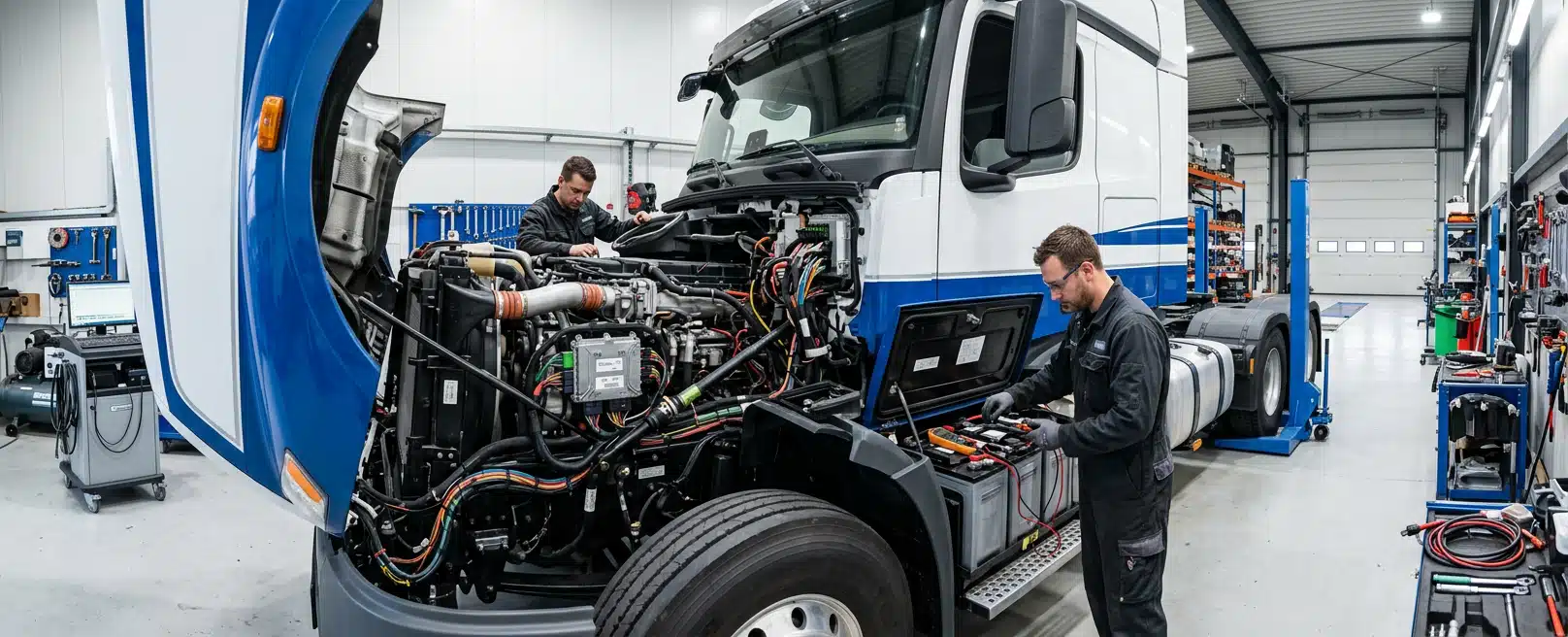
A heavy vehicle electrical fault rarely gives you a clean warning and a free bay. Connectors corrode, harnesses chafe, and a control circuit can drop out while the machine is still mechanically sound. Unplanned downtime follows when the inspection was never tied to failure consequence, actual condition and a window operation can hold.
A useful electrical preventive programme follows a planner’s order of work. Rank circuits by the consequence of loss, inspect the condition on that vehicle, use manufacturer-approved tests after competent isolation, book the work where the machine can actually be reached, and keep a few measures that change the next interval.
Rank Work by Failure Consequence
Start by asking what happens if the circuit is lost. A lighting fault on a service ute and a failed interlock on a haul unit are both electrical jobs, yet they can carry very different operational and safety weights.
Treat required lighting as a safety circuit when its loss leaves the vehicle unfit for the road, the pit or night work. Convenience lamps that leave legal lighting and safety functions intact can wait behind starting, charging, control power and interlocks.
On a light support ute the same split applies when extra tray or toolbox payload is fitted. Required lighting and starting stay in the high-consequence set because they still decide whether that ute can leave the yard. If the ute also carries braking and suspension upgrades for the extra load, keep the body electrical interface in the vehicle ranking rather than treating the tray as a separate afterthought.
Rank by Variant and Duty
Rank the high-consequence items first, then sort again by how often they actually fail on that variant:
- Starting, charging and main power distribution
- Engine and machine control connections
- Lighting and safety circuits, including emergency stops and interlocks where fitted
- Collision avoidance, communications and fleet management already on the vehicle
- On the variants that carry them: proximity, autonomy interfaces and operational radios
If losing the circuit parks the machine or removes a safety function, it belongs near the top even when the connector still looks tidy. A sealed module with a clean history may be a candidate for a longer interval only where the manufacturer or service obligation still allows it, and only where its loss would not park the machine or drop a safety function.
Write that ranking against vehicle variant rather than a fleet average. The same OEM family on highway duty and on a dusty haul road will not share the same risk order. Name the variant and the duty before you lock the ranking, because those two facts change which circuits fail and how badly.
Consequence also decides how you spend a short window. If operations will only give you an hour, that hour belongs on the circuits that strand the vehicle or remove a safety function, including lighting required for the shift.
Inspect Actual Condition on the Vehicle
Manufacturer intervals are a starting point. They assume the environment and load the book was written for. Heat, dust, vibration, wash-down and continuous auxiliary load change how fast a terminal, boot or loom ages. Set any change in frequency from recorded condition and from the manufacturer’s guidance for that variant and duty.
Record Present Condition, Not Remaining Life
Condition is what you can see, measure and record on this vehicle. A battery terminal inspection is complete when you record torque, corrosion on a consistent scale and a load voltage drop. Those readings describe the joint as it is today.
Use those readings to decide whether to restore the joint now, and keep them so the next visit has a comparison. They show the present condition. They do not prove their remaining life until the next booked window.
A harness inspection should name chafe points, connector faces, strain relief and seal condition. If the loom sits against a bracket that moves, the chafe will return after a wrap. The inspection has to say where and how, so the next technician can work from a location rather than a guess.
Confirm the seals and breathers that the design actually uses. Apply a manufacturer-approved enclosure test only where that procedure exists for that box. Many enclosures are assessed by seal, boot and breather condition rather than by a pressure test.
Intermittent module faults after rough terrain are a condition finding. Check mounting, service loops and whether the harness is pumping vibration into the connector before you replace the controller. Repair the path you can evidence.
Dust inside a connector housing can raise resistance and hide behind dull pins. Record contamination and seal condition, then clean or replace to the approved method. Investigate the module after the connector and seal have been assessed.
Where a repeating mechanical mode is beating on a mount or loom, vibration data analysis can help you decide whether the structure around the circuit is contributing to the electrical fault. Keep the connector inspection as the electrical check, and use vibration data as supporting evidence for the structure around it.
Use Approved Procedures and Competent Isolation
Electrical work that opens covers or disturbs live conductors starts with isolation by someone competent for that energy source. Lockout, tags and proved isolation belong before that work. Isolation is a prerequisite. It does not by itself prove a connector or cabinet is safe to open.
Confirm residual energy, stored charge and the OEM isolation method for that circuit before covers come off. Once isolation is proved and residual energy is managed, follow the OEM or system-owner procedure for that circuit.
Apply continuity, insulation and functional tests where the OEM or system-owner procedure names them for that component. Attached electronics often need their own functional checks rather than a generic loom test.
Safety and driver-assist systems need the checks those systems were commissioned with. That may include sensor aim, bus health and a review of stored faults where the procedure calls for them. Follow the OEM electrical and functional tests for a camera or radar pack so the unit is protected as well as verified.
Inspect Against the Drawing That Matches the Vehicle
We produce engineering-grade electrical schematics and harness packs with cut lists, material specifications and termination instructions so assembly and troubleshooting work from the same document. Use that documentation as the working reference for the inspection when it still matches the vehicle.
If the vehicle in front of you no longer matches the drawing, reconcile the as-built before you pass a circuit that has been modified in the field. A preventive check against the wrong schematic can record a pass on a circuit that is no longer the one drawn. Where the route is hard to reconstruct from photographs, 3D scanning can capture the current loom path so the inspection is against the vehicle you have.
Keep Records That Change the Next Interval
Capture measured values, a simple condition rating, the variant, hours or kilometres, site, and what you actually corrected. Those fields are what the next service uses. Without them, the next crew repeats the same visual pass with no comparison.
Over a few cycles those lines show which connector family, which route and which duty keep coming back. That history is how you argue for a tighter or unchanged interval on that variant, without guessing across the whole fleet.
If the same joint is clean at every visit, you have a reason to ask whether the manufacturer interval and any service obligation still require that task at the current frequency. If it is already corroded at the booked window, the interval is too long for that duty on that variant. Change that item rather than every vehicle on the register.
Mixed fleets need tiers rather than one calendar. Severe dust, heat or vibration gets more frequent eyes on the circuits that actually suffer. Moderate highway work can stay closer to the book. Consequence still decides which items move, including required lighting, so the extra window is spent on circuits that strand the truck or drop a safety function.
Digital capture helps only if someone reads it. A maintenance system full of electrical OK ticks will not show a repeating pin cavity. Use the same words and the same scales so two workshops can compare the same connector.
Treat Repeating Chafe as a Drawing Change
When the same chafe or termination returns after a competent repair, treat it as a candidate for engineering review. Routing, clamp position, specification or variant differences are common causes, though impact, a missed repair or a parts substitution can produce the same pattern. Bring that history to engineering and the harness documentation so the next change is specified rather than wrapped again.
A loom that is the correct length on paper can still be short once a guard, tray or tank has moved. The circuit then fails because the route, clamp or surrounding structure has changed. Compare the schematic with the defect history before you buy another identical harness. If the mechanical change and the harness path have to be designed together, that is a system integration job rather than another wrap. When the same bracket or mount keeps flexing under the connector, finite element analysis can test that structure before you keep replacing the joint.
Match the Task to Workable Access
The electrical procedure only holds if the vehicle can be reached, isolated and opened in the time you booked. Access belongs in the programme at the same time as the task list, because the isolation method, parts and test set all change with location.
Book the Workshop When the Vehicle Can Attend
When the vehicle can come in for a condition audit and scheduled servicing, workshop preventive maintenance is the practical option. Pre and post checks are straightforward in a controlled bay, and electrical work can sit with other booked tasks.
That is also where harness replacement to drawing and aftercare on kits we have fitted belong, provided the vehicle can actually attend. Use bay time for inspections that need a bench, the schematic and harness documents, or coordinated mechanical work.
Pack the Field Window When It Cannot
When the machine cannot leave the pit, the pad or the remote workshop, on-site maintenance is the practical path. Field servicing still needs isolation, the right test set and the parts you actually use on that variant. The constraint is logistics: what you can carry, where you can prove isolation, and how long operations will hold the unit.
For a field window, pack the isolation kit for that energy source, the OEM procedure, the connector and seal parts for that variant, and the meters the procedure names. Confirm a place to prove isolation, a cover-off time operation will hold, and a path to return the unit if a cabinet needs a bench.
Plan that window with site operations so commissioning and multi-crew work share one agreed slot. Match the task to isolation, parts, test method and the booked time, then write those constraints on the work order before the crew leaves.
A visual connector inspection can stay with the machine if the site can isolate and open it safely. A cabinet rebuild that needs a bench belongs in a workshop if the vehicle can attend. Send a field crew when the site can support isolation and parts. Book a haul unit into a bay when the job needs that bench.
Tell us the site, the service window and whether the vehicle can reach Forrestdale or must stay at the machine. We work from Forrestdale in Western Australia and from Paget in Queensland, and we mobilise field crews when the job cannot come to the bay. Bring that access constraint to Engineered Installations Group so we can crew the bay or the pad. That choice follows access rather than a preference for one facility.
Measure Results, Then Change the Interval
Before you add tasks, write down the last year’s unplanned electrical stops: count, duration, variant and cause as best you know it. After a few cycles, compare those fields with the new record. If strandings are unchanged, review whether the inspections, the ranking or the booked windows are the weak point. Random defects, impact and missed access can also leave the count flat.
Schedule compliance is the companion metric. If operations defer the electrical window every time, the programme is not reaching the vehicle. Either the window is unrealistic or the consequence ranking has not been agreed with the people who own the roster.
Direct labour and parts on scheduled electrical system maintenance will rise if you were previously doing almost none. That is expected. Judge scheduled spend together with emergency callouts, secondary damage and lost hours. Use your own hours, your own stops and your own parts. If those numbers are missing, collecting them is the first programme task.
A condition audit gives you the baseline those measures need. We can support condition audits, scheduled servicing and installation aftercare. Where a mechanical mode is beating up an electrical part, vibration findings from an earlier inspection can inform mounting and harness support. Keep those findings with the connector record.
Random defects and impact damage still occur. Heavy vehicle preventive maintenance on electrical systems aims for fewer preventable stops, clearer causes when something does stop, and a shorter argument about what to inspect next time. Prediction of every failure is outside that aim.
Scope the Next Conversation From Those Inputs
The case for the programme is fewer preventable electrical stops. Set the next interval from recorded condition and from manufacturer or service obligations. A clean joint is evidence to take back to that review, with the OEM interval still in force until you change it on purpose.
When you are ready to discuss your requirements, send the vehicle variants, the circuits you already rank as high consequence, recent electrical stop records, the isolation and OEM procedures you must work to, and whether the machines can enter a workshop or must be serviced on site. We use those inputs to scope audits, scheduled electrical servicing or harness documentation changes. The inspection on the vehicle still decides the work.



Leave A Comment