
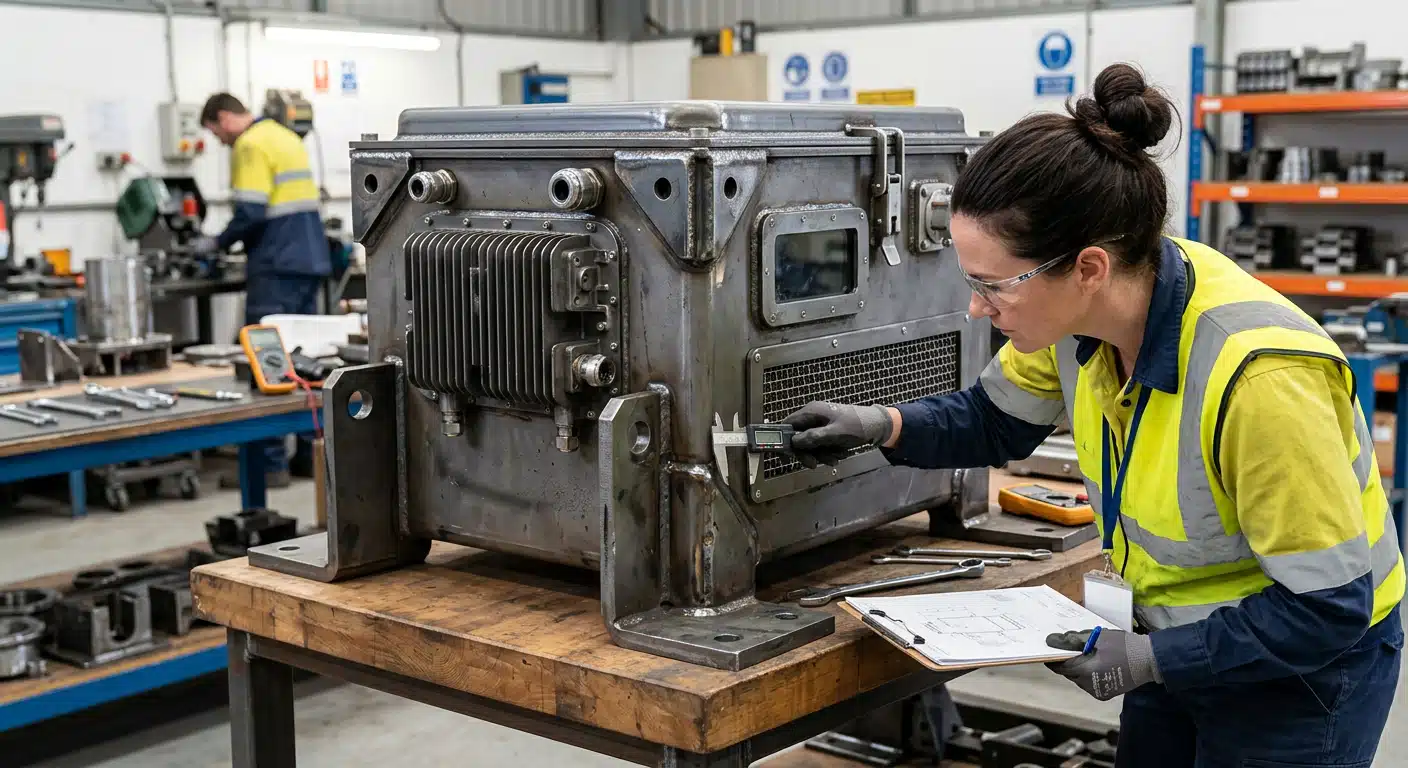
In practice, battery enclosure validation is critical when energy systems are installed on mobile mining assets. The enclosure must protect weight, heat, impact and vibration risks.
A mining vehicle does not treat equipment gently. Structural movement, shock loads and harsh operating conditions can expose weak enclosure decisions quickly.
Battery Enclosure Validation Starts With the Operating Environment
In practice, battery enclosure validation should begin with the asset’s real duty. Mobile mining assets face rough ground, vibration, heat, dust and repeated service cycles.
An enclosure that suits a clean workshop may not suit a mine site. It must protect the battery system while still allowing inspection and safe access.
Engineered Installations Group’s finite element analysis can support structural simulation. That helps assess design integrity before fabrication or installation.
Structure and electrics around the pack meet as an enclosure system fit, not as a last-hour bracket.
Why Mobile Assets Create Higher Structural Risk
A stationary enclosure mainly deals with static loading and access needs. A mobile asset adds movement, impact and changing load direction.
Brackets, welds, fasteners and mounting points can experience repeated stress. Small design weaknesses may become field failures over time.
That is why battery enclosure validation needs more than visual review.
FEA Energy Systems Reviews Help Test Mounting Decisions
The battery electrical path is planned with the enclosure, not after the box is closed.
FEA energy systems reviews can model how an enclosure may behave under expected loads. This can identify stress concentration and deflection concerns.
The goal is not to make every component heavier. The goal is to place strength where the operating risk demands it.
3D services can support component design, scanning and custom deliverables. That digital work can feed better structural review and manufacturing decisions.
Modelling Should Reflect Real Installation Constraints
A useful model needs realistic inputs. Mounting location, support geometry, enclosure mass and access cut-outs all affect the result.
If the model ignores the real asset, the result can be misleading. Validation should stay connected to the final installation method.
This is especially important when batteries are added to equipment not originally designed for that load.
Enclosure Design Must Protect More Than the Battery
A battery enclosure protects the energy system, but it also protects nearby people and equipment. It must reduce risk from impact, water, dust and vibration.
It should also support isolation, inspection and controlled service work. A strong box with poor access can still create operational problems.
Engineered Installations Group’s system design supports integrated solutions. That matters when enclosure design affects electrical routing, controls and maintenance.
A look at the installed pack once the asset has left the workshop is an enclosure field check.
Thermal and Service Access Need Early Planning
Energy systems can generate heat and may need defined airflow or spacing. Enclosure design should not trap heat without a management plan.
Service access also needs careful thought. Covers, fasteners and inspection points should suit site maintenance conditions.
A design that is difficult to inspect can hide small problems until they become expensive.
Vibration Can Shorten Battery System Life
Enclosure structural analysis is the load check for battery enclosure validation.
Mobile mining assets create vibration across frames, trays and mounted equipment. Battery enclosures must be designed for that repeated movement.
Vibration can affect brackets, cable penetrations, connectors and internal supports. It can also change how loads move through the enclosure.
Vibration data analysis can help identify dynamic risks. That evidence can support better dampening and mounting decisions.
Cable Penetrations Are Common Weak Points
Battery enclosures often need cable entry points, service ports and vents. Each opening can affect strength, sealing and cable protection.
Engineered Installations Group can run that enclosure check from the Forrestdale or Paget workshop.
Those details should be reviewed during validation. A small penetration in the wrong place may create stress or water ingress risk.
Good design treats the enclosure and electrical system as connected.
Field Installation Needs Design Control
An enclosure vibration review is the check when the pack will see repeat shock.
Even a validated enclosure can fail if installed poorly. Mounting surfaces, torque settings, isolation and final cable routing need careful control.
On-site services can support installation, commissioning and maintenance. Field delivery should match the design assumptions used during validation.
If the final installation changes the mounting arrangement, validation may need review. Small field changes can affect structural behaviour.
Commissioning Should Include Physical Checks
Commissioning should include more than electrical operation. The physical enclosure, brackets, fasteners and cable protection should be checked.
Inspection records can help future maintenance teams understand the baseline condition. They can also support later fault investigation.
For mobile assets, that baseline is useful before the equipment returns to full service.
Integrated Engineering Reduces Battery Enclosure Risk
An enclosure geometry scan helps when the mount clash is hard to see on a sketch.
Battery enclosure work sits between mechanical design, electrical architecture and field installation. Treating those areas separately can create gaps.
Engineered Installations Group provides engineering and installation support for heavy vehicles, mining and industrial systems. That mix suits projects where energy systems need practical protection.
In practice, battery enclosure validation is strongest when analysis, design and site execution stay aligned.
FAQ
What Is Battery Enclosure Validation?
In practice, battery enclosure validation checks whether an enclosure can protect an energy system under expected operating loads. It should consider structure, access and environment.
Repeat brackets and fittings for the same pack can be held as enclosure repeat kits.
How Does FEA Help Battery Enclosure Design?
FEA can model stress, deflection and weak points before parts are built. This helps improve mounting and enclosure geometry.
Why Are Mobile Mining Assets Difficult for Battery Systems?
Mobile mining assets face vibration, impact, dust, heat and difficult access. These conditions can expose weak design choices.
Should Validation Be Repeated After Field Changes?
Yes, if the mounting arrangement or enclosure design changes materially. Validation depends on the final installed condition.
What to Settle Before the Job Moves
The battery enclosure validation decision is easier when the asset, the site rule and the access limit are written down first. A verbal brief tends to drop the one constraint that changes the fit.
Pair that note with FEA energy systems. The field step should use the same names for parts, mounts and records, or the workshop file and the site file drift apart.
Records That Should Travel With the Asset
A useful battery enclosure validation pack names what was checked, what was fitted and what still needs a site look. It is a work record, not a promise that the asset will perform a certain way.
Photos of access, a parts list and the open questions on FEA energy systems are more useful than a slogan on the cover sheet.
Where Workshop Work Stops and Field Work Starts
Some preparation for battery enclosure validation can be finished at Forrestdale or Paget. What remains depends on the asset as it sits on the day, not on a generic bench claim.
That is why FEA energy systems still need a named handoff. The person who did the workshop work and the person who sees the asset on site should be looking at one list.
Questions Worth Asking Before Fabrication
Ask where the battery enclosure validation work will be inspected, who signs the site record, and which part has to stay reachable. Those answers change the job more than a generic label.
What the validation includes should be read as an enclosure scope list before the file is closed.
Use FEA energy systems as the second check, not as a new topic. If the second check disagrees with the first sketch, stop and revise the sketch before metal or film is cut.
When the enclosure load case is drafted, speak with us before the FEA file is closed.
Battery enclosure validation starts with the duty the asset actually sees. Rough ground, heat, dust and repeat service cycles are inputs, not afterthoughts. The enclosure has to protect the energy system and still leave a way to inspect it. A closed box that cannot be checked is a later problem, not a finished design. Record the load case, the access path and what was assumed, so a field change is not treated as the original design.



Leave A Comment