
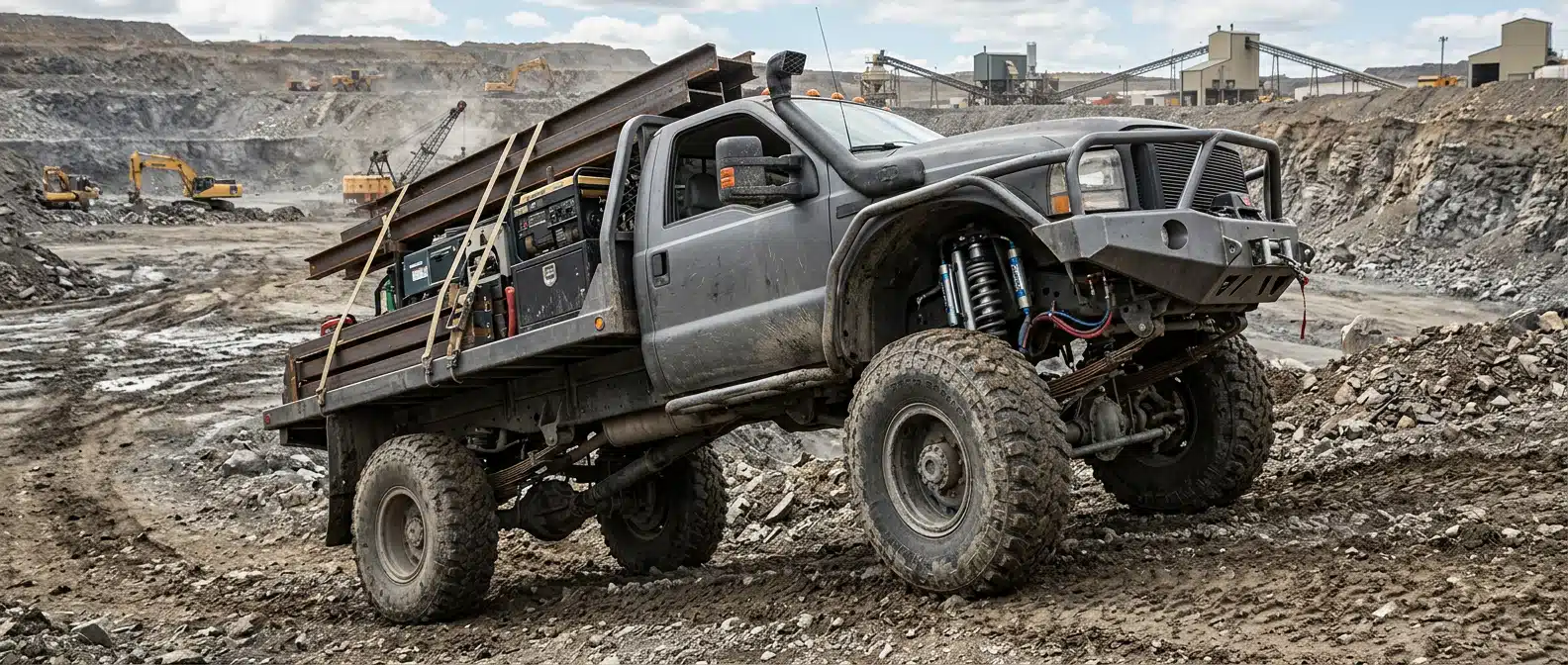
Vehicles operating in mining and trade environments face demands that standard factory specifications rarely anticipate. Payloads regularly reach legal maximums, terrain varies from sealed highways to unmaintained mine access roads, and operational schedules leave little room for mechanical failure. Under these conditions, factory-fitted braking and suspension systems often operate at or beyond their design limits, creating safety risks and accelerating component wear. Braking and suspension modifications address these limitations by recalibrating vehicle systems to match actual operational demands.
These mining vehicle performance upgrades extend beyond simple component replacement; they involve engineering assessments, compliance verification, and integration with existing vehicle control systems to deliver measurable improvements in stopping performance, load management, and operational safety.
Why Standard Braking and Suspension Systems Fall Short in Demanding Applications
Vehicle Manufacturers Design Braking and Suspension
Vehicle manufacturers design braking and suspension systems for general-purpose use, balancing performance, comfort, and cost across broad market segments. These factory specifications assume typical driving conditions including sealed roads, moderate payloads, and regular maintenance intervals. Mining and heavy trade applications violate nearly all these assumptions.
A standard light commercial vehicle rated for 1,000 kg payload may regularly operate at maximum capacity on corrugated mine access roads, where suspension travel, damping rates, and spring loads face continuous extreme cycling. Factory brake systems calibrated for urban and highway use encounter thermal loads during repeated heavy stops that exceed design parameters, leading to brake fade, accelerated pad wear, and in severe cases, complete brake failure. For any mine-spec vehicle fitout, addressing these foundational system limits is a prerequisite for site safety.
The consequences extend beyond component longevity. Inadequate braking performance increases stopping distances, creating collision risks in confined mine site environments where heavy machinery, light vehicles, and personnel operate in close proximity. Suspension systems operating beyond their design envelope compromise vehicle stability, particularly during emergency manoeuvres or when managing uneven terrain at speed.
Compliance issues also emerge. Vehicles modified to carry increased payloads or fitted with auxiliary equipment that alters weight distribution may no longer meet Australian Design Rules (ADRs) without corresponding upgrades. Operating non-compliant vehicles creates legal liability and can void insurance coverage; this is a risk few mining operators or trade businesses can afford to manage.
Load Capacity and Brake Performance Requirements
Braking Force Requirements Scale with Vehicle
Braking force requirements scale with vehicle mass and operating speed. A vehicle’s ability to stop safely depends on brake system capacity to convert kinetic energy into heat while maintaining friction coefficient stability across the brake pad and rotor interface. When payload increases, kinetic energy increases proportionally. The energy $E_k = \frac{1}{2}mv^2$ dictates that doubling vehicle weight doubles the energy that brakes must dissipate during each stop. Selecting high-quality components for mining vehicle performance upgrades supports that the chassis remains protected from these high-energy impacts.
Load-rated brake components address this challenge through larger rotor diameters, increased pad surface area, and enhanced thermal management. Larger rotors provide greater leverage for clamping force and increased surface area for heat dissipation. Upgraded brake pads use friction materials formulated to maintain consistent performance across wider temperature ranges, reducing fade during repeated heavy braking. EIG provides components engineered to ensure that the friction coefficient remains stable even as internal rotor temperatures exceed $400^\circ\text{C}$.
Hydraulic system upgrades often accompany rotor and pad changes. Larger bore master cylinders and upgraded callipers deliver increased hydraulic pressure, ensuring adequate clamping force even when brake components reach elevated temperatures. Braided stainless steel brake lines replace factory rubber hoses, eliminating flex under pressure and improving pedal feel and response consistency.
Thermal management becomes critical in mining applications where vehicles may descend long grades with maximum payloads. Upgraded brake systems incorporate ventilated rotors with directional vane designs that enhance airflow and heat extraction. Some heavy industrial modifications include supplementary engine braking systems or exhaust brakes that reduce reliance on friction brakes during sustained descents, preserving brake system capacity for emergency stops.
Suspension Modifications for Terrain and Payload Management
Suspension Systems Perform Three Primary Functions
Suspension systems perform three primary functions: supporting vehicle weight, absorbing road irregularities, and maintaining tyre contact with road surfaces. Standard factory suspension achieves acceptable performance across these functions for typical use cases. Mining and trade applications stress all three functions simultaneously. Heavy payloads increase weight loads, rough terrain amplifies shock inputs, and operational speeds demand consistent tyre contact for vehicle control.
Mine-spec suspension systems address these demands through component upgrades calibrated to actual operating conditions. Heavy-duty coil springs or leaf spring packs with increased load ratings support greater vehicle mass without excessive compression, maintaining proper ride height and suspension geometry under load. This prevents bottoming out on rough terrain and preserves suspension travel for absorbing large impacts.
Professional braking and suspension upgrades focus on these structural foundations to prevent chassis fatigue.
Shock absorber upgrades provide damping rates matched to heavier spring loads and higher-frequency terrain inputs. Standard shock absorbers designed for empty or lightly loaded vehicles may under-damp when carrying maximum payload, allowing excessive body motion and reducing vehicle stability. Braking and suspension modifications for work vehicles used in the Pilbara often require higher fluid volumes to prevent thermal thinning of the shock oil during extended shifts on corrugated access roads.
Airbag suspension systems offer variable load capacity, allowing operators to adjust suspension characteristics based on payload. When empty, airbag pressure can be reduced for improved ride comfort. Under load, increased air pressure stiffens the suspension to maintain ride height and control body motion. This adaptability suits vehicles that operate across varying payload conditions throughout work cycles.
Suspension geometry considerations also influence modification approaches. Vehicles fitted with auxiliary fuel tanks, toolboxes, or equipment trays experience altered weight distribution that can affect suspension loading and vehicle handling. Systematic design work supports modifications account for actual weight distribution rather than applying generic upgrade packages. The goal extends beyond simply supporting additional weight; properly engineered systems maintain vehicle control, reduce driver fatigue, and extend component service life across demanding operational environments.
Compliance and Engineering Certification
Australian Design Rules Establish Minimum Safety
The engineering team at Engineered Installations Group matches that duty to the vehicle in the bay.
Australian Design Rules establish minimum safety and performance standards for vehicles operating on public roads. Modifications that alter vehicle mass, braking performance, or suspension characteristics trigger compliance requirements under ADR regulations. Braking and suspension modifications must maintain or improve original safety performance to remain compliant with state transport regulations in Western Australia and Queensland.
3D services help when a guard hides the face that has to be measured.
Vehicle compliance standards require engineering assessments that verify upgraded components meet ADR specifications for brake force distribution, stopping distance, suspension load capacity, and vehicle stability. The assessment must demonstrate that modifications do not compromise other vehicle systems or create new safety risks. Engineering certification follows a structured process where a qualified engineer reviews modification specifications and performs calculations to verify performance against ADR requirements.
Electrical engineering covers the loom and controller side of the same brake job.
The engineer issues a certification document that accompanies vehicle registration, providing evidence that modifications comply with applicable regulations. For mining vehicles that operate exclusively on private property, ADR compliance may not be legally required. However, mine site operators typically impose equivalent or stricter standards through their own vehicle acceptance criteria. Site access often requires evidence that vehicles meet specific safety specifications, including brake performance and suspension capacity appropriate to site conditions.
Metro services apply when the vehicle can be booked into Forrestdale.
The compliance process also addresses modification traceability. Documented modifications require documentation of component specifications, installation procedures, and test results. This documentation supports future maintenance, provides evidence of proper installation for insurance purposes, and enables verification during vehicle inspections or incident investigations.
Integration with Existing Electronic Control Systems
Modern Vehicles Incorporate Electronic Control Systems
Finite element analysis belongs when a mount or caliper bracket is the question.
Modern vehicles incorporate electronic control systems that monitor and manage braking and suspension performance. Anti-lock Braking Systems (ABS), traction control, and electronic stability programs rely on sensor inputs and calibrated control algorithms to optimise vehicle behaviour. Modifications must integrate with these systems to maintain proper function and avoid triggering fault codes or degraded performance.
Vibration data analysis belongs when a repeating mechanical mode shows up in the running gear.
ABS systems modulate brake pressure to prevent wheel lock-up during heavy braking, maintaining steering control and optimising stopping distance. The system relies on wheel speed sensors and calibrated pressure control valves matched to original brake component specifications. Upgrading to larger rotors or different callipers can alter the relationship between hydraulic pressure and brake force, potentially affecting ABS calibration.
Professional installation addresses these integration challenges through proper component selection and ABS recalibration where necessary. Upgraded brake components should maintain compatible hydraulic characteristics, or the ABS control module may require reprogramming to account for changed brake force curves. Failure to address ABS integration can result in premature ABS activation, extended stopping distances, or complete system faults that disable ABS protection.
The on-site technical team can verify these calibrations during the commissioning phase on-site.
Suspension modifications similarly affect electronic systems. Vehicles equipped with electronic stability control use suspension position sensors and accelerometers to detect body roll and loss of traction. Suspension modifications that alter ride height or suspension geometry can affect sensor readings, potentially triggering false stability interventions.
Load-sensing systems that adjust brake force distribution based on vehicle load also require consideration. Some vehicles use suspension position or pressure sensors to detect payload and automatically adjust rear brake force. Upgrades often necessitate sensor recalibration to maintain proper brake bias. The integration challenge extends to ensuring upgraded components do not interfere with existing vehicle systems. Larger brake rotors must clear wheel spokes, and modified suspension geometry must preserve steering and drivetrain angles within acceptable ranges.
Long-term Performance and Maintenance Considerations
Braking and Suspension Modifications Deliver Performance
Braking and suspension modifications deliver performance benefits only when properly maintained. Upgraded components typically require different maintenance intervals compared to factory systems, and operators must understand these requirements to preserve system performance and longevity. Engineered Installations Group recommends structured intervals for vehicles operating in high-dust environments.
Modifications using larger rotors and performance brake pads may require more frequent inspections to monitor pad wear and rotor condition. Performance brake pads often use softer friction materials that provide superior stopping power but wear faster than standard pads. Operators must balance the performance benefits against increased maintenance frequency and replacement costs. Rotor replacement intervals depend on operating conditions; vehicles making frequent heavy stops will wear rotors faster than those on flat terrain.
Upgraded suspension systems require attention to shock absorber service life, spring condition, and mounting hardware integrity. Heavy-duty shock absorbers contain larger oil volumes and higher-pressure gas charges that eventually degrade. Shock absorber replacement intervals vary based on operating conditions, but mining and trade applications typically require replacement more frequently than manufacturer’s standard service intervals.
Suspension mounting hardware experiences continuous stress from shock loads and vibration. Regular inspection of bushings, bolts, and mounting brackets identifies wear before it progresses to component failure. Worn bushings allow excessive suspension movement and altered geometry that degrades handling and accelerates wear on other suspension components. Condition-based maintenance optimises component service life while ensuring systems remain within safe operating parameters.
Selecting and Implementing System Upgrades
The Process of Specifying Appropriate Mining
The process of specifying appropriate mining vehicle performance upgrades begins with understanding actual vehicle operating conditions. Generic upgrade packages may not address specific operational demands, and over-specification wastes resources on unnecessary capacity. Effective mining vehicle performance upgrades match component specifications to measured requirements.
Load analysis establishes actual vehicle operating mass, including base vehicle weight, typical payload, auxiliary equipment, and fuel. This total operating mass determines brake force requirements and suspension load ratings. Terrain assessment identifies travel requirements, shock absorber damping needs, and brake thermal management considerations.
These assessments are standard practice for workshop installation services during the initial system design phase.
Operating cycle analysis examines how vehicles are actually used including frequency of heavy braking, typical speeds, duration of continuous operation, and maintenance access. This information guides component selection and maintenance planning. Vehicles in continuous operation require components with extended service intervals and robust designs that tolerate deferred maintenance.
Professional installation supports proper component fitment, system integration, and compliance with engineering standards. Installation quality directly affects system performance and longevity; even premium components will underperform if incorrectly installed or poorly integrated with existing vehicle systems. Post-installation validation confirms that modifications deliver intended performance improvements including brake testing to verify stopping distances and suspension evaluation to confirm proper load handling.
Speak with us to arrange an assessment of the vehicle, the duty, and the installation path.



Leave A Comment