
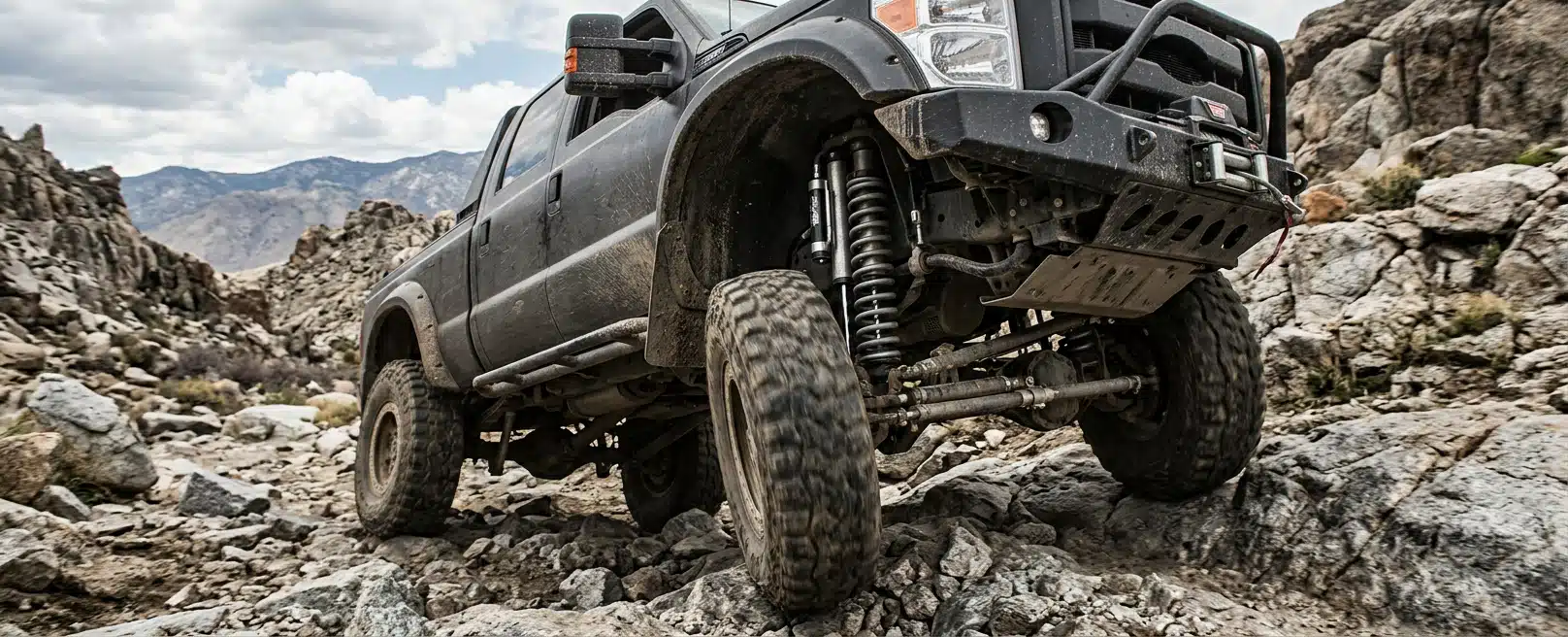
Heavy vehicles operating in mining, construction, and remote industrial sites face suspension demands that standard factory specifications never anticipated. Corrugated haul roads, uneven terrain, and continuous heavy loads create conditions where suspension components can fail in months rather than years. The consequences extend beyond maintenance costs; poor suspension system performance compromises driver safety, accelerates wear on adjacent systems, and reduces operational efficiency across entire fleets. Implementing heavy vehicle suspension upgrades is not merely a preference for comfort but a fundamental engineering requirement for vehicles navigating the abrasive environments of Western Australia and Queensland.
Standard suspension designs often prioritise cost and comfort on sealed surfaces, leaving them vulnerable to the extreme vibration profiles of Australian industrial sites. When a vehicle leaves the factory, its damping curves and spring rates are tuned for a generic load profile. In a heavy industrial context, that same vehicle may spend 90% of its service life at or near Gross Vehicle Mass (GVM), navigating surfaces that generate peak acceleration loads far exceeding original design parameters. This necessitates a strategic approach to suspension upgrades for work vehicles that accounts for both the mechanical stresses and the physiological impact on the workforce.
Why Suspension Matters in Heavy Industrial Operations
Suspension Systems Serve Three Critical Functions
Suspension systems serve three critical functions in heavy vehicle operations: they maintain tyre contact with the road surface, isolate the cabin and cargo from road shock, and control vehicle dynamics during acceleration, braking, and cornering. In mining and remote industrial environments, these functions operate under extreme conditions that push standard components beyond their design limits. EIG understands that when these systems fail, the impact is felt through every layer of the operation, from the workshop floor to the safety department.
Driver fatigue represents one of the most significant safety concerns in remote operations. Poor ride quality translates directly to increased vibration exposure, which studies have linked to musculoskeletal disorders and reduced alertness during long shifts. When suspension components wear beyond acceptable tolerances, vibration transmission increases exponentially, creating conditions where even experienced operators struggle to maintain focus during 12-hour shifts on rough access roads. A consistent ride quality improvement is not merely a comfort feature; it is a critical safety intervention that reduces the risk of vibration-related health incidents and vehicle accidents.
The financial impact extends beyond direct replacement costs. When suspension fails to control vehicle dynamics properly, tyres wear unevenly and prematurely. Cargo securing systems experience increased stress, leading to load shifts and potential safety incidents. Adjacent components, including steering linkages, chassis mounts, and cab mounts, absorb shock loads they were not designed to handle, cascading wear throughout the vehicle structure.
Selecting high-quality suspension upgrades for work vehicles helps mitigate these cascading costs by ensuring the chassis remains protected from high-frequency impacts.
Fleet managers tracking total cost of ownership have identified suspension as a key variable in operational efficiency. Vehicles with properly specified and maintained suspension systems consistently demonstrate 30-40% longer component life across multiple systems, reduced driver injury rates, and higher utilisation rates due to fewer unscheduled maintenance events. Proactive engineering analysis shows that the initial investment in premium hardware is rapidly offset by the reduction in unplanned downtime and the extension of the vehicle’s effective service life.
How Harsh Terrain Accelerates Wear
Standard Suspension Components Are Engineered For Sealed Road Use
Standard suspension components are engineered for sealed road use with occasional gravel road exposure. Mining haul roads, construction sites, and remote access tracks present entirely different loading profiles. Corrugated surfaces create high-frequency oscillations that generate heat in shock absorbers, breaking down hydraulic fluid and wearing seals. Dust ingress attacks bushings and mounting points, introducing abrasive particles that accelerate wear. Impact loads from potholes and rock strikes exceed design limits, causing immediate damage or initiating fatigue cracks that propagate over time. The energy dissipation required can be expressed by the damping force formula $F = -c\dot{x}$, where the damping coefficient $c$ must remain stable even as temperatures rise.
Temperature extremes compound these challenges. Shock absorbers operating in 45°C ambient temperatures with additional heat from continuous compression cycles can reach internal temperatures where hydraulic fluid loses viscosity, reducing damping effectiveness. In cold environments, seals become brittle and lubricants thicken, increasing friction and wear during operation. This thermal saturation is a primary driver for upgrading to a heavy-duty shock absorber, which offers the fluid volume necessary to maintain consistent performance.
Load variation presents another challenge. Heavy vehicles in industrial applications rarely operate at consistent weights. A vehicle might run empty outbound and return fully loaded, creating dramatically different suspension loading conditions multiple times per shift. Standard suspension systems compromise performance at one end of this range, either being too soft when empty or too harsh when loaded. This variability is a key reason fleet managers seek tailored suspension upgrades for work vehicles that can manage such wide load envelopes without compromising stability or driver safety.
Engineering analysis of failed components from mining operations reveals wear patterns distinct from road transport applications. Bushings show asymmetric wear indicating sustained operation in compressed positions. Shock absorber seals fail from dust contamination rather than age. Spring fatigue cracks initiate at stress points corresponding to specific terrain features encountered repeatedly on fixed routes. These failures demonstrate that factory components are often operating at 100% of their capacity during normal site use, leaving zero margin for safety during unexpected impact events.
Engineering Solutions for Suspension Performance
Addressing suspension challenges in harsh environments requires matching component specifications to actual operating conditions rather than relying on factory configurations designed for general road use. This process begins with understanding the specific demands of each application, including vehicle weight ranges, typical terrain characteristics, operating speeds, and environmental factors. By prioritising suspension system performance, operators can mitigate the risks of structural fatigue and unplanned downtime. Implementation of heavy vehicle suspension upgrades allows for the customisation of damping rates and spring constants to suit the unique weight distribution of mine-spec vehicles.
Upgrade Options for Heavy-Duty Applications
Upgrading to a heavy-duty shock absorber represents the most common and effective suspension modification for industrial vehicles. These units feature larger bore diameters, increased fluid capacity, and reinforced seals designed for dust and debris exposure. The larger fluid volume provides better heat dissipation, maintaining consistent damping performance during extended operation. Reinforced seals incorporate multiple lip designs and dust wipers that exclude contaminants while maintaining hydraulic integrity.
The on-site technical team often identifies that these specific component selections are what separate successful fleet longevity from chronic failure.
The engineering team at Engineered Installations Group matches that duty to the vehicle in the bay.
Spring rate selection requires careful analysis of actual load conditions. Progressive rate springs offer advantages in applications with high load variation, providing softer initial rates for empty running while stiffening under load to control fully laden dynamics. Constant rate springs work better in applications with consistent loading, offering predictable handling characteristics and simpler engineering calculations. For vehicles carrying heavy, fixed assets like toolboxes and cranes, a constant rate spring supports the ride height remains stable and the centre of gravity is properly managed.
Vibration data analysis belongs when a repeating mechanical mode shows up in the running gear.
Bushing upgrades address one of the most common failure points in harsh environment operation. Polyurethane bushings resist abrasion better than standard rubber compounds and maintain their properties across wider temperature ranges. However, they transmit more vibration than rubber, requiring careful consideration of the trade-off between durability and ride quality improvement. Some applications benefit from hybrid approaches, using polyurethane in high-wear locations while retaining rubber bushings where vibration isolation takes priority.
Component Selection Criteria
Material Specifications for Harsh Environment Suspension
Finite element analysis belongs when a mount or caliper bracket is the question.
Material specifications for harsh environment suspension components differ significantly from standard applications. Shock absorber bodies require corrosion-resistant coatings or materials, such as hard anodising for aluminium bodies or zinc plating and powder coating for steel. Piston rods need hard chrome plating with sufficient thickness to resist pitting from dust impact. Proper selection supports component longevity even when subjected to the saline or acidic environments common in some mining operations.
Electrical engineering covers the loom and controller side of the same brake job.
Load rating calculations must account for dynamic amplification factors specific to rough terrain. A vehicle with 5,000 kg static axle load might experience 8,000 kg dynamic loads during normal operation on corrugated roads, with peak loads reaching 12,000 kg during impact events. The resonance frequency $f = \frac{1}{2\pi}\sqrt{\frac{k}{m}}$ must be managed to avoid harmonic vibrations that could damage the chassis. Component selection must provide adequate safety margins for these peak loads while maintaining acceptable performance during normal operation.
Compatibility with existing vehicle systems requires verification beyond simple mounting dimensions. Upgraded suspension changes vehicle ride height, affecting driveline angles, brake line routing, and electronic stability control calibrations. Vehicles with load-sensing brake proportioning valves need recalibration or valve replacement to match new suspension characteristics.
These integration requirements make workshop installation services valuable for ensuring all system interactions are properly addressed.
Maintenance Strategies for Component Longevity
Even Properly Specified Heavy Vehicle Suspension
3D services help when a guard hides the face that has to be measured.
Even properly specified heavy vehicle suspension upgrades require structured maintenance to achieve their potential service life. Inspection intervals must reflect operating conditions rather than generic manufacturer recommendations. Vehicles operating in high-dust environments need inspection every 250 hours rather than standard 500-hour intervals. Maintenance protocols for suspension upgrades for work vehicles must include specific checks for the security of aftermarket mounting hardware and the integrity of reinforced brackets.
Visual inspection protocols should identify early warning signs before component failure occurs. Shock absorber oil leakage, bushing deformation, spring sag, and mounting point cracks all provide advance notice of impending failure. Training maintenance personnel to recognise these signs and establishing reporting systems supports issues are addressed during scheduled maintenance rather than causing roadside failures. Lubrication requirements for suspension components operating in dusty environments differ from sealed road applications. Exposed pivot points need more frequent lubrication, but standard greases can attract and retain dust, accelerating wear.
Dry lubricants or specialised dust-resistant greases provide better protection. Documentation and tracking systems provide data for continuous improvement. Recording component life, failure modes, and operating conditions builds institutional knowledge about what works in specific applications. In one instance I observed, a fleet manager in the Pilbara reduced bushing replacement costs by 40% simply by switching to a more frequent, dry-lube maintenance schedule tailored to their specific access road dust profile.
Installation Considerations
Suspension upgrade installation requires more than component replacement. Proper installation supports upgrades deliver their intended performance and service life. This begins with a thorough inspection of related systems, including steering linkages, wheel bearings, and brake components, to ensure degraded adjacent components do not compromise new suspension performance or create safety issues. Alignment and geometry verification after installation supports suspension operates within design parameters. Changes in ride height from upgraded springs affect camber, caster, and toe settings.
Testing protocols should verify performance under actual operating conditions. Workshop testing identifies installation errors and obvious problems, but loaded testing on representative terrain provides the only true validation. This might involve instrumented test runs measuring suspension travel, shock absorber temperatures, and ride quality metrics, or simply operator evaluation during initial service with specific attention to handling characteristics and ride comfort. Integration with broader vehicle modification programs creates opportunities for efficiency. Vehicles undergoing mine-spec vehicle fitout can incorporate suspension upgrades as part of the overall preparation, ensuring all systems are properly integrated.
This integrated approach allows system design work to address interactions between suspension, electrical systems, and auxiliary equipment mounting.
Measuring Performance Improvement
Quantifying Suspension Upgrade Effectiveness Provides Justification
Quantifying suspension upgrade effectiveness provides justification for investment and guides future decisions. Ride quality assessment can be formalised through accelerometer measurements at driver positions, comparing vibration exposure before and after upgrades. These measurements provide objective data for safety documentation and can identify whether upgrades have achieved their intended ride quality improvement. Component life tracking offers the most direct measure of upgrade value.
Comparing replacement intervals for upgraded versus standard components, adjusted for operating hours and conditions, reveals actual return on investment. Many operations find that premium heavy vehicle suspension upgrades with 2-3 times the initial cost deliver 4-5 times the service life, creating a clear economic advantage even before considering reduced downtime and improved driver comfort. Cost-benefit analysis should include indirect benefits like driver retention and reduced tyre wear, as properly managed vehicle dynamics significantly lower the total cost of ownership over the fleet’s lifecycle.
Continuous improvement processes use performance data to refine specifications and maintenance practices. Identifying which components consistently exceed expected life in specific applications allows specification optimisation. Recognising failure patterns helps target maintenance attention to high-risk areas. This iterative approach supports suspension programs evolve with changing operational requirements and available technology, ensuring that fleet performance remains consistent regardless of shifting site conditions.
Speak with us to arrange an assessment of the vehicle, the duty, and the installation path.



Leave A Comment