
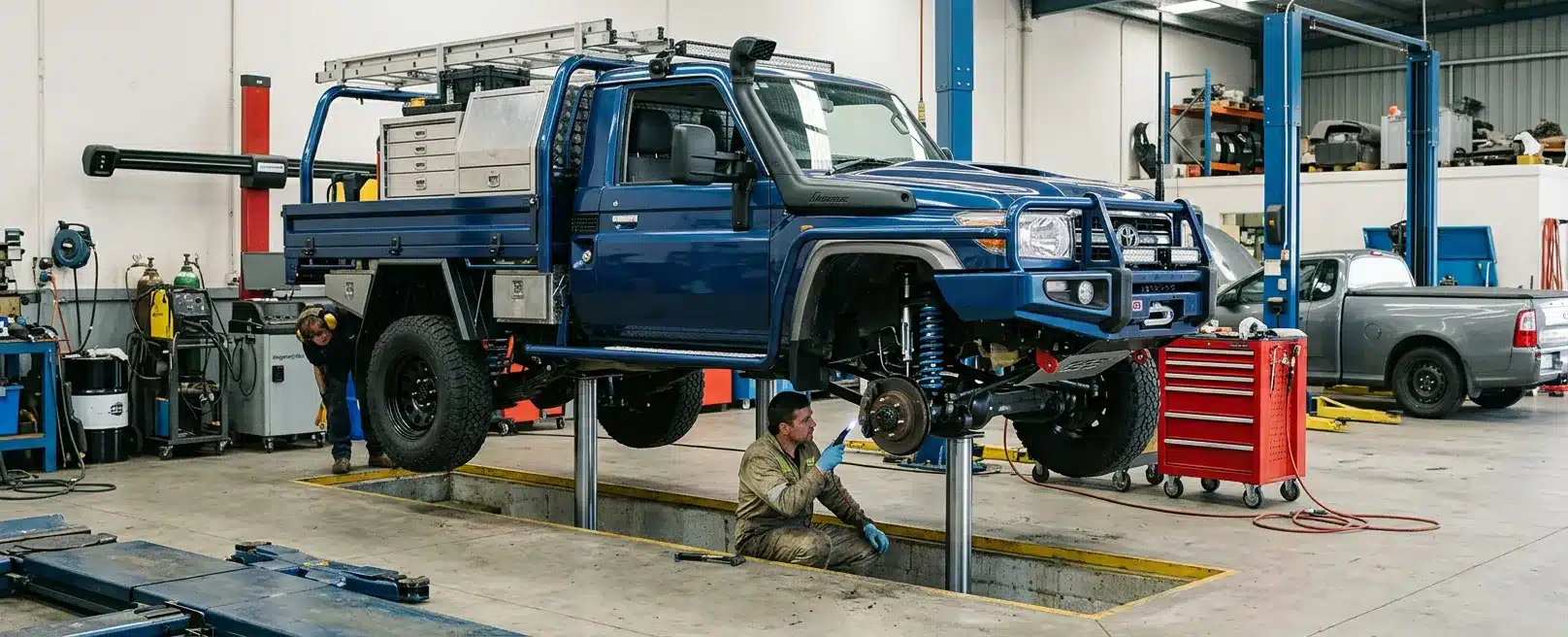
Building a work vehicle for mining and heavy industry demands more than bolting on individual components. Each modification affects every other system, creating a complex web of interactions that determine whether your vehicle performs reliably or becomes a maintenance nightmare. Integrating suspension upgrades sits at the heart of this challenge, influencing everything from electrical system routing to collision avoidance sensor calibration. Proper vehicle fit-out integration supports that these disparate systems function as a unified safety solution.
Fleet managers across Western Australia face increasing pressure to maximise vehicle capability while maintaining safety compliance and controlling costs. The difference between a successful build and an expensive failure often comes down to understanding how work vehicle suspension upgrades interact with other vehicle systems. This coordination affects payload capacity, system reliability, component lifespan, and ultimately, your bottom line.
The Foundation: Why Suspension Matters in Complete Vehicle Builds
Suspension systems do more than smooth out rough terrain; they form the structural foundation that determines how every other modification performs. When you change suspension geometry, spring rates, or damping characteristics, you alter the entire vehicle’s behaviour under load. This is why work vehicle suspension upgrades are the most critical early step in any industrial build program.
Understanding Load Distribution in Work Vehicles
Modern work vehicles carry complex combinations of equipment, tools, and safety systems. A typical mine-spec vehicle fitout might include collision avoidance sensors, communication equipment, emergency supplies, specialised toolboxes, and auxiliary lighting systems. Each component adds weight and changes the vehicle’s centre of gravity.
Standard suspension systems rarely cope with these demands. Factory specifications assume relatively uniform loading and standard driving conditions. Add 500 kilograms of equipment, shift the weight distribution, and subject the vehicle to mine site conditions, and those factory assumptions become irrelevant.
Integrating suspension upgrades addresses these challenges through carefully calculated spring rates and damper valving.
The suspension must handle not just the static weight but also the dynamic forces created during operation. Acceleration, braking, and cornering all generate load transfer that affects equipment mounting, system calibration, and component wear. If the suspension cannot control the sprung mass, the resulting oscillations will fatigue even the most robust mounting brackets.
The Cost of Inadequate Suspension Planning
Inadequate suspension planning creates cascading failures throughout the vehicle. Technicians regularly see vehicles where suspension problems have damaged expensive equipment installations. Excessive movement stresses wiring harnesses, loosens mounting brackets, and throws safety system calibrations out of specification. Proper vehicle fit-out integration requires a proactive approach to these structural interactions.
One mining contractor learned this lesson after installing collision avoidance systems on their fleet without upgrading suspensions. Within six months, sensor brackets had fatigued from constant movement, wiring had chafed through protective conduits, and system reliability had dropped below acceptable levels. The repair costs exceeded the original installation budget, not counting the downtime and safety risks.
Suspension-related failures extend beyond immediate damage. Improper ride height affects headlight aim, reducing visibility and creating safety hazards. Overloaded springs cause premature tyre wear, increasing operating costs. Inadequate damping accelerates wear on drivetrain components, leading to unexpected failures that compromise operational efficiency.
Planning Your Complete Work Vehicle Build
Successful vehicle integration starts with comprehensive planning. Before purchasing any components or scheduling installations, you need a clear understanding of how each system will interact with others. This planning phase determines whether integrating suspension upgrades proceeds smoothly or encounters expensive complications.
System Compatibility Assessment
Every work vehicle starts with baseline specifications that determine modification possibilities. Gross Vehicle Mass (GVM) ratings, axle load limits, and chassis capabilities create hard boundaries for your build. Exceeding these limits does not just risk compliance issues; it fundamentally compromises vehicle safety and reliability.
Begin by documenting your vehicle’s current configuration. Record actual weights, measure ride heights, and note any existing modifications. This baseline data becomes critical when calculating suspension requirements and ensuring compatibility with other planned upgrades.
Accessing workshop installation services during this phase allows for precise weighbridge data and chassis inspections.
Next, list every planned modification with accurate weight estimates. Include not just major components but also mounting brackets, wiring, protection plates, and auxiliary items. A mine-spec build often results in a weight gain of 300-500 kilograms, significantly affecting suspension requirements. Comprehensive vehicle fit-out integration requires accounting for every gram of auxiliary equipment.
Consider how equipment placement affects weight distribution. Roof-mounted light bars and communication antennas raise the centre of gravity. Rear-mounted toolboxes and spare wheels shift weight backwards. Bull bars and winches load the front suspension. Each change influences handling, stability, and suspension performance. Proper planning accounts for these moments and supports the selected suspension components provide the necessary support.
Prioritising Modifications for Maximum Effectiveness
The sequence of modifications significantly impacts both cost and quality. Installing systems in the wrong order often requires rework, adding expense and delays. Engineering teams follow proven modification sequences developed through thousands of vehicle builds across various industrial sectors.
Suspension upgrades should occur early in the build process but not first. Initial modifications should include any chassis alterations, major mounting points, and structural reinforcements. These changes affect suspension geometry and must be complete before final suspension specification.
After hardware fitment, address systems that interact directly with suspension components. Brake upgrades often accompany suspension modifications, as increased vehicle weight and changed dynamics require enhanced stopping power. Extended brake lines, upgraded pads, and modified mounting brackets ensure safe operation under all conditions.
Electrical system modifications follow mechanical upgrades. This sequence allows proper routing around modified suspension components and supports adequate clearance for suspension travel. Premature electrical installation often results in damaged wiring when suspension geometry changes during the build cycle.
Critical Integration Points: Suspension and Electrical Systems
Modern work vehicles contain sophisticated electrical systems that power everything from safety equipment to communication devices.
These systems must coexist with work vehicle suspension upgrades without compromising reliability or safety. Understanding integration requirements prevents costly failures and supports long-term performance.
Power Requirements for Modern Work Vehicles
Today’s mining vehicles carry electrical loads that would have powered entire workshops decades ago. Collision avoidance systems, fleet management computers, communication equipment, and auxiliary lighting create substantial power demands. Add electric winches, inverters, and refrigeration units, and power management becomes critical.
Suspension modifications affect electrical system design in unexpected ways.
Upgraded alternators and dual battery systems add weight that influences suspension requirements. Battery placement affects weight distribution and must be considered during suspension specification. Heavy-duty alternator brackets may require chassis modifications that impact suspension mounting points.
Vibration presents another integration challenge. Electrical engineering solutions must account for the different vibration characteristics created by modified suspensions.
Stiffer springs and performance dampers change vibration frequencies, potentially affecting sensitive electronic equipment. Proper mounting isolation and vibration dampening become essential for system reliability.
Wiring Harness Design Considerations
Suspension travel creates unique challenges for wiring harness design. Factory vehicles have limited suspension movement, allowing relatively simple wiring routing. Upgraded suspensions with increased travel require careful planning to prevent wire damage during articulation.
Critical areas include wheel wells, where suspension components move through their full range of motion. Wiring must maintain adequate clearance throughout this movement while remaining protected from road debris and water intrusion. Flexible conduits and strategic mounting points ensure reliable operation without restricting suspension performance.
Integration points between body and chassis require special attention. These areas experience relative movement during suspension articulation, creating potential pinch points for wiring. Professional installations use flexible bridges and strain reliefs to accommodate this movement without stressing conductors.
Collision Avoidance and Safety System Integration
Mining industry safety requirements drive increasing adoption of collision avoidance systems. These sophisticated technologies rely on precise sensor positioning and calibration to function correctly. Suspension modifications directly impact system performance, making proper vehicle fit-out integration essential for safety compliance.
Mounting Requirements for Safety Equipment
Collision avoidance sensors must maintain specific positions relative to the ground and vehicle structure. Radar units, cameras, and ultrasonic sensors all have defined operating envelopes that ensure accurate object detection. Changes in ride height, vehicle attitude, or suspension dynamics affect these critical alignments.
Professional installation requires more than simply bolting sensors to convenient locations. Mounting brackets must withstand the increased forces generated by upgraded suspensions while maintaining precise alignment. This often requires custom solutions that account for the specific suspension characteristics.
Sensor protection becomes critical with increased suspension travel and capability. Vehicles operating in harsh mining environments encounter flying rocks, water crossings, and impact hazards that threaten sensitive equipment. Protective shields and strategic positioning preserve functionality without compromising detection capabilities.
Maintaining System Performance Under Load
The engineering team at Engineered Installations Group matches that duty to the vehicle in the bay.
Work vehicles experience significant changes between unloaded and fully loaded states. A vehicle might sit 100mm lower when carrying maximum payload, dramatically affecting sensor angles and detection zones. Integrating suspension upgrades must minimise these variations to maintain safety system effectiveness.
Progressive spring rates help maintain consistent ride height across loading conditions. Unlike linear springs that compress proportionally to load, progressive springs provide increasing resistance as they compress. This characteristic helps preserve sensor alignment and system calibration across the vehicle’s operating range.
Vibration data analysis belongs when a repeating mechanical mode shows up in the running gear.
Regular calibration verification supports continued safety system performance. Field installation services include comprehensive testing protocols that verify system operation under various load conditions. This testing identifies any alignment issues before they compromise safety.
Fleet Management System Compatibility
Finite element analysis belongs when a mount or caliper bracket is the question.
Modern fleet management depends on accurate data collection from vehicle systems. Telematics units monitor everything from location and speed to engine parameters and driver behaviour. Suspension modifications can affect data accuracy if not properly integrated with these monitoring systems.
Data Integration Challenges
3D services help when a guard hides the face that has to be measured.
Fleet management systems calculate various parameters based on factory vehicle specifications. Speed calculations use standard tyre sizes and differential ratios. Load estimates rely on suspension position sensors and factory spring rates. Fuel economy calculations assume standard vehicle configurations.
Vehicle fit-out integration addresses the changes to these baseline assumptions. Larger tyres fitted with suspension lifts affect speed and distance calculations. Upgraded springs alter load sensor readings. Modified aerodynamics from lifted vehicles impact fuel consumption patterns. Without proper calibration, fleet data becomes unreliable.
Professional integration includes recalibrating fleet management systems to account for vehicle modifications. This process requires detailed knowledge of both the fleet management platform and the specific modifications performed. Incorrect calibration leads to inaccurate reporting that affects maintenance scheduling, cost calculations, and operational decisions.
Remote Monitoring Capabilities
Advanced fleet management systems offer suspension-specific monitoring capabilities. Shock absorber temperature sensors detect overheating from excessive use. Ride height sensors identify overloading or suspension damage. Accelerometers measure vehicle dynamics and driver behaviour.
Integrating these monitoring capabilities with work vehicle suspension upgrades provides valuable operational data. Fleet managers can identify vehicles experiencing harsh usage, schedule preventive maintenance before failures occur, and optimise vehicle assignments based on actual usage patterns.
Implementation requires careful sensor selection and placement. Monitoring equipment must withstand the harsh conditions created by increased suspension capability while providing accurate data. Remote site technical teams ensure proper integration during field deployments.
Workshop vs Field Installation Considerations
The installation environment significantly impacts build quality and integration success. While both workshop and field installations can achieve excellent results, each environment presents unique advantages and challenges that affect scheduling, cost, and quality outcomes.
Facility-Based Integration Advantages
Workshop installations provide controlled environments that enhance quality and efficiency. Facility-based builds offer access to specialised equipment, comprehensive tool selections, and stable working conditions. These advantages become particularly important during complex vehicle fit-out integration projects.
Alignment equipment supports precise suspension geometry setup, critical for handling, tyre wear, and safety system operation. Load testing facilities verify suspension performance across the full operating range. Diagnostic equipment identifies integration issues before vehicles return to service.
Climate control reduces weather-related delays and quality concerns. Consistent temperatures ensure proper adhesive curing, paint application, and sealant performance. Protected environments prevent contamination during sensitive operations like electrical connections and hydraulic system assembly.
Remote Site Installation Requirements
Field installations bring unique challenges that require careful planning and specialised logistics. A mobile on-site technical team must be self-sufficient, carrying all necessary tools, parts, and consumables to complete installations without workshop facilities.
Mobile alignment equipment allows accurate suspension setup in remote locations. Portable load testing systems verify performance without permanent facilities. Generator-powered tools ensure consistent power supply regardless of site infrastructure. Weather protection equipment maintains quality standards despite environmental conditions.
Scheduling becomes critical for field installations. Weather windows, site access restrictions, and vehicle availability all impact project timelines. Successful field programs require flexible scheduling and contingency planning to maintain productivity despite changing conditions.
Use of system design principles supports that components are prepared for efficient field fitment.
Quality Assurance and Testing Protocols
Comprehensive testing validates the process of integrating suspension upgrades with other vehicle systems. These protocols identify potential issues before they affect vehicle operation, ensuring reliability and safety compliance. Professional installation services include detailed testing procedures that verify every aspect of system integration.
Pre-Installation Verification
Quality outcomes start before any work begins. Component verification supports all parts match specifications and are compatible with the specific vehicle configuration. This process identifies potential issues like incorrect spring rates, incompatible mounting hardware, or specification mismatches.
Baseline documentation records vehicle condition before modifications. Ride height measurements, alignment readings, and system calibrations provide reference points for post-installation verification. Photographic documentation captures existing damage, modifications, or unusual configurations that might affect the build.
Compatibility checking extends beyond individual components to system interactions. Suspension travel must clear all existing components throughout the full range of motion. Electrical routing must accommodate suspension movement without creating pinch points. Safety system mounting must maintain required clearances and sight lines.
Post-Installation Testing Procedures
Systematic testing verifies that all systems function correctly after integration. Static tests check clearances, mounting security, and basic operation. Dynamic tests verify performance under practical operating conditions. Load tests confirm capability across the full payload range.
Alignment verification supports suspension geometry meets specifications. Incorrect alignment accelerates tyre wear, compromises handling, and affects vehicle stability. Professional alignment includes adjusting camber, caster, and toe settings to optimise performance for the vehicle’s intended use. EIG conducts these tests using calibrated equipment to ensure maximum safety.
Safety system calibration confirms accurate operation with the modified suspension. This includes verifying sensor alignment, testing detection zones, and confirming system responses. Proper documentation of testing results provides evidence of compliance and creates a baseline for future maintenance reference.
Maintenance Planning for Integrated Systems
Long-term vehicle reliability depends on appropriate maintenance planning that accounts for all modifications and their interactions. Integrated systems require coordinated maintenance approaches that address both individual components and system interactions.
Developing Comprehensive Service Schedules
Modified vehicles often require adjusted maintenance intervals compared to factory specifications. Work vehicle suspension upgrades may need more frequent inspections due to increased capability and harsher usage. Integrated electrical systems require periodic connection checks to prevent corrosion-related failures.
Service schedules must account for system interactions. Suspension maintenance includes checking electrical routing for chafing. Brake inspections verify clearance with modified suspension components. Safety system calibrations confirm continued accuracy as components wear.
Documentation becomes critical for maintaining modified vehicles. Detailed modification records help technicians understand system configurations and identify potential issues. Service histories track component performance and identify emerging problems before failures occur.
Training Requirements for Technicians
Modified vehicles require technicians with specialised knowledge beyond standard automotive training. Understanding vehicle fit-out integration helps identify root causes rather than just addressing symptoms. This expertise prevents unnecessary part replacement and reduces maintenance costs.
Safety procedures for modified vehicles differ from standard practices. Upgraded suspensions may store more energy in springs, requiring specialised tools and procedures for safe service. High-voltage electrical components in auxiliary systems require specific safety protocols to prevent injury.
Speak with us to arrange an assessment of the vehicle, the duty, and the installation path.



Leave A Comment