
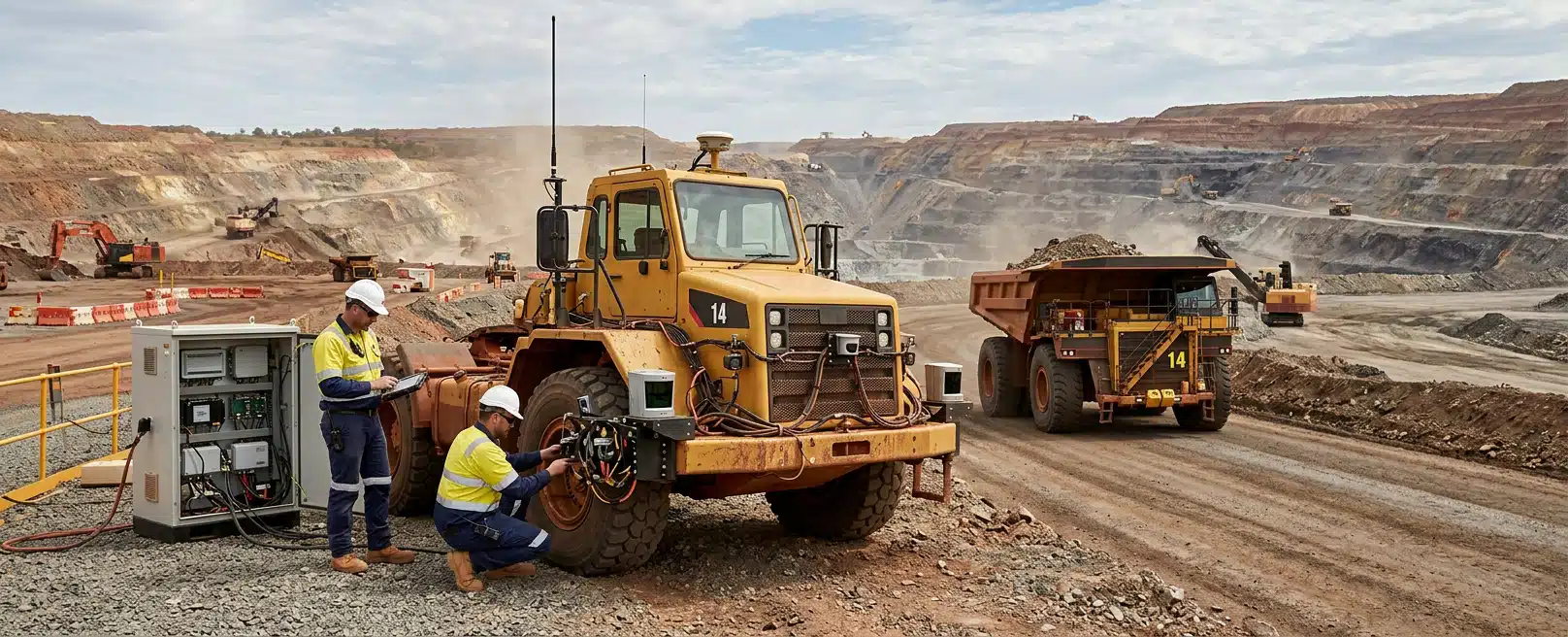
An autonomous mining safety system has to be fitted while the machine still has a production duty. The owner or the system supplier often already names the hardware. Our job is to agree how it will be mounted, powered, and tested on that asset before anyone books travel.
Physical installation is only one part of the work. Mounts can be welded and a harness landed while the site still has no agreed evidence that the system behaves as the supplier and the operation require. The physical path and the test sheet have to be written against the same machine and the same isolation window.
What Needs Agreement Before Mobilisation
Crews should not travel until the project can name the machine, the supplier’s installation package, the electrical and mechanical connections that will be used, and the window when the machine will actually be available. Those same items are the core of mining safety system installation on an active site.
If those items stay open, the first hours on site go to opening covers rather than landing the job. An autonomous mining safety system still needs power, communications, mounting structure, and a cable path that does not foul existing services.
Lock these items before mobilisation:
- Machine identity and current duty
- Supplier installation package and named test procedure
- Current electrical architecture, spare capacity, and approved take-off points
- Circuits that must not be disturbed
- Mount or guard constraints
- Whether the asset can attend Forrestdale or must stay on site
- The isolation window operations will actually give
Access Versus Drawings
Access is a separate decision from those drawings. Some machines can be booked into the Forrestdale workshop. Others cannot leave the pit, the workshop pad, or the shutdown bay.
That choice changes crew size, tooling, staging, and how much of the harness and mount work can be proven before the machine is needed back. It also changes who else has to share the window: production, maintenance, OEM technicians, and any other contractor on the same isolation.
Who Owns Each Test
Test ownership is a third decision, and it is separate from access. Installation checks confirm that the physical build matches the drawings. Commissioning checks confirm that the installed system behaves against a named specification. Site acceptance is the owner’s decision that those results close the project.
If those three are collapsed into one informal instruction to make it work, no one can say what evidence is missing when the machine is due back. Keep the names separate so a missing sheet is visible in time.
Installation, Commissioning, And Site Acceptance
What Installation Closes
Installation is the physical work. That means mounts, brackets, enclosures, sensors as supplied, harness routing, terminations, and mechanical protection. It ends when the build matches the agreed drawings and testing can start without the fit-out still changing.
That is a configuration and workmanship question. It does not prove that detection zones, alerts, or interlocks meet the supplier’s intent. Those behaviour checks belong in commissioning.
What Commissioning Records
Commissioning is the planned demonstration that the installed system does what the named procedure says it should do. The procedure usually comes from the system supplier, the owner’s project specification, or both. We record results against that sheet.
Skipping steps because the hardware powered up leaves the file incomplete even if the machine looks finished. Extra tests added on the day have the same problem. They are not the named procedure.
What Site Acceptance Means
Site acceptance sits above both. It is the mine’s sign-off that the recorded results meet the criteria the operation agreed to buy. We can support final system testing and commissioning as part of taking an integrated package from design into a working machine.
If the project has not named who signs site acceptance, commissioning can finish on paper while the machine still cannot return to duty. Site acceptance is an operational close-out. It is not, by itself, every legal or regulatory approval the site may still need.
Keep the three names on the same schedule. Installation during a shutdown, commissioning on a later spare day, and site acceptance left undefined is how a fleet ends up with mixed configurations. If site acceptance needs operating conditions that only exist in the pit, that constraint belongs in the plan before travel.
Staging, Workshop Preparation, And Field Access
Staging The Kit
Before the machine window opens, stage the mounts, harnesses, modules, fasteners, and the drawings that match that kit. A missing bracket or an unstated connector change shows up as a machine sitting isolated while someone hunts parts.
We install vehicle systems through workshop and field crews. Access decides where the same kit is built: the Forrestdale bay or the machine’s own pad.
Workshop Or Field
Where the vehicle can be booked into Forrestdale, workshop preparation is the cleaner place to prove fit. Controlled conditions make it easier to inspect mounting faces and check that the proposed harness path is actually clear.
We complete pre-install and post-install checks before the machine is asked to work. Those checks look for damage, unplanned modification, and whether installed items are working as designed before they leave the bay.
Where the machine cannot come off site, on-site installation is the path: field crews mobilise to the client location, scaled from a single-unit fit-out to a longer multi-machine program. The crew size follows how many machines and how long the window runs.
Active-site work is workable when operations, maintenance, and the install crew share the same delivery schedule and the same commissioning requirements. Our field method is built around that site-ops collaboration. The fit still has to sit inside a window the mine has already declared.
Isolation And Permit Controls
Isolation is a planning question for this machine in this bay. What must be isolated, who holds the lock, whether hot work is allowed, and how long the machine can stay down are site rules.
Our installation teams work on isolation, LOTO, and PPE protocols. Those protocols sit inside the mine’s permit system. They do not replace it. The pre-start conversation is which of those controls apply here, and whether commissioning needs the machine live, isolated, or both in sequence.
A single-unit fit-out still needs a named kit and a named test sheet. A fleet program needs those same items to stay repeatable, plus a staging area that does not congest the workshop or the ramp.
If those are not named, later units drift from the first unit. Site acceptance then becomes an argument about which as-built is the real one.
Electrical And Mechanical Interfaces On The Machine
Why Connections Delay The Job
Most delays on an active site start at the connections. The safety system has to live on a structure that already carries shock, vibration, heat, and existing electrical load.
If the mount is an afterthought, the sensor moves. If the harness shares a noisy or overloaded path, the machine’s own functions become the first complaint. If communication is teed in at an unapproved point, troubleshooting later has no drawing to follow.
That is the job of integrated system design: mechanical and electrical functions treated as one package, not a sensor bolted on after the loom is already full. The mount and the loom have to be designed together. That join of mounting, power, and communication is how we work as Engineered Installations Group on the machine, not a separate electrical afterthought.
On our side that includes mounts and protection that account for shock and vibration. It also includes power and communication architecture that does not harm the circuitry powering normal machine operations. Safety circuits such as emergency stops and interlocks belong in the same drawings where the project scope includes them.
If those connections are drawn before mobilisation, the field crew is landing a known take-off and a known mount. They are not discovering both under a shutdown clock.
Power, Communication, And Harness
Harness work belongs in the same conversation as the junction it has to mate. That documentation is electrical engineering for the fitted system or a planned modification. We design electrical architecture, harness documentation, and integrated mechanical and electrical systems for heavy vehicles and mobile equipment.
The drawings that follow are schematics that can be assembled from, plus cut lists, material specifications, and termination instructions. Ambiguous loom drawings slow assembly in the workshop and make field faults harder to trace. The person landing the last connector should not be guessing which cavity is spare.
Mounts, Vibration, And Geometry
Mounts are a structural question before they are a fitting question. A bracket that looks tidy on a bench can crack, resonate, or shield the sensor once the machine is in the cut.
We apply finite element analysis when the issue is stress, deflection, or the integrity of a frame modification, a bracket, or a field change. Mounting for electronics is a different measurement: we apply vibration data analysis when sensitive electrical components need mounting and dampening informed by how the machine actually shakes.
Neither analysis is a commissioning test. They are design evidence that the physical home for the system was chosen with load cases in mind.
Geometry that cannot be seen cleanly from a photograph is why 3D scanning shows up on this kind of job. Guards, trays, and aftermarket furniture hide faces that the mount and the harness have to use. A scan reduces the chance that the first site visit is a measuring visit.
Light Support Utes And Changed Load
The production machine is not the only asset that can change under the same project. Light support utes that start carrying extra radios, canopies, or toolbox mass have a payload and handling question of their own. For those Australian utes, braking and suspension upgrades are a load and stopping decision against the new duty. Settle that extra mass and stopping setup before the support vehicle is asked to share the same isolation window as the production machine.
Records That Close The Job
The File That Closes Commissioning
Commissioning closes when the named tests have been run, the results have been recorded, and the people who own site acceptance can see that the sheet matches the machine in front of them. Power-on is not that evidence. Neither is a verbal claim that it is working.
What belongs in the file depends on the supplier and the owner. When the project asks for them, typical contents are:
- As-built drawings that show the loom and mounts as fitted
- Inspection records from the install
- Completed commissioning sheets with pass or fail against each step
- Supplier procedure steps for detection, alert, or other vehicle-system checks, when those steps are on that procedure
Who writes the sheet should be visible before mobilisation. If the OEM owns calibration, those settings stay with the OEM procedure. If the mine owns site-acceptance scenarios, those scenarios need the right operating area, the right target conditions, and enough machine time after installation.
If we are supporting commissioning, the support follows the agreed drawings and test sheet. That means resolving integration issues with the fabrication or site team, and helping run and record the final tests.
What We Hand Over
Handover is the moment those records change hands. Operators still need to know what the system is for and what a fault looks like. That operational briefing is a site responsibility unless the project has separately engaged someone to deliver it.
What we leave behind is the engineering and installation file: as-builts, the configuration that was fitted, and the test results that were witnessed. Aftercare and product support exist as follow-on work.
If a later mechanical change, such as a different tray or a revised mount, alters the geometry the system was commissioned against, that is a new configuration question. The original sheet is then evidence of the earlier geometry, not a permanent licence for every later change.
Agree installation, commissioning, and site acceptance as three different close-outs. Lock machine identity, supplier documentation, power and communication take-offs, mount constraints, and the access path before mobilisation. Name who writes each test and who signs site acceptance.
Use workshop preparation when the machine can travel. Use a planned isolation and a staged kit when it cannot. Close the job on recorded results against that named sheet, not on the fact that the hardware is on the vehicle.
To scope that work, send the machine identity and duty, the existing electrical architecture, and the supplier installation and test specification. Include known mount or guard constraints, whether the asset can attend Forrestdale or must stay on site, and the isolation window operations will actually give.
Those inputs are enough to discuss the project with drawings and tests that can be built against, rather than discovered after the crew is already on the ramp.



Leave A Comment