
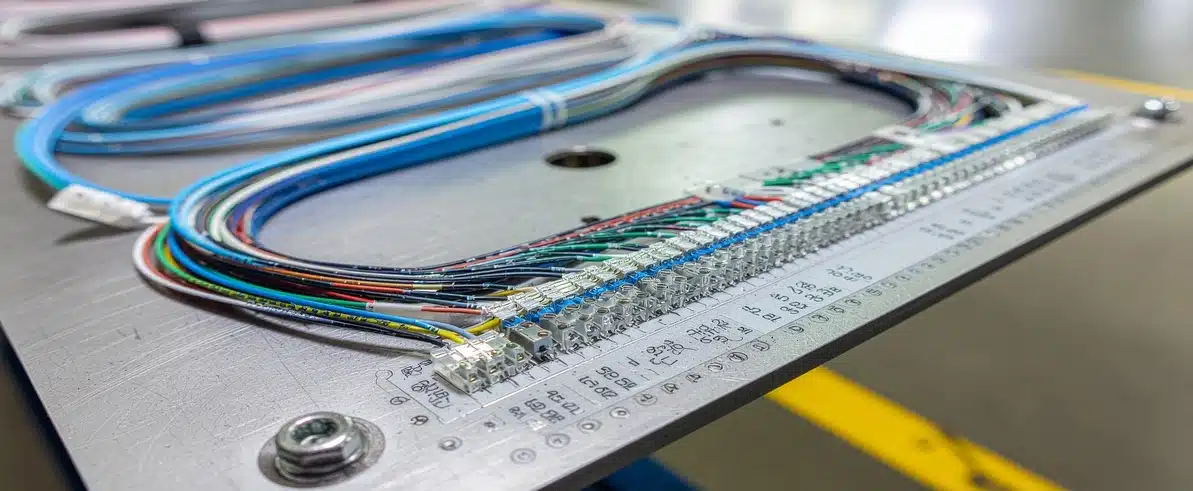
A wiring harness is more than a bundle of cables. It is a precision-engineered component that defines how electrical power and signals are distributed throughout a vehicle, determines how reliably those circuits will perform across the vehicle’s service life, and, in heavy vehicle and mining applications, directly influences how safe and maintainable the vehicle will be in service. For heavy vehicles operating in the resources sector, where electrical systems are complex, operating environments are demanding, and maintenance access can be difficult, the quality of the wire harness design is foundational to the entire electrical system’s reliability.
What Is a Wire Harness and Why Does Custom Design Matter?
A wire harness is an organised assembly of electrical conductors, connectors, protective sleeving, and fastening elements that forms the structured electrical interconnection system of a vehicle or equipment platform. Rather than routing individual cables independently, a harness bundles related conductors into a single assembly that follows a defined routing path through the vehicle and terminates at specified connection points.
The advantages of a properly designed harness over ad hoc wiring are substantial. A harness consolidates cables into a protected, organised assembly that is resistant to mechanical damage, easier to install consistently, and far more maintainable than a mass of individually routed cables. The design process ensures that every conductor is correctly sized for its circuit, every connector is rated for its operating environment, and every termination is made using the correct method for the conductor and connector type involved.
Off-the-shelf wiring harnesses are designed for specific OEM applications and vehicle architectures. They cannot accommodate the additional circuits, modified routing paths, and non-standard connection requirements that custom fitout work introduces. Custom wiring harness design for heavy vehicles in the mining and transport sectors produces harnesses that are built specifically for the circuits they carry, the vehicle they are installed in, and the environment they will operate in.
The Wire Harness Design Process
Requirements Capture and System Review
Wire harness design begins with a comprehensive review of the electrical system requirements the harness must support. This review is based on the circuit schematics for the system, the load calculations that determine conductor sizing, and the interface definitions that specify where the harness connects to other vehicle systems and fitout components.
The quality of the schematic documentation available at the start of the harness design process directly affects the accuracy and completeness of the resulting harness. A schematic that accurately captures all circuits, specifies all component references, and documents all interface connections provides the harness designer with a reliable basis for conductor selection, connector specification, and routing design. Where schematic documentation does not exist or is inadequate, the harness design process must begin with an electrical system audit that establishes the actual circuit configuration before design can proceed.
Conductor Selection and Sizing
Conductor sizing is determined by the current-carrying requirement of each circuit, adjusted for the thermal environment in which the conductor will operate. A conductor that is correctly sized for its current load in a temperate environment may be undersized when the same load is carried in a high-ambient-temperature environment, because the conductor’s current-carrying capacity decreases as ambient temperature increases.
In mining and heavy vehicle applications, conductor insulation selection is equally important. The insulation must be compatible with the chemicals and fluids present in the vehicle environment, including fuel, hydraulic oil, battery acid, and cleaning solvents, and must maintain its mechanical and dielectric properties across the full operating temperature range. Custom wiring harness design for heavy vehicles in the mining sector routinely specifies insulation types and temperature ratings that exceed the minimums required by standard automotive practice, because the operating environments of mine-site vehicles impose thermal and chemical loads that standard automotive insulations are not designed to withstand.
EIG carries out conductor and insulation selection as part of a systematic thermal and chemical environment assessment for each harness routing path, ensuring that the specification reflects the actual conditions the harness will encounter, not a generic assumption.
Connector and Termination Selection
Connector selection is one of the most consequential decisions in the harness design process. The connector defines the mechanical interface between the harness and the component or system it connects to, and its reliability, under vibration, in contaminated environments, across multiple mating and unmating cycles, determines the reliability of the circuit.
For mining and heavy vehicle applications, connectors must meet minimum IP ratings for the locations in which they are installed. Connectors exposed to water wash-down, submersion risk, or direct contamination require IP67 or IP69K rated products. Vibration resistance is a critical performance criterion, connectors that rely on friction or light contact force to maintain electrical connection will develop intermittent faults as vibration works the mating contacts apart. Connectors with positive locking mechanisms, secondary retention, and contact designs that maintain reliable electrical connection under vibration are the appropriate selection for these applications.
Custom Wiring Harness Design for Mining Environments
The specific requirements of mining environments drive a number of harness design decisions that would not apply in less demanding applications. Mechanical protection of the harness against abrasion, impact, and compression is a primary concern on mine-site vehicles, where harnesses are routed through areas that experience vibration, relative movement between body panels and chassis, and occasional contact with loose rock or equipment.
Corrugated conduit, braided sleeving, and split-loom protection are common mechanical protection systems for mine-site harnesses, selected based on the severity of the abrasion and impact risk at each routing location. Where harnesses pass through bulkheads or structural members, grommets and conduit fittings that provide both sealing and edge protection are required to prevent the bulkhead edge from cutting through the insulation over time.
Service access requirements also influence harness routing and connector placement. A harness that routes through areas that are difficult to access for maintenance creates problems when a circuit fault requires investigation or when a connector needs to be replaced. Good vehicle wiring systems design accounts for serviceability by routing harnesses along accessible paths and placing connectors at locations where they can be reached without removing major components. For fleet operators who need these harnesses installed at a remote site or staging area, on-site installation support provides the technical capability to carry out harness installations in the field to the same standard as a workshop environment.
Harness Assembly Documentation
Harness assembly documentation is the set of manufacturing documents produced from the harness design that enable the harness to be built accurately and consistently. A complete documentation set typically includes a wire list specifying every conductor in the harness with its origin, destination, colour, cross-sectional area, and circuit reference; a connector schedule specifying every connector with its part number, pin assignments, and mating connector reference; a harness drawing showing the physical layout with dimensions, branching points, and bundle diameters; and a build instruction specifying the assembly sequence and any specific manufacturing requirements.
The quality of harness assembly documentation determines the quality and consistency of the manufactured harness. Documentation that is accurate and complete enables a harness to be built correctly the first time, with no ambiguity about conductor routing, connector pinning, or termination method. Documentation that is incomplete or ambiguous introduces the possibility of manufacturing errors that may not be detected until the harness is installed and tested.
Wiring Harness Manufacturing
Quality Standards for Harness Production
Wiring harness manufacturing for industrial applications is governed by standards that specify the quality requirements for crimped terminations, loom assembly, and finished harness inspection. IPC/WHMA-A-620 (Requirements and Acceptance for Cable and Wire Harness Assemblies) is the internationally recognised standard that defines acceptability criteria for harness manufacturing, including crimp quality, insulation damage limits, conductor routing, and protective covering application.
Crimp quality is a particularly important manufacturing quality criterion. A correctly crimped termination creates a gas-tight electrical connection between the conductor and the contact that maintains its integrity under vibration and thermal cycling. An incorrectly crimped termination, whether due to incorrect crimp tooling, incorrect tool settings, or operator error, creates a high-resistance connection that generates heat, increases fault risk, and will fail prematurely in service. Crimping must be performed with calibrated tooling that is correctly set for the conductor size and contact type, and the resulting crimp must be inspected against defined acceptance criteria.
From Prototype to Production
For harnesses that will be produced in multiple units, as part of a fleet fitout programme or an ongoing supply arrangement, the process of moving from prototype to production involves a first-article inspection that verifies the prototype harness against the design documentation, followed by the establishment of a production configuration that captures any adjustments made during prototyping.
Production documentation includes the approved first-article inspection record, the released revision of the harness drawing and wire list, and the batch quality records produced for each production run. This documentation supports repair and replacement activities across the harness service life by providing accurate reference information for fault diagnosis and component procurement. The workshop installation services at EIG’s Perth facility support fleet harness programmes with the capacity to manage series production and staged vehicle builds within a controlled and well-equipped environment.
Vehicle Wiring Systems Integration
The installation of a custom wiring harness into a vehicle is the point at which design quality is translated into operational performance. A harness that has been correctly designed and manufactured must still be installed in a way that preserves its integrity, correctly routed, adequately supported, properly connected, and protected from post-installation damage.
Harness routing must follow the planned routing path established during design, with support clips or clamps at the specified intervals to prevent harness movement that would cause chafing or connector strain. All connections must be verified against the connection schedule before the vehicle is energised, and the completed installation must be tested against the circuit schematics to confirm that all circuits are correctly connected and functioning.
EIG’s Custom Wiring Harness Design Capability
Engineered Installations Group designs and manufactures custom wiring harnesses for heavy vehicle and industrial applications as part of its broader electrical engineering solutions capability. The design process uses professional CAD and harness design tools to produce documentation that meets industrial drawing standards, and manufacturing is carried out to IPC/WHMA-A-620 quality requirements.
EIG manages the full process from harness design through manufacture to vehicle installation, providing a single point of responsibility for the complete electrical assembly. This integrated approach ensures that design intent is preserved through manufacture and installation, and that the completed vehicle wiring system can be verified against a coherent set of documentation.
Conclusion
Custom wire harness design is the engineering discipline that translates a complex set of circuit requirements into a physical assembly that can be manufactured, installed, and maintained reliably across a vehicle’s service life. In heavy vehicle and mining applications, where the consequences of electrical failures are serious and the operating environment is unforgiving, the investment in proper harness design and compliant manufacture pays consistent dividends in reliability, maintainability, and reduced downtime. To discuss custom wiring harness design for your heavy vehicle application, call +61 (08) 9419 7318 to speak with the EIG team.



Leave A Comment