
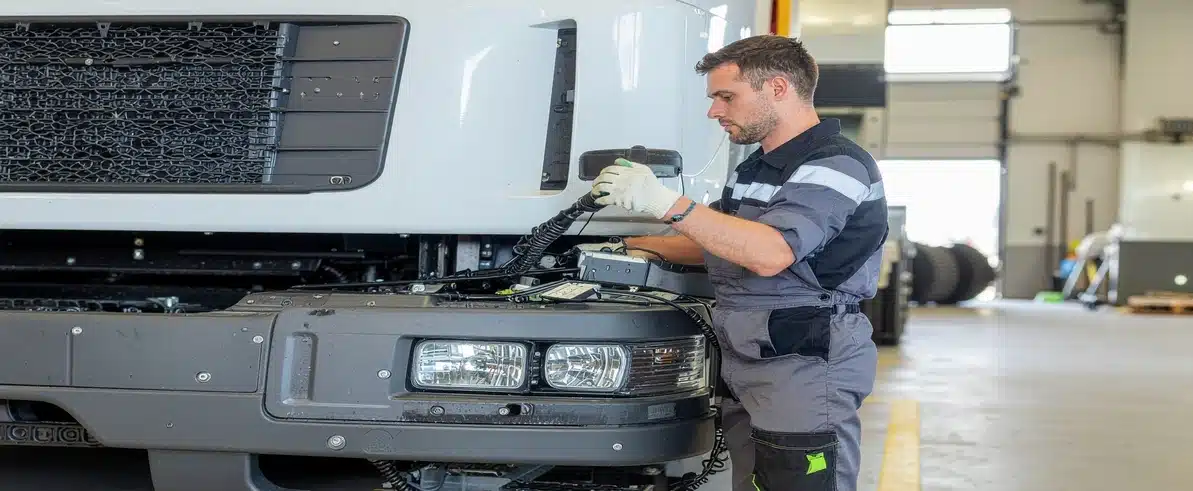
The interaction between light vehicles and heavy plant is one of the most persistently lethal hazards in Australian surface mining operations. Despite decades of focus on traffic management and procedural controls, collisions between personnel vehicles and heavy equipment continue to cause fatalities and serious injuries across the sector. Collision avoidance systems represent the most significant technological advancement in addressing this hazard, but their effectiveness depends entirely on how well they are installed, configured, and integrated into the vehicle’s existing electrical and safety architecture. For mining operators and fleet managers, understanding what a professional collision avoidance system installation involves is the starting point for making informed decisions about system selection and deployment.
The Collision Hazard Context in Mining Operations
Surface mining operations create conditions where the collision hazard between light vehicles and heavy plant is structurally difficult to eliminate through procedural controls alone. Open cut pit environments place light vehicles and haul trucks on the same roads and ramps, often with limited separation options during active production. The blind spots of large mining trucks, which can extend 15 to 20 metres behind and beside the cab, make the truck operator dependent on traffic management systems and technology to be aware of light vehicles in their immediate vicinity.
The consequences of a collision between a light vehicle and a haul truck or excavator are almost always catastrophic for the light vehicle occupants. The disparity in mass between a 300-tonne haul truck and a 2-tonne light vehicle leaves no margin for a minor incident, any contact at operational speeds is likely to be fatal. This asymmetry of consequence is what drives the regulatory and industry pressure to implement collision avoidance systems as a higher-order control in the hierarchy of risk management.
Underground mining environments present a different but equally serious collision hazard profile. Confined travelways, restricted sight lines, and the presence of large mining equipment in close proximity to personnel create collision risks that proximity detection systems are specifically designed to address. The obligation on mine operators to implement collision avoidance systems where the risk analysis supports their use is increasingly embedded in state mining safety legislation and operator safety management plans.
Types of Collision Avoidance Systems Used on Mine Sites
Proximity Detection Systems
Proximity detection systems are designed to alert vehicle operators and personnel when another vehicle or person equipped with a compatible tag or transponder enters a defined hazard zone around the vehicle. The detection technology used varies between system types, and each has characteristics that make it more or less suitable for specific mine-site environments.
Radar-based proximity detection systems use millimetre-wave radar to detect objects within a defined range, regardless of whether those objects carry a compatible tag. This makes radar systems useful for detecting untagged obstacles as well as tagged personnel and vehicles, but the signal processing required to distinguish relevant hazards from background clutter in a complex mine environment can limit detection reliability.
GPS-based proximity detection systems use the position data from GPS receivers fitted to all tagged vehicles and personnel to calculate separation distances and predict collision risk. These systems require all participants to carry GPS-enabled tags and depend on GPS signal availability, a limitation in underground environments and in pit environments with restricted sky view. However, GPS-based systems provide accurate positional data that supports not only proximity alerting but also fleet tracking and production management.
Magnetic field systems create a defined detection zone around the vehicle using a low-frequency magnetic field. Tags worn by personnel or fitted to vehicles respond to this field and trigger an alert when they enter the hazard zone. Magnetic field systems perform well in underground environments where GPS is unavailable, and their detection zones can be shaped to match the vehicle’s actual blind spot geometry.
Vehicle-to-Vehicle and Vehicle-to-Infrastructure Systems
Vehicle-to-vehicle (V2V) and vehicle-to-infrastructure (V2I) collision avoidance systems use direct wireless communication between equipped vehicles to share position, speed, and heading data in real time. This approach allows each vehicle’s on-board system to calculate the trajectories of all other equipped vehicles in range and alert the operator when a collision risk is predicted.
V2V systems require all vehicles in the interaction zone to be equipped and communicating on compatible protocols. The installation of V2V systems involves not only the vehicle-mounted hardware, transceivers, antennas, controllers, and operator displays, but also the configuration of communication parameters that must be consistent across the entire fleet. Where mine sites operate mixed fleets from different OEMs, system interoperability is a significant consideration that must be assessed before system selection.
V2I systems extend this architecture to include fixed infrastructure nodes, mounted at intersections, ramps, and high-risk areas, that communicate with equipped vehicles and provide awareness of hazards that are not visible to the vehicle operator. Installation of V2I infrastructure requires assessment of mounting locations, power supply arrangements, and network connectivity that goes beyond the vehicle-level fitout.
Camera and Sensor-Based Awareness Systems
Camera-based collision awareness systems provide the vehicle operator with a visual field of view that supplements their direct sight lines, typically covering the rear of the vehicle and areas adjacent to the cab. When combined with object detection algorithms, these systems can provide automated alerts when a person or vehicle is detected in the camera field of view.
Installation of camera and sensor systems involves mounting cameras and sensors in locations that provide the required field of view while withstanding the vibration, dust, and temperature exposure of the mine-site environment. Cable routing from camera mounting points to the cab display must be protected along its full length, and connector selections must provide the IP rating required for the installation location. Display mounting in the cab must be positioned so that the operator can view the display without compromising their direct sight lines or ergonomic access to vehicle controls.
Proximity Detection Fitout: Technical Requirements
A compliant proximity detection fitout involves more than mounting a controller and connecting a power supply. The installation must be carried out in a way that ensures the system operates within its specified detection zone geometry, interfaces correctly with the vehicle’s warning systems, and maintains reliable performance across the vehicle’s service life in a demanding environment.
Antenna placement for proximity detection and radar systems directly affects detection zone geometry. Antennas must be mounted in locations specified by the system manufacturer, with clear lines of sight or field propagation paths as required by the system type. Deviations from the specified mounting positions, driven by convenience or the constraints of the specific vehicle, can significantly alter detection performance and may invalidate the system’s compliance certification.
Controller mounting must account for both the physical security of the unit and the thermal environment of the mounting location. Controllers mounted in locations that exceed their rated operating temperature will fail prematurely and unpredictably. Power supply wiring must be correctly fused, sized for the system’s current draw, and connected to a supply that remains active whenever the vehicle’s ignition is on. The on-site installation support capability at EIG enables proximity detection fitouts to be completed at the mine location, ensuring system calibration can be carried out in the actual operating environment rather than a workshop setting removed from site conditions.
Mine-Site Collision Prevention: Compliance and Standards
The regulatory framework governing collision avoidance on Australian mine sites combines state workplace health and safety legislation with mine operator safety management plans and, increasingly, mandatory requirements imposed by state mining regulators. In Queensland, the Recognised Standard 19 (Management of risks from light vehicle and mobile plant interactions) provides explicit guidance on the hierarchy of controls for vehicle interaction risk, within which collision avoidance systems sit as an engineering control.
In Western Australia, the Department of Energy, Mines, Industry Regulation and Safety has published guidance on proximity detection and collision avoidance for the mining industry, and major mine operators in the Pilbara and Goldfields regions have incorporated collision avoidance system requirements into their equipment approval standards.
Site-specific requirements vary significantly between operators in terms of the system types they approve, the detection zone configurations they require, and the documentation they need to support access approval for newly fitted vehicles. A collision avoidance system installation that meets the requirements of one site may need reconfiguration or additional documentation to meet the requirements of another. EIG maintains current knowledge of the approval requirements of major Australian mine operators and structures installation documentation to support efficient access approval across multiple sites.
Vehicle Proximity System Integration Challenges
Integrating a vehicle proximity system into an existing vehicle presents technical challenges that are often underestimated during the system selection process. The vehicle’s existing electrical architecture, its wiring, earthing system, and the electronic systems already installed, all interact with the new installation in ways that must be understood and managed.
Electromagnetic interference is a common challenge in proximity detection installations. The high-current circuits present in mine-spec vehicles, starter motors, alternators, electric fans, and auxiliary loads, generate electrical noise that can interfere with the signal processing of proximity detection systems. Managing this interference requires careful attention to cable routing, shielding, and earthing architecture during the installation process.
Mounting constraints on fully fitted mine-spec vehicles can make finding compliant antenna and sensor positions challenging. Vehicles that have already been fitted with bull bars, lighting systems, communications equipment, and other accessories may have limited available mounting positions that satisfy both the system manufacturer’s specifications and the site’s physical requirements. An experienced installation team works through these constraints systematically, identifying solutions that maintain system performance without compromising other installed systems.
Heavy Vehicle Safety Upgrade Considerations
Collision avoidance system installations on heavy vehicles, haul trucks, graders, loaders, and service vehicles, present additional complexity relative to light vehicle installations. The 24V electrical systems of heavy vehicles, the physical scale of the vehicles, and the high-current electrical environment all affect installation approach and system selection.
Interference management in heavy vehicle installations requires more extensive mitigation than in light vehicle work. The large motors and high-current circuits present in heavy vehicles generate significant electrical noise across a broad frequency range, and the proximity detection system’s signal processing must be able to operate reliably in this environment. Cable routing and shielding requirements are more demanding, and the installation team must have the electrical engineering knowledge to design and implement effective interference mitigation.
Cab layout on heavy vehicles often requires custom mounting solutions for operator displays and warning devices. The workshop installation services at EIG’s Perth facility provide the workspace and tooling needed to carry out these custom fabrications and installations to a consistently high standard before vehicles are deployed to site.
Certification requirements for heavy vehicle safety system installations may require formal engineering assessment where the installation involves modifications to the vehicle’s electrical system beyond the scope covered by the system manufacturer’s installation instructions. EIG engages certifying engineers where required to ensure that the completed installation is formally certified and documented.
Installation Process and Quality Assurance
Every collision avoidance system installation at Engineered Installations Group follows a structured process that begins with a pre-installation assessment of the vehicle and the target site requirements, proceeds through a staged installation with documented quality checkpoints, and concludes with a system test, calibration, and operator familiarisation session before the vehicle is submitted for site access approval.
The pre-installation assessment reviews the vehicle’s existing electrical condition, identifies the mounting positions for all system components, and confirms that the selected system is appropriate for the target site’s requirements. Where the assessment identifies issues with the vehicle’s existing electrical system, earthing deficiencies, wiring defects, or incompatible existing equipment, these are addressed before the new system is installed.
System testing and calibration after installation verifies that detection zones conform to the specified geometry, that warning systems activate correctly at the programmed alert thresholds, and that all interfaces with the vehicle’s existing systems function as intended. Calibration records and test results are documented and included in the installation documentation package that supports site access approval. The capability statement provides mining operators and procurement teams with a detailed overview of EIG’s qualifications and experience in safety system installations across the resources sector.
Conclusion
Collision avoidance system installation is a technically demanding process that requires deep knowledge of both the systems being installed and the vehicles and environments they are installed into. Systems that are correctly specified, professionally installed, and thoroughly documented provide mining operators with a reliable engineering control against one of the sector’s most serious hazards. Those that are poorly installed, with compromised detection zones, interference-affected signal processing, or incomplete documentation, provide a false sense of protection that may be more dangerous than no system at all. To discuss collision avoidance system installation for your mining fleet, call +61 (08) 9419 7318 to speak with the EIG team.



Leave A Comment