
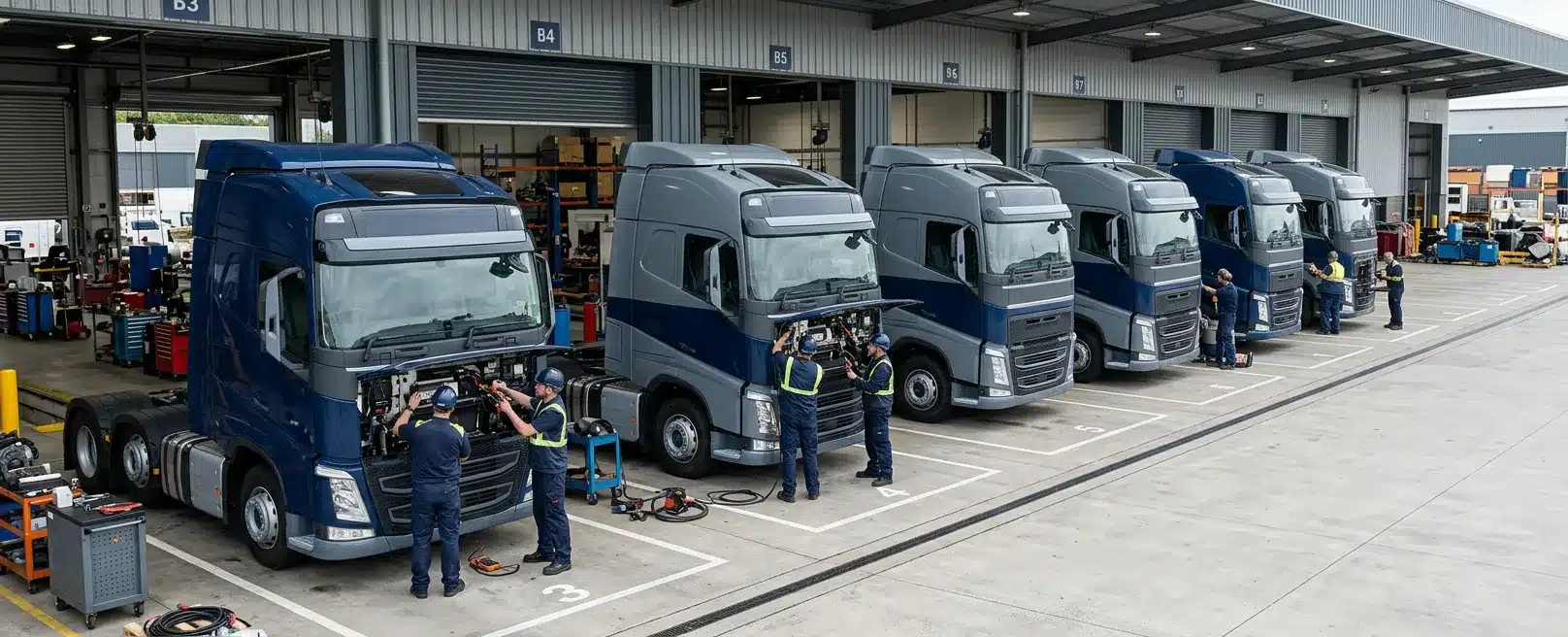
Simplifying Maintenance Across Large Truck Fleets
When a technician opens a cab and finds a different connector layout from the last truck, the job is no longer the fault they were sent to fix. Time goes into locating the module, tracing a harness that does not match the last vehicle, and guessing which drawing still applies.
Standardisation helps only if it shortens that search. Forcing incompatible trucks onto one layout does not. The work is to freeze a small family of approved configurations, keep the variants the duty actually needs, and keep the as-built record in step as kits change.
What Belongs In The Standard
The useful standard is not the whole truck. It is the interfaces the bay touches every week: connector families, harness routes, module mounts, isolation points, and how a kit ties into existing power and communication circuits.
Lock those, and diagnosis starts from a known path. Leave chassis, axle, body and OEM electrical architecture where they sit. Those differences are often why two vehicles cannot share one layout, even when they carry the same camera or the same radio.
Recorded Offset Versus A New Part Number
A camera that sits two hundred millimetres off the last truck is not automatically a defect. It becomes a maintenance problem when nobody recorded the offset, the bracket part number or the harness length that went with it. Standardise the documented family, not every millimetre of bodywork.
If two builds can share one bill of materials and one schematic without fighting the chassis, they are not two standards. They are one configuration that was allowed to drift. Bring them back onto a single drawing before you invent another part number.
Which Vehicle Variants Should Remain
Some differences should stay because the duty is different. Night-haul lighting is not a service-ute lighting job. A collision avoidance fit on a light vehicle does not copy onto a heavy truck without another mount, another power feed and another sightline.
On a support ute the tray, canopy and toolbox change payload and the space a harness can use. That is a reason to keep a light-vehicle variant, not a reason to copy heavy-truck mounts onto the ute. If the extra load is why the vehicle no longer sits level, braking and suspension upgrades for Australian utes sit in that same variant conversation because they share the chassis the kit has to live on.
Treat those as named variants, not as workshop improvisation. Each variant still uses the same drafting rules, the same connector practice and the same inspection points where the hardware allows it. Stores and training can then call the extra by name.
Keep A Variant When The Hardware Changes
Keep a variant when it changes a mount, a harness path, a power budget or a safety interface. Drop it when the only difference is installer habit. If two trucks cannot share a harness route because the chassis and the existing loom occupy different space, record them as separate configurations.
Putting those trucks on one drawing slows the next fault because the technician cannot trust the connector location or the harness path on the sheet. Keep the variant list short enough to learn, and only as long as the chassis and the duty actually require.
Approved Configuration Families
A family is a short list of approved builds: shared interfaces, named variants, and the vehicle types each variant is allowed on. That list is what maintenance can plan against. Anything outside it is a project change or a deviation that needs a recorded reason. The named list is the working brief for Engineered Installations Group when we design the kit, fit the pilot and later audit the truck.
We use integrated system design when the kit has to sit in the structure, take power without harming the circuitry that already runs the machine, and still leave access for later inspection. Mounting, harness routing and safety circuits belong in the same package so the family is physically possible.
The package should include 3D routing for harness and fluid lines where clash is likely, detailed schematics, and mechanical assembly drawings. Feasibility comes first: what the kit must do, what it must not disturb, and which vehicle types are in scope. A loom that will not pass a chassis member is a family problem, not an installer problem. On trucks already in the yard, 3D scanning of the chassis and existing loom shows whether that route is actually free before you freeze the family.
Manufacturing documentation then freezes the family. That means cut lists, a bill of materials, termination instructions and installation drawings. We design harnesses so they can be built and fitted to those documents. The cut list, BOM and termination sheet are what the bay and the supplier work from.
Emergency stops and interlocks belong in that same package when the kit touches a safety function. Design them with the family rather than adding a late loom in the field. The standard that applies depends on the machine and the site, so confirm it in the design scope.
That is what engineered fleet installations are for: a controlled family, fitted to drawings, revised when the kit changes. Maintenance then works from that family rather than from a one-off layout on each truck.
Traceable As-Built Records
Once trucks are in service, the drawing that matters is the one that matches the vehicle in the bay. Our electrical schematics are that working record. They set out layouts for the machinery system and the custom harness so assembly and troubleshooting read the same document.
A schematic that is not revised after a kit change sends the technician down the old path. Configuration control is the habit of updating the schematic, the harness BOM and the termination instructions when the installation changes, then tying that revision to the vehicle identity.
Cut lists and termination instructions also protect parts. If the family uses one connector series and one termination method, stores can stock what the drawings call. If a site substitutes a connector because it was on the shelf, the family has already split, even if the trucks look similar from the yard.
An inspection that finds extra splices or a relocated module is a configuration event, not only a tidy-up. Photograph the change, raise the drawing revision, and decide whether this truck has left its approved variant. Leaving the splice undocumented is how the next shutdown starts with the wrong pinout.
Parts That Match The Family
Inventory improves when the family is short, not because every truck became the same. Count the part numbers technicians actually consume: brackets, connectors, protective sleeving, harness sub-assemblies and the modules the kits use.
Where two variants can share a connector and a fuse arrangement, share them. Where a heavy-truck mount cannot use the light-vehicle bracket, keep both part numbers and label which configuration each belongs to. Collapsing incompatible hardware into one stock item only moves the delay into the bay. If you intend one bracket across several vehicle types, finite element analysis of that mount and the local frame tells you whether the shared part can actually carry the kit before you delete the other number.
New vehicles should enter on an approved configuration so they do not add another camera bracket to a fleet that already carries several. Existing trucks can move onto the family during scheduled refurbishment or a kit upgrade, when the vehicle is already out of service.
That is a planning choice, not an argument for stripping every in-service truck at once. Hybrid fleets are normal during transition: some vehicles on the family, some still on legacy layouts, provided the record says which is which. Retire stray part numbers on purpose once a configuration has left the yard.
Training That Follows Revisions
Training is not a single course, because the family will change. A new collision-avoidance revision, a different lighting driver or a harness reroute creates a new configuration even when the truck looks the same from the outside.
Teach the current approved builds, the inspection points and where the schematic lives. New technicians reach useful competency faster when they are learning a handful of named configurations rather than every historical one-off in the yard.
Experienced staff still need the revision. The value is repetition on the current family, not a promise that nobody will open a drawing again. Pattern recognition helps on a stable build. It misleads when the last truck was an older variant.
Troubleshooting sequences can be written per configuration: isolation points, connector locations and known failure paths for that build. Those sequences stay valid only while the as-built record is current. If the schematic has moved and the course has not, the bay is working from two versions of the same truck.
Pilot Checks Before The Copy Run
Mount positions, harness lengths, connector access and isolation still have to be proved on a real chassis. Use a pilot vehicle, or a small first batch, for that check. A workshop installation at our Forrestdale facility is the controlled place for that check when the truck can be booked in.
Pre-install and post-install checks belong on the pilot and on the production run. Confirm the parts match the BOM, the route matches the drawing, and the completed kit matches the schematic. Catching a clash on one truck is cheaper than copying it across a site.
Field Copy Uses The Same Family
When the machine cannot come to Perth, on-site installation follows the same drawings. Site conditions change access and sequence, not the approved configuration. If the field install cannot follow the family, that is a design change to record, not a local workaround to leave undocumented.
Isolation, LOTO and PPE sit in that process because the install is live industrial work. Quality checks should confirm that equipment was not damaged or modified beyond the design, and that the system works as drawn.
We work with your fabrication team to resolve integration issues on the first units, then lock what was proved. Copying starts after that lock, not during the experiment. Scale the crew to the sites, but keep each truck on a named configuration so the copy run still matches the drawings.
Control After The Next Kit Lands
Configuration control fails at the next kit, not at the first. A fleet management system, a driver monitor, extra lighting or a battery-management change can all occupy the same power distribution and the same harness space. If the new module sits in a high-vibration area, vibration data analysis helps decide whether the current family mount is still valid or whether that kit needs a named variant with a different damper or location.
Ask three questions before the install. Does this kit fit an existing approved configuration? Does it need a new named variant? Or does it break the family for that vehicle type? The answer decides whether you reuse the current schematic and BOM or raise a revision.
Check The Truck Still Matches The Record
After the work, the vehicle record should show the configuration identity, the drawing revision and the date. Condition audits and installation aftercare are how we later check that the truck still matches that record, rather than assuming the last job left the family intact.
Scheduled servicing on a standardised kit is simpler when inspection points are shared across a configuration. It is not simpler if half the fleet has been quietly altered. Audits exist to find those alterations while they are still a documentation problem.
What The Cost Case Can Honestly Include
Cost shows up in labour time, parts diversity, repeat visits and time the truck spends waiting on an unknown layout. Measure those against the configurations you actually run. Do not hang the case on a payback period the job has not earned.
A shorter family should cut time spent hunting connectors and should concentrate stock on fewer high-use items. It will not remove every vehicle-specific job, and it will not make two incompatible chassis share one harness. Judge the programme on whether diagnosis and stores now follow the drawings.
Name the configurations in the fleet before you try to measure a saving. List vehicle types, current kits and which drawings still match. That list is the baseline. Later work is then a change to the family, not another undocumented fit-out.
Implementation cost is real: design time, pilot install, documentation, parts for the family and the labour to bring legacy trucks across during planned windows. Set those against the recurring cost of searching, stocking one-offs and retraining on surprises. The comparison belongs to your own labour and stores data.
Freeze The Family And Keep The Record
Standardise the interfaces and the named variants that technicians can actually service. Leave the vehicle differences that the chassis and the duty require. Keep control by revising schematics, harness documentation and the vehicle record whenever an installation changes.
Bring the vehicle types in the fleet, the kits already fitted or planned, which trucks can come to Forrestdale and which must stay on site, and any drawings or BOMs you still trust. We can then discuss your requirements against a proposed family, including which variants to keep and which layouts to retire.



Leave A Comment