
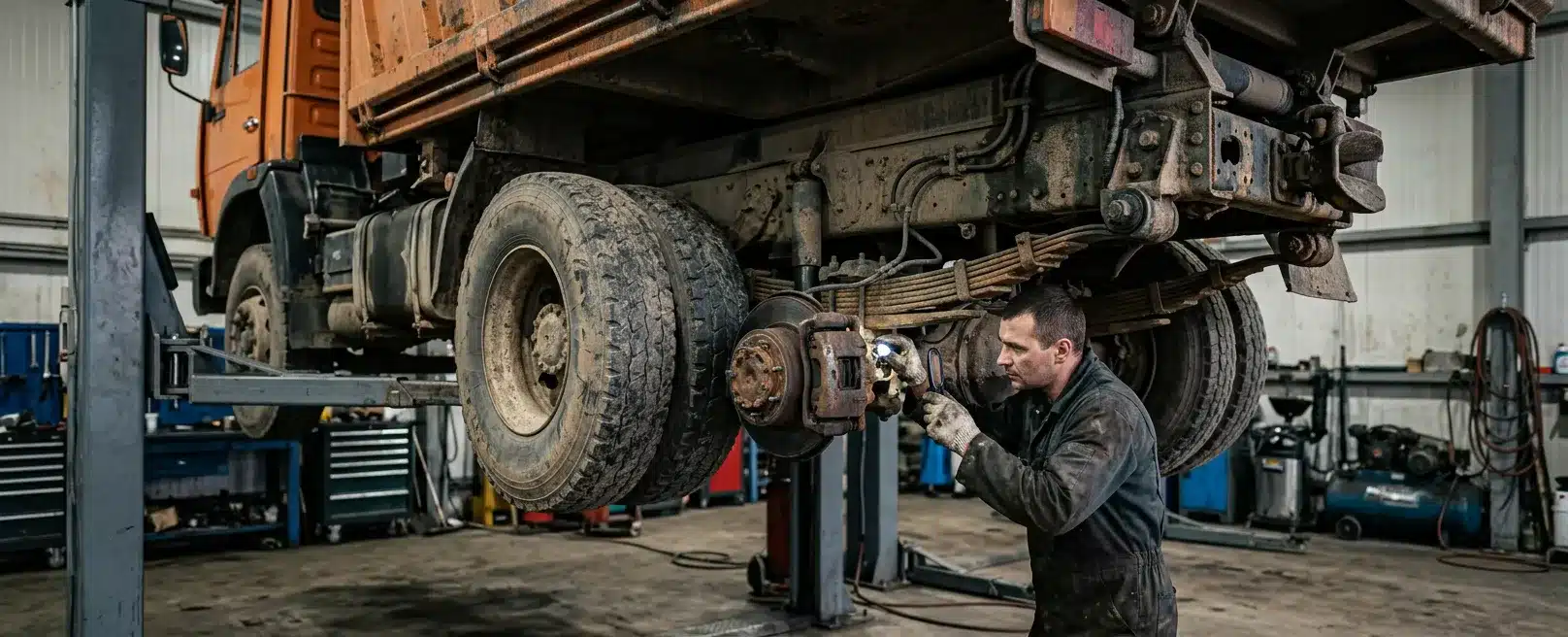
Heavy work vehicles operating across mining sites, remote locations, and demanding transport routes face mechanical stresses that standard passenger vehicles never encounter. Braking and suspension systems designed for highway use often prove inadequate when subjected to continuous heavy loads, corrugated mine roads, and emergency stopping requirements that characterise industrial operations. Recognising when these critical safety systems require a braking and suspension upgrade rather than simple maintenance can prevent catastrophic failures, reduce operational downtime, and ensure compliance with increasingly stringent safety standards.
Fleet managers and site supervisors frequently encounter a challenging decision point; determining whether deteriorating braking or suspension performance indicates normal wear requiring routine replacement, or whether the operational demands have exceeded the system’s design parameters entirely. This distinction matters significantly, as replacing worn components with identical specifications may provide only temporary relief if the underlying issue stems from inadequate system capacity. Understanding the specific warning signs that indicate upgrade necessity rather than standard maintenance helps organisations make informed decisions that balance safety, compliance, and operational efficiency.
Warning Signs Your Braking System Needs Attention
Brake System Degradation Rarely Announces Itself
Brake system degradation rarely announces itself through catastrophic failure in well-maintained fleets. Instead, heavy vehicle braking systems typically provide progressive warning signs that attentive operators and maintenance personnel can identify well before safety becomes critically compromised. The challenge lies in distinguishing between normal wear patterns and indicators that the system fundamentally cannot meet operational demands.
Extended stopping distances represent the most critical warning sign, yet they often develop so gradually that operators adapt unconsciously to the degraded performance. A vehicle that previously stopped comfortably within 50 metres when loaded may gradually require 55 metres, then 60, with drivers subconsciously allowing greater following distances to compensate. Systematic measurement of stopping distances under controlled conditions provides objective data that removes subjective operator assessment from the equation. The physics of kinetic energy $E_k = \frac{1}{2}mv^2$ dictates that any increase in mass or velocity demands an exponential increase in the thermal work the brakes must perform. Any measurable increase in stopping distance beyond manufacturer specifications, even if operators report no concerns, warrants immediate investigation.
A braking and suspension upgrade is only worth specifying against that evidence.
Brake pedal characteristics change distinctly when systems approach capacity limits. A pedal that travels further before engagement begins, requires greater force to achieve equivalent braking, or exhibits a spongy feel rather than firm resistance indicates problems ranging from air in hydraulic lines to worn master cylinders or inadequate brake booster capacity. Conversely, a pedal that feels excessively hard may indicate a failing booster or, in vehicles operating beyond original specifications, a booster inadequately sized for the increased demands placed upon it. This often occurs when auxiliary equipment adds significant mass tA braking and suspension upgrade is only worth specifying against that evidence. hat the original vacuum or hydraulic assist system was not engineered to manage.
Thermal management failures manifest through brake fade during repeated stops or prolonged descents. Vehicles operating in hilly terrain or making frequent stops with heavy loads generate substantial heat in braking systems. Components designed for lighter-duty applications may reach temperatures where friction materials lose effectiveness, hydraulic fluid begins to vaporise, or metal components experience temporary deformation. Distinctive odours, visible smoke from brake assemblies, or steering wheel vibration during braking after extended use all indicate thermal capacity issues that component replacement alone may not resolve. Professional brake fluid analysis often reveals a lowered boiling point, indicating that the fluid has reached its thermal limit and absorbed moisture or degraded due to extreme heat cycles.
Physical inspection reveals wear patterns that distinguish normal deterioration from systemic inadequacy. Brake pads worn unevenly across their surface, rotors exhibiting heat checking or severe scoring, or callipers showing signs of overheating suggest the system operates beyond its design envelope.
The workshop installation services team regularly encounters vehicles where brake components require replacement every few months despite using quality parts, which is a clear indicator that the braking system requires upgrading rather than continued replacement with identical specifications.
Suspension System Degradation Indicators
Suspension systems in heavy work vehicles serve multiple critical functions beyond passenger comfort. They maintain tyre contact with road surfaces to enable effective braking and steering, control vehicle body movement during cornering and emergency manoeuvres, and protect cargo and vehicle structure from impact damage. When suspension systems degrade or prove inadequate for operational demands, these functions deteriorate progressively, often presenting distinct signs of suspension problems that operators normalise rather than recognise as warning signs.
Load Handling Performance Changes
Vehicles designed for specific payload capacities exhibit predictable handling characteristics within those parameters. When operational demands increase payload beyond original specifications, or when suspension components wear to the point of inadequacy, handling characteristics change in distinctive patterns. A vehicle that previously maintained level stance when loaded may begin exhibiting pronounced rear sag, indicating springs or air suspension components no longer provide adequate support. This stance change affects more than aesthetics; it alters headlight aim, changes weight distribution affecting braking balance, and modifies suspension geometry in ways that compromise handling.
Tyre wear patterns provide detailed evidence of suspension geometry problems. Inner or outer edge wear on tyres indicates camber issues stemming from worn suspension bushings, bent components, or suspension travel exceeding design limits under load. Cupping or scalloping patterns suggest worn shock absorbers that no longer control wheel movement effectively. Vehicles operating on mine-spec vehicle compliance standards require particular attention to these patterns, as uneven tyre wear not only reduces tyre life but also compromises the traction necessary for safe operation on challenging surfaces.
Handling during cornering reveals suspension inadequacy through excessive body roll, a feeling of instability when changing direction, or rear-end sway that continues after steering input stops. These characteristics indicate that damping capacity, spring rates, or anti-roll bar effectiveness no longer match vehicle mass and operational demands. The damping force $F = -c\dot{x}$ must be sufficient to control the mass $m$ of the vehicle; when $c$ degrades or $m$ increases, the system becomes under-damped. The distinction between worn components requiring replacement and a suspension system fundamentally inadequate for the application becomes evident when new shock absorbers and springs fail to restore acceptable handling characteristics.
Component-Level Warning Signs
Vibration data analysis belongs when a repeating mechanical mode shows up in the running gear.
Visual inspection identifies signs of suspension problems at various stages, from minor bushing cracks to critical shock absorber leaks. Rubber bushings that appear torn or compressed beyond their designed range of motion no longer provide the isolation and controlled movement necessary for proper suspension function. Leaking shock absorbers indicate seal failure and lost damping capacity. Coil springs that appear compressed even when the vehicle is unloaded have taken a permanent set indicating metallurgical failure. Air suspension systems exhibiting frequent pressure loss point to either component failure or operational demands exceeding system capacity.
The engineering team at Engineered Installations Group matches that duty to the vehicle in the bay.
Unusual noises during operation often indicate advanced wear or failure. Clunking sounds over bumps suggest worn bushings allowing excessive movement between components. Squeaking during suspension travel may indicate dry or worn bushings, while groaning sounds often accompany failing rubber components. Rattling from the suspension area typically indicates loose or broken components requiring immediate attention. The challenge lies in distinguishing sounds indicating components requiring replacement from those suggesting the entire suspension system needs a braking and suspension upgrade to handle operational demands.
Finite element analysis belongs when a mount or caliper bracket is the question.
Steering response provides indirect but reliable information about suspension condition. Excessive play in steering, wandering that requires constant correction, or a vehicle that does not track straight on level roads are often overlooked signs of suspension problems that indicate geometry failure. Vehicles pulling to one side during braking may indicate suspension issues rather than brake problems, as suspension component failure can prevent even brake force distribution across axles.
Compliance and Safety Considerations
Australian Design Rules Establish Minimum Performance
Braking and suspension work has to be specified against the actual loaded mass.
Australian Design Rules establish minimum performance standards for heavy vehicle braking systems, with specific requirements varying based on vehicle mass, configuration, and intended use. Vehicles modified to carry greater loads, operate in more demanding conditions, or perform specialised functions may require braking systems exceeding ADR minimums to maintain safe operation. The legal responsibility for ensuring modified vehicles meet applicable standards rests with vehicle owners and operators, making documentation of system specifications and performance testing critical.
System design belongs on the same sheet as the brake duty, not as a later add-on.
Mine sites impose additional requirements beyond general road regulations. Mine-spec vehicle compliance typically mandates specific braking performance standards, emergency brake capacity, and documentation proving systems meet site-specific requirements. Vehicles operating on mine sites often encounter conditions such as steep grades, heavy loads, and challenging surfaces that demand braking and suspension capabilities far exceeding those necessary for highway operation. Sites increasingly require engineering certification for modified vehicles, including detailed documentation of component specifications, installation procedures, and performance validation testing.
3D services help when a guard hides the face that has to be measured.
The preventive maintenance servicing schedules established by manufacturers assume specific operational parameters. Vehicles operating beyond these parameters, such as heavier loads, more challenging terrain, and higher duty cycles, require adjusted maintenance intervals and enhanced inspection protocols. The distinction between standard maintenance and a strategic system upgrade becomes critical here: maintenance restores systems to original specification, while upgrading enhances capacity to match actual operational demands. Fleet managers must recognise when adherence to standard maintenance schedules proves inadequate because the operational envelope has expanded beyond original vehicle design parameters.
Insurance and liability considerations increasingly focus on whether vehicles operate within their design specifications and maintain documented compliance with applicable standards. A vehicle involved in an incident due to brake or suspension failure may face scrutiny regarding whether systems were appropriate for the application, properly maintained, and met relevant standards. Documentation proving systematic inspection, appropriate upgrades when operational demands changed, and compliance with engineering recommendations provides critical protection in such circumstances.
When Upgrades Become Necessary
Operational Changes Frequently Create Situations Where Previously Adequate Heavy
Operational changes frequently create situations where previously adequate heavy vehicle braking systems no longer meet requirements. A vehicle originally specified for highway transport that transitions to mine site operation faces dramatically different demands. Continuous operation on corrugated dirt roads, frequent stops with heavy loads, and steep grade navigation all exceed typical highway vehicle design parameters. Rather than accepting accelerated component wear and degraded performance, systematic upgrading to match new operational realities provides safer, more economical long-term operation.
Payload increases represent another common trigger for upgrade necessity. Organisations often incrementally increase vehicle loading as operational demands grow, with each small increase appearing insignificant. The cumulative effect, however, may push braking and suspension systems well beyond their design capacity. Engineered Installations Group understands that a vehicle designed for a 5-tonne payload that regularly carries 6 or 7 tonnes operates with substantially compromised safety margins. Brake systems struggle to dissipate the additional heat generated, while suspension components wear rapidly and provide inadequate control. Upgrading to components designed for higher capacity restores proper safety margins rather than simply accepting degraded performance.
Terrain and environmental factors may demand capabilities beyond original equipment specifications. Vehicles operating in mountainous areas require enhanced brake cooling capacity and lower gear ratios to manage descents safely. Those operating in extreme temperatures need brake fluids, seals, and components rated for the environmental conditions encountered. Coastal operations demand corrosion-resistant components and protective coatings. Matching component specifications to actual operating environment rather than accepting premature failure and frequent replacement improves reliability and reduces lifecycle costs.
The approach to upgrade assessment begins with systematic evaluation of actual operational demands compared to vehicle design specifications. This analysis identifies gaps between capability and requirement, enabling targeted upgrades that address specific deficiencies rather than unnecessary wholesale replacement of adequate systems. Engineering analysis determines whether proposed upgrades require certification, what testing validates performance, and how modifications affect other vehicle systems.
Professional Assessment and Installation
Accurate Diagnosis Distinguishes Between Components Requiring
Accurate diagnosis distinguishes between components requiring replacement due to wear and systems requiring upgrading due to inadequate capacity. Professional assessment begins with detailed operational history: payload ranges, terrain types, duty cycles, and any incidents suggesting performance inadequacy. Physical inspection follows, examining component condition, wear patterns, and any modifications or damage. Performance testing under controlled conditions provides objective data on stopping distances, suspension travel, and handling characteristics.
The on-site technical team can perform these evaluations in the field to identify impending suspension component failure before it stops the vehicle.
Engineering analysis becomes necessary when contemplating major braking and suspension upgrade programs. Increasing brake capacity may require larger components, enhanced cooling systems, or modifications to brake balance and ABS calibration. Suspension upgrades must consider spring rates, damping characteristics, load capacity, and how changes affect vehicle geometry and handling.
The electrical engineering solutions team integrates electronic brake control systems, ABS modifications, and suspension monitoring systems that enhance safety and performance while maintaining compliance with applicable standards.
Installation quality directly affects upgrade effectiveness and safety. Brake system modifications require precise attention to hydraulic line routing, bleeding procedures, and brake balance adjustment. Suspension installations demand proper torque specifications, geometry verification, and comprehensive testing. Quality assurance protocols including pre-installation inspection, systematic installation procedures, and post-installation testing ensure upgraded systems perform as intended. Documentation of specifications, installation procedures, and performance validation provides the evidence necessary for compliance verification and liability protection. Regular preventive maintenance servicing supports these modified systems remain within safe tolerances throughout their service life.
Speak with us to arrange an assessment of the vehicle, the duty, and the installation path.



Leave A Comment