
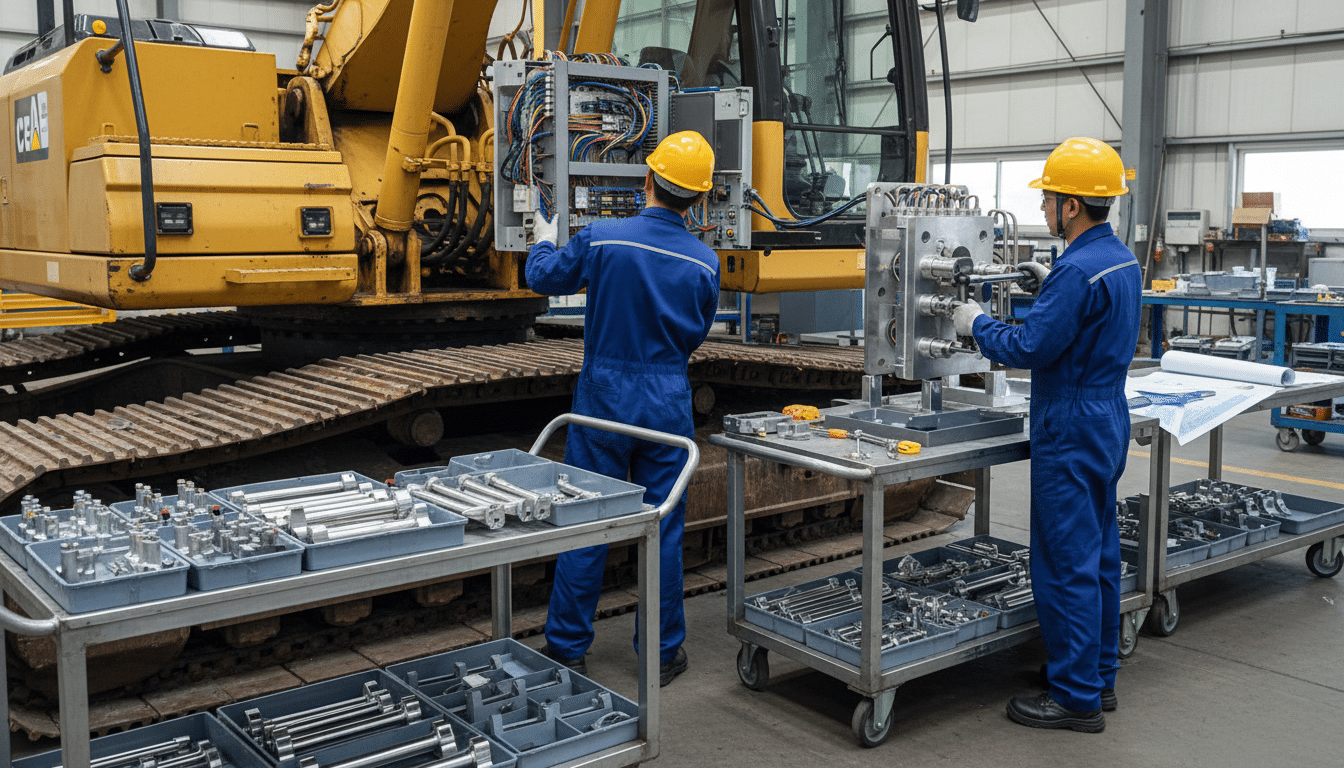
Machinery retrofits in mining and heavy industrial environments carry inherent risk. When technicians modify equipment in the field, working with loose components and improvised solutions, installation errors become almost inevitable. A misrouted cable, an incorrectly torqued fastener, or a wiring connection that works initially but fails under vibration can halt operations and trigger expensive rework. Pre-engineered kits eliminate most of these vulnerabilities by shifting complex assembly work from unpredictable field conditions into controlled workshop environments where quality can be verified before equipment ever reaches site.
The difference between a successful retrofit and a costly failure often comes down to how much engineering happens before installation begins. Pre-engineered kit solutions shift that engineering work into the workshop, where it can be completed, tested, and documented before any field deployment begins. Traditional approaches require technicians to interpret drawings, select components, fabricate mounting brackets, and route wiring harnesses on-site, introducing multiple points where human error can compromise the final result. Plug and play engineering reverses this model by completing design validation, component integration, and testing in advance, delivering solutions that install with minimal field interpretation.
The Hidden Cost of Retrofit Installation Errors
Why Errors Rarely Announce Themselves Immediately
Installation errors in machinery retrofits rarely announce themselves immediately. A loose electrical connection might function for weeks before vibration causes intermittent faults. An improperly mounted sensor bracket may appear secure until thermal cycling fatigues the material. A wiring harness routed too close to a heat source might operate normally until ambient temperatures rise during summer operations. These delayed failures create cascading problems: unplanned downtime, emergency mobilisation of technicians to remote sites, rushed diagnostic work under pressure, and the reputational damage that comes with delivering unreliable solutions.
The financial impact extends beyond direct repair costs. When a retrofit fails on a production vehicle at a mine site, the client loses not just the machine’s productivity but often the output of an entire production chain waiting for that equipment. If that fault traces back to an installation error that could have been prevented through better engineering, the responsibility falls on the retrofit provider. Most installation-related failures stem from preventable causes: inadequate planning, insufficient testing, or reliance on field improvisation rather than engineered solutions.
Safety Consequences of Poor Installation
Safety incidents represent the most serious consequence of installation errors. An improperly installed collision avoidance system that fails to detect obstacles puts operators and ground personnel at risk. These are the consequences when collision avoidance system installation relies on field improvisation rather than pre-validated engineering. A braking system upgrade with incorrectly torqued fittings could lead to hydraulic failure under load. A lighting installation with inadequate wire protection might create fire hazard conditions. These scenarios are not theoretical – they represent actual failure modes that occur when retrofits rely on field assembly without rigorous engineering validation. Mining environments, where equipment operates in close proximity to personnel and other machinery around the clock, have no tolerance for safety system unreliability.
What Makes Pre-Engineered Kits Different
From Field Improvisation to Workshop-Validated Assemblies
A pre-engineered kit represents the opposite of field improvisation. Instead of sending technicians to site with a box of components and a set of drawings, customised kit solutions arrive as integrated assemblies where critical connections, mounting points, and routing paths have already been finalised and tested. The kit includes pre-terminated wiring harnesses with connectors already crimped and heat-shrunk, mounting brackets fabricated to exact specifications and pre-fitted with fasteners, and labelled components that correspond to clear installation documentation.
This approach shifts the majority of skilled labour from the field into the workshop, where conditions support precision work. Workshop environments provide proper lighting, climate control, access to specialised tools, and the ability to pause work for quality checks without pressure from waiting equipment or production schedules. EIG’s workshop installation services operate on exactly this principle – building and validating kit assemblies in a controlled facility before they are committed to site deployment.
What Pre-Engineered Kit Work Actually Means
Pre-engineered kit work does not mean installations require no skill – it means the skill focuses on correct positioning and securing of pre-validated assemblies rather than interpreting how components should connect. A technician installing a pre-engineered lighting kit does not need to determine wire gauge, select appropriate connectors, calculate voltage drop, or design mounting solutions. Those decisions have already been made, validated through analysis, and proven through testing.
The engineering work that happens before a kit ships includes design checks through finite element analysis so mounting structures can be reviewed against expected loads, electrical system integration testing to verify compatibility with vehicle power systems and communication networks, vibration analysis to confirm that cable routing and component mounting survive harsh mining conditions, and documentation development that translates engineering intent into clear installation procedures. This is what field installation efficiency looks like in practice: a defined, executable sequence rather than an engineering exercise repeated at every vehicle.
The Engineering That Happens Before the Kit Ships
Design Validation: Structural, Electrical, and Thermal
Quality checks for pre-engineered kits begin during design, not after assembly. Engineers model mounting loads, heat and vibration. Vibration data analysis can feed that check. Customized kits still need the same platform review. For electrical systems, this includes analysing voltage drop across harness lengths, calculating current capacity with appropriate safety margins, and verifying that connector ratings exceed maximum expected loads. For mechanical assemblies, finite element analysis identifies stress concentrations, validates fastener selections, and confirms that bracket designs provide adequate strength without unnecessary weight.
Physical Testing That Replicates Field Conditions
Once design validation completes, prototype kits undergo physical testing that replicates field conditions. System design should sit in the same pack as that test. Electrical harnesses are subjected to vibration testing on shake tables that simulate thousands of hours of vehicle operation. Mounting brackets are loaded to verify that calculated strength margins translate to real-world performance. Connectors are mated and de-mated repeatedly to ensure they withstand the connection cycles expected over the kit’s service life. Environmental testing exposes assemblies to temperature extremes, humidity, dust, and other conditions encountered in mining and industrial environments.
What Testing Reveals That Design Analysis Misses
This testing phase frequently reveals issues that would not be apparent from design analysis alone. Engineered Installations Group keeps those test notes with the kit pack. A connector that meets all electrical specifications might prove difficult to mate in the confined space where it needs to install. A mounting bracket that is structurally sound might interfere with adjacent components when fitted to the actual vehicle. A cable routing path that looks optimal in a CAD model might create chafing risk when the vehicle articulates over uneven terrain. Identifying and resolving these issues in the workshop, where modifications cost hours rather than days, prevents them from becoming field problems that halt installations and require emergency redesign.
Documentation That Enables Correct Installation
Written by Engineers, Reviewed by Technicians
Documentation development happens in parallel with physical testing. 3D services can capture the as-fitted path before later kits are copied. Installation procedures are written by engineers familiar with the design intent, then reviewed by technicians who will perform actual installations to ensure instructions are clear and complete. Photographs and diagrams illustrate critical steps. Torque specifications, connector orientations, and test procedures are explicitly stated rather than assumed. The goal is documentation that enables a competent technician to complete installation correctly without needing to contact engineering for clarification.
Supporting Field Installation Efficiency
When a pre-engineered kit arrives on site, installation follows a defined sequence that minimises interpretation and decision-making. Customized kits still need that sequence named. System design should sit in the same pack. The kit includes all necessary components, pre-assembled where practical, along with any specialised tools required for installation. Fasteners are bagged and labelled by installation step. Wiring harnesses are pre-routed through protective sleeving and terminated with connectors that only mate correctly, preventing reverse polarity or mis-wiring.
Colour-coded wiring and clear labelling reduce the chance of connection errors. 3D services can capture the as-fitted cable path before later kits are copied. System design should sit in the same pack. Cable routing follows paths marked in the installation documentation, with supplied clips and grommets positioned to prevent chafing and maintain proper separation from heat sources and moving components. The installation concludes with a functional test procedure that verifies each system operates correctly – included in the kit documentation and designed to be completed with standard diagnostic tools. This is field installation efficiency delivered through preparation rather than improvisation. EIG’s on-site installation teams execute these procedures across both accessible and remote locations, using kit documentation as their single reference point throughout.
Pre-Engineered Kits in Mine-Spec Vehicle Fitout Programs
How Integration Happens in the Workshop, Not on Site
A typical mine-spec vehicle fitout using pre-engineered kits might include lighting systems, communication equipment, collision avoidance sensor installation, and auxiliary power distribution. Rather than installing these as separate systems requiring custom integration on the vehicle, the kit approach provides interface modules that tie everything together with standardised connections. The lighting harness plugs into the power distribution module. The collision avoidance system connects to the communication network through a pre-configured gateway. Auxiliary power outlets receive supply through circuit-protected distribution blocks already mounted and wired.
This integration happens in the workshop during kit assembly, where engineers verify that all systems communicate correctly and that power distribution meets each component’s requirements. By the time the kit reaches the installation site, these integration challenges have been resolved. The installer’s task becomes physical mounting and making the final connections that tie the kit to the vehicle’s base electrical system.
Remote Site Applications in the Pilbara and Bowen Basin
Mining operations represent the environment where pre-engineered kits are most useful. Remote site locations make installation errors costly to correct, as bringing technicians and replacement parts to site involves mobilisation delays and travel expenses. Production pressure creates urgency that can lead to shortcuts if installation procedures are not straightforward. Harsh operating conditions mean that marginal installations fail quickly, while properly engineered solutions prove their value through reliable operation.
On remote Pilbara or Bowen Basin jobs, site teams often work with limited workshop access. A pre-engineered kit still needs a checked drawing and a clear install sequence. That does not remove the need for a site-specific check.
Quality Control Built Into the Process, Not Added at the End
Component Selection and Assembly Verification
Quality assurance for pre-engineered kits operates on multiple levels, starting with component selection. Engineers specify parts from manufacturers with proven track records in demanding applications, avoiding components known for high failure rates or poor environmental resistance. Electrical connectors are rated for vibration and sealed against dust and moisture ingress. Fasteners are specified with appropriate coatings to prevent corrosion. Wire and cable selections consider not just current capacity but also insulation temperature ratings, abrasion resistance, and flexibility in cold conditions.
Assembly procedures include verification steps at critical points. After a wiring harness is assembled, continuity testing confirms that every circuit is complete and that no short circuits exist between conductors. Assembled kits undergo functional testing before shipping. Documentation accompanies each kit, providing traceability through bill of materials, assembly records, test results, and installation instructions specific to that kit configuration.
Electrical Engineering Documentation That Proves Compliance
Electrical engineering solutions that underpin pre-engineered kits include detailed schematics, load calculations and design records. That is documentation, not a certificate. For collision avoidance system installation in particular, this documentation confirms that sensor fields of view, alert thresholds, and vehicle interface connections all meet the site standard before the first vehicle is commissioned. This engineering backup ensures that kits are properly designed systems with documented performance characteristics, not just assemblies of components that happen to fit. When a vehicle experiences a fault years after a retrofit, troubleshooting becomes straightforward because the installation used a documented, standardised kit – and complete component history exists for every assembly decision that was made.
For a pre-engineered kit on a machinery retrofit or mine-spec fitout, Contact us to check the current scope.



Leave A Comment