
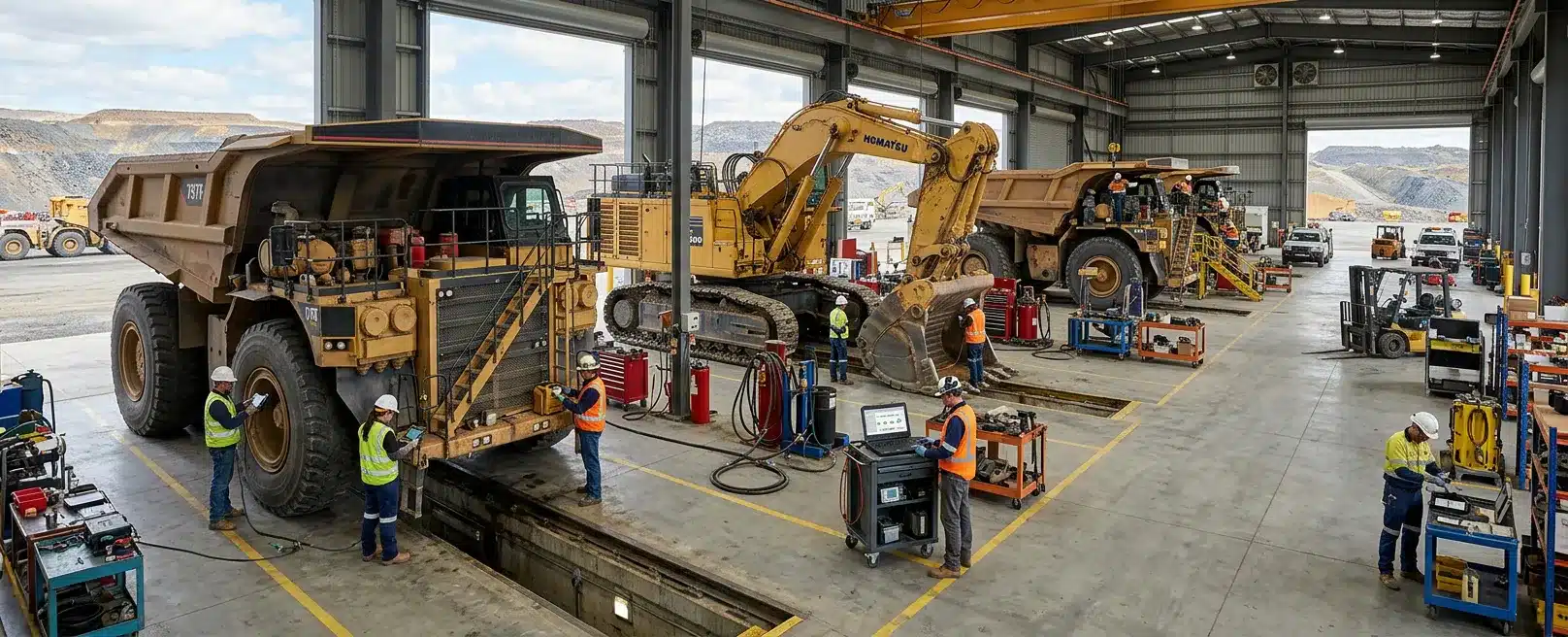
Reactive maintenance waits for the failure. Predictive maintenance tries to see the failure early enough to plan the repair. Both exist on Australian mining fleets. The useful question is which asset you will pilot first, what you will measure the same way twice, and which named job the workshop will raise when the trend moves.
Unplanned downtime still changes the shift when a haul truck, loader or crusher stops without a prior signal. A dashboard does not fix that. A comparable measurement set on one critical failure mode does. The engineering team brings that measurement path, the analysis and the installation together at the engineering team when you are ready to treat one machine as the pilot rather than the whole fleet.
Why Reactive Work Still Leaves You Without a Record
The invoice for a failed final drive is not the cost. The cost is the machine standing, the replacement that is not there, the overtime, the freight, and the secondary damage when a bearing takes a gearbox with it. You already know that. What is often missing is a record that separates a chosen run-on from a failure that never had a signal.
A reactive fleet can still be a disciplined fleet. It has a breakdown process, a parts list and a tow plan. It does not pretend every failure was a surprise. The problem starts when the same component fails on the same route and nobody keeps the operating hours, the load case or the last inspection against the asset ID.
Calendar servicing still has a place. OEM and statutory inspections stay on the card whether or not a logger is fitted. Predictive work sits beside those controls. It does not cancel them. If the fleet already collects oil, hours and temperature, keep those files. A new vibration channel is another comparable measurement, not a reason to discard the oil sample.
Select the Pilot Before You Scale Sensors
Start with the machines whose unplanned stop changes production. Haul trucks, loaders and crushers are not interchangeable with light vehicles. Rank by consequence of the failure mode, parts lead time and whether the workshop can actually act on a signal. Programmes that begin with every asset ID on the register collect noise. One critical asset and one named mode give you a trend you can defend.
Name the Asset, the Mode and the Job
For the chosen machine, write three lines: the failure you are trying to see early, the signal that would show it, and the work order you will raise when the signal moves. If the third line cannot be written, you are collecting data for a report, not for a bay.
Wheel ends, final drives, gear mesh, fans, alternators, pumps and hydraulics are common vibration uses on mobile plant. Those are assemblies and sensor locations, not the mode. Name the fault you want to see, such as a bearing, gear or driveline fault on the unit that already costs you unplanned time.
A useful signal has a sensor point, a speed or load band, and an alarm band the technician can explain. Early fault detection through vibration data analysis belongs here because it watches bearings, gears and drivelines, supports remaining useful life estimates, and can feed CMMS work orders once the baseline is honest. That is the analysis role. Fitting a logger without those three lines is hardware, not a maintenance change.
Keep Light Utes on Their Own Duty Card
Australian light utes that work mine roads have a different duty and a different maintenance comparison from heavy mobile plants. Load, GVM, braking heat and ride height sit on a light-vehicle card. They should not inherit haul-truck vibration rules or heavy-equipment brake language.
When those utes carry increased loads in harsh country, braking and suspension upgrades are a light-ute decision about holding power, cooling, stopping performance and a level ride under load. Keep that work on its own card.
Capture Comparable Measurements, Not Snapshots
Predictive maintenance is a habit of measuring the same point the same way, then changing a job when the trend moves. Vibration is one family. Oil, temperature and hour meters are others. A bracket that resonates near the sensor can contaminate the reading, so mount on a stiff, repeatable face. An accelerometer cable-tied to a guard is a weak mounting for wet, dusty duty.
Set the Sensor Point and the Baseline Together
Define the sensor point, the mounting face and the alarm band before the first capture. Train the person who mounts the sensor to separate machine vibration from travel noise. Mobile plant sees variable speed, load and rough terrain, so the file header should name asset ID, operating hours, speed or load class and sensor location. A single snapshot is a photograph. A trend is a film.
Take a baseline after a known-good install or after a rebuild. Repeat at a stated interval that matches duty. A high-hour haul truck may need a shorter gap than a standby pump. Write the interval on the asset card. If the last capture is older than that interval, treat remaining useful life as stale and stage nothing on that file.
Decide Whether the Machine Comes to Forrestdale or Stays in the Field
A controlled bay can set a clean baseline: known speed, known load class, and a logger that will still be there next month. When the vehicle can be booked in, workshop installation at Forrestdale is the place to fit loggers, looms and brackets under repeatable conditions. Dust, access and isolation rules are different on a pit road.
When the machine cannot come in, on-site installation is the field path, including vibration data capture and engineering data capture on the asset you named. A pit measurement includes travel vibration, dust and whatever isolation the permit allows. Mixing a Forrestdale file with a pit file without a note is how trends lie. Prove isolation before a logger is opened on a live chassis. A workshop baseline does not waive that step in the field.
Engineer the Sensor Path So the Next Capture Matches
The sensor path is an engineered run. Cable length, gland, earth, connector and logger power all fail in the wet. The mount and the loom need system design in the same pack as the analysis method, so shock and vibration do not turn the install into the loudest thing in the spectrum.
Loom layout, cut lists and termination instructions sit with electrical engineering once isolation is proved. Ambiguous harness documentation slows troubleshooting and creates field failures that look like machine faults. If the only clean mount sits behind a tray or a toolbox that will be removed later, 3D scanning gives a measured face so the bracket is designed for the geometry that is actually there.
Engineered Installations Group holds that process against the named asset.
Recheck Comparability After Configuration or Load Changes
Not every kit on the vehicle invalidates history. Recheck comparability when the sensor point, mounting stiffness, logger, speed band or load class changes. A new mass next to the sensor, a relocated bracket, or a duty change that moves the machine into a different load case can shift the baseline. After those jobs, take a new baseline rather than keeping the old clock running.
A tray or toolbox that alters the cable run or hides the mounting face is a configuration change for that channel. A change that does not touch the sensor, the structure it sits on, or the operating band can leave the historical file usable. Write the change on the asset card so the next analyst is not guessing.
Use Structure Analysis When the Question Is a Crack or a Mount
Vibration work watches repeating mechanical modes. A crack path, a mount, a bracket, a frame or a field modification is a structural question, and that is where finite element analysis belongs. It quantifies stress, deflection, vibration and thermal behaviour against mapped load cases, material data, geometry, boundary conditions and a validation check. Raw acceleration from a logger is not a force you can paste into a model.
Fatigue, buckling and failure-risk evaluation can inform an asset-specific replacement discussion. That still needs judgment on the load map and correlation with tests. It does not mint an automatic interval. When a component has already failed, reverse-engineering the load path can point to a design change that should apply across the same class, not only the broken unit.
Keep OEM and statutory inspection controls on the same asset. Structural evidence supports a mount or crack decision. It does not replace the inspection the manufacturer or the regulator still requires.
Turn Evidence Into a Named Maintenance Action
A useful weekly meeting has three outcomes: inspect, stage a part, or reset the watch. Name the asset ID, the sensor point, the operating hours, the mode and the work order number. If the mode cannot be named, the action is inspect, not buy. Remaining useful life estimates from vibration work are planning aids for parts lead time and crew scheduling. They are not an hours-to-fail number you bet a shutdown on.
CMMS integration and automated work orders can raise the job when an alarm band is crossed. Creating a work order is not authority to stop or restart the machine. Isolation, permit and operations still own that call. Oil, hours and temperature still count. A rising temperature at the same bearing, or iron in the oil, can confirm a mode the spectrum only hinted at. Use those together.
When a sensor fails, treat it as a failed measurement, not a healthy machine. A dead logger is a gap. Until the channel is restored, use the checks that belong to the named mode on that asset, then refit the logger. Do not reset the watch because the chart went blank. Files without a header that names the person, the permit and the hours do not go into the trend.
Expand Only After the Pilot Produces a Job You Can Repeat
Scale after the pilot has a comparable baseline, a trend rule and at least one named action the workshop actually raised. Then copy the sensor point, the interval and the job language to the next asset in the same class. Starting with the critical fleet and then scaling is the sequence that keeps alarm bands honest.
If the next step is an installation and analysis pack for a named machine, discuss the project with the records below. The engineering team can prepare the measurement path and the first baseline from those details. The captures still decide the job.
Bring:
- Asset ID, make, model and whether the unit can come to Forrestdale or must stay in the field
- The failure mode you want to see early, plus last operating hours and load class
- Existing oil, temperature or hour-meter files for the same component
- Current sensor points, if any, and any recent mount, tray, logger or duty changes
- The work order language the workshop will use if the trend moves
The move from reactive to predictive work happens asset by asset, signal by signal, job by job. Choose the critical failure mode, measure it the same way twice, and raise a named work order before you buy another logger.



Leave A Comment