
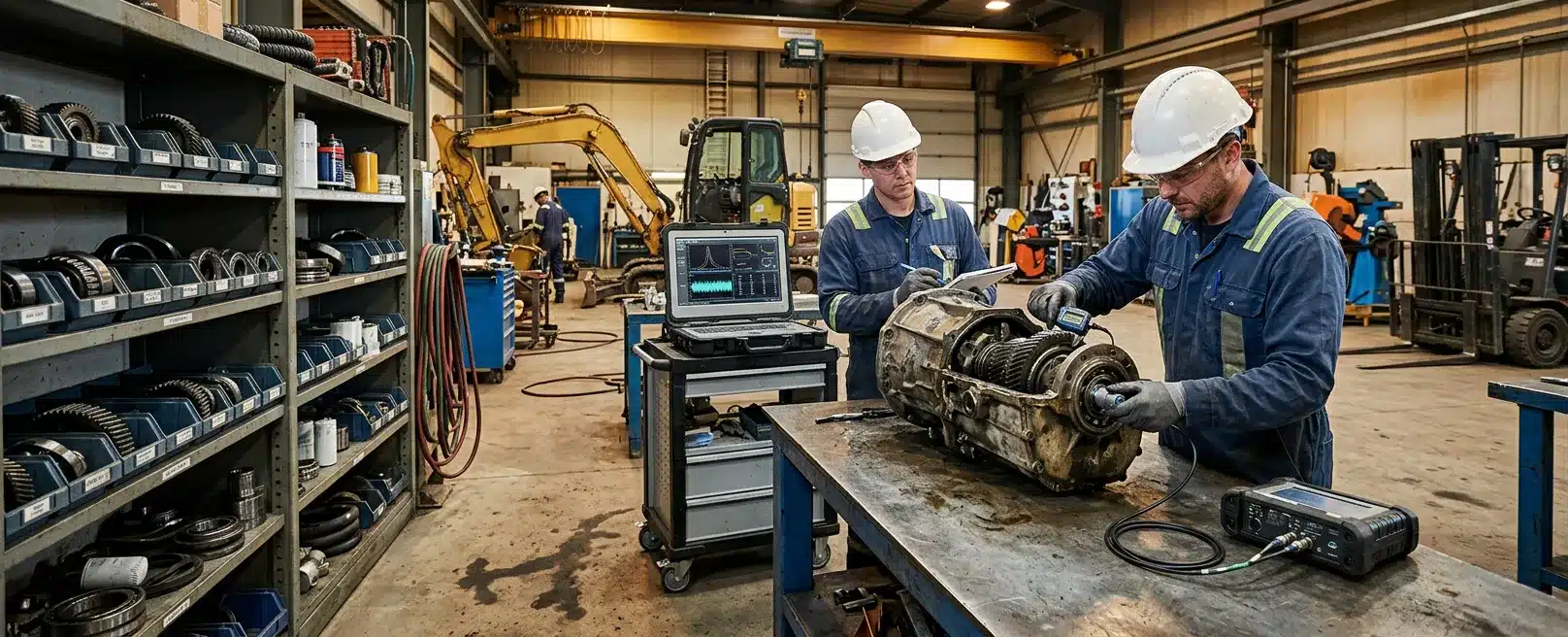
A remaining useful life figure helps stores when it changes a date you can act on. Pair that figure with the named part, the freight clock and the next real maintenance window. Use a qualified estimate: asset identity, failure mode, uncertainty and lead time on the same line as the hours. A single unverified point estimate is a poor purchase order.
The engineering team brings capture, analysis and the sensor path together with the engineering team so the number you take to store sits on a named asset, a named sensor point and a file that can be compared later.
The vibration data analysis work supports remaining useful life estimates, condition-based planning and CMMS integration for automated work orders. A work order is a planning record. Isolation and permit remain the stop and restart authority on the machine.
What a Qualified RUL Estimate Contains
Treat remaining useful life as a planning input built from three things that must match. You need a named failure mode, a vibration signal that moves before that mode, and a history of similar components under comparable duty. Bearing-band energy, gear mesh, imbalance and looseness do not share one shape. If the analyst cannot name the mode, stores should not buy from the decimal.
Name the Mode Before You Stage the Part
Peaks at known bearing frequencies are a common signal on wheel ends, final drives, fans, alternators, pumps and hydraulics. They are useful when the band and the component family agree. Stage the part the mode actually names. A noisy cooling-fan bearing is not a reason to stage a gearbox.
Keep the Sensor Where the History Expects It
The install has to keep the sensor at the defined point. A logger that has been kicked, waterlogged or moved to a cleaner bracket is measuring a different machine. Record asset ID, sensor point and operating hours on the same file as the spectrum. Wrong truck, wrong part, wrong buy.
How Stores Should Use the Estimate
Stores do not want every final drive on the continent. They also do not want a machine down waiting on freight for a part the vibration already named. Remaining useful life estimates help when they move a date: check stock, inspect, then book the named change in the next planned window. If the estimate still says watch, do not raise a panic buy.
A parts plan that treats every orange chart as an emergency recreates reactive maintenance with extra software. Hold a small buffer of the named component instead. Do not fill a warehouse from a trend that has not been inspected on the machine.
Write Lead Time Next to the Part Number
Freight time belongs in the rule. If the named bearing is a week away, the threshold has to fire earlier than a part that already sits on the shelf. Write the lead time beside the part number on the same line as asset ID, hours, mode and job. An RUL date that ignores freight is a date that misses the shutdown.
Use the supplier’s current lead time as a planning input and refresh it when the buyer confirms stock. A vibration date that looks comfortable on the chart can still miss the window if freight moved this week. Confirm availability before you treat the part as staged.
Plan Against a Range, Not a Single Hour
A useful estimate is a range you can plan against, not a single hour stamp. Compare the lower end of the range with parts lead time and the next available maintenance window as two separate clocks. Delivery, preparation and the named change need to finish before that lower end.
Do not add freight onto the lower end and treat the later date as your action point. If current freight or the next window would miss that lower end, pull the job forward or stage the part so both are ready in time.
A window that still sits inside the range is not automatically a watch. Check OEM and statutory inspection dates, the named mode and site risk before you leave the job where it is.
Uncertainty is operational. Speed, load, lubrication and a recent rebuild all stretch or compress the same defect. State the comparison conditions on the file: speed band, load case, hours and whether the measurement was static or on route. Then the next spectrum can be compared rather than argued.
When the Estimate Needs a New Comparison
RUL models struggle when duty changes. A truck that moves from a short haul to a long climb is not the same operating story. Grease, alignment or a recent rebuild can reset the vibration history. After a component change, take a new baseline at the same sensor point. Do not keep the old RUL clock running on a different part.
Not every modification invalidates every historical file. Comparability checks are needed when the sensor point moves, the mount stiffness changes, logger power or earth changes, or the load path at that measurement point changes. If those stay the same, keep the history and note the duty.
Workshop Capture Versus Route Capture
Vibration capture in Forrestdale bay is quieter and easier to repeat. Capture on a haul road includes travel, dust and whatever isolation the permit allows. Mixing those two datasets without a note is how trends lie. Label static baselines from workshop installation separately from route files taken during on-site installation work.
Field files should name who captured them, on which asset, at which hours, and the speed band. Workshop files should say static. If those labels are missing, do not mix the points when you set an RUL date for stores.
Australian Light Ute Duty Is a Separate Stores Book
Heavy plant and Australian light-ute fleets do not share a parts book, a duty cycle or a brake specification. Keep ute stores planning in its own category. For a working ute, braking and suspension upgrades change how the vehicle sits, stops and carries load. That can change the vibration story at wheel ends and mounts if the load path or sensor bracket moves.
Do not assume every upgrade changes unsprung mass or wipes the historical file. Check whether the sensor point, bracket stiffness and operating load at that corner still match the baseline. If they do not, close the old RUL file and open a new one after the first comparable run. OEM and statutory inspection intervals for that ute stay in the same folder as a calendar control beside the vibration rule.
Engineered Installations Group holds that process against the named asset.
Keep Structural Plots Off the Purchase Order
Load Cases Are Not Remaining Useful Life Hours
Use finite element analysis when the question is whether a mount, bracket or frame can carry judged load cases. That work needs material data, geometry, boundary conditions and validation together. It does not convert a vibration spectrum into hours, and a raw acceleration trace is not a force.
Keep the two packs separate so stores are not buying a bearing from a stress plot, or delaying a named bearing because a frame model looks comfortable. Fatigue results can inform a longer design conversation. They are not an automatic replacement interval and they do not replace the vibration mode on the work order.
Build a Sensor Path That Will Still Be There
The measurement is only comparable if the sensor is still on the same point next month. Use system design for the sensor path: glands, earths, power and a mount that survives a tray coming off. Account for shock and vibration at the physical install, not only in the spectrum later.
Power, Earth and Loom Records
When logger power or earth moves, electrical engineering documentation matters. Schematics, harness cut lists and the bill of materials keep the loom repeatable. After those changes, check comparability. Same sensor point and same earth scheme can keep the history. A new power take-off or a relocated earth is a prompt to check the channel and the load path. Keep the valid history unless that check shows the measurement is no longer comparable.
Geometry When Trays Hide the Stiff Point
When the only stiff point sits behind trays and toolboxes, 3D scanning gives a geometry you can design a mount against. Keep a one-page map of sensor location, cable run and logger power. That page is cheaper than a lost measurement and it is the record stores should see before they argue with the trend.
A Planning Rule Stores Can Use
Write the rule so the store can apply it without a meeting. If the named bearing band rises past the site’s own threshold, raise a job for inspection this week and check stock for the named part. If inspection confirms the mode, book the change in the next planned window. If inspection does not confirm, reset the watch.
That rule is local. Copying another site’s threshold is how false alarms train people to ignore the chart. Refuse a buy that has no asset identity, no hours, no mode and no job. Refuse a buy that uses last month’s file after the sensor moved. Refuse a buy that treats a structural plot as vibration.
Refuse a duplicate order for the same named component, fault and work order unless inspection confirmed the mode. Two orange charts are not two parts. Raise one inspect job for that mode, then one buy if the mode holds. A second named component on the same asset can still need its own line.
After the change, close the loop. Take a new baseline at the same sensor location. Include the new part batch in the file name if the store has it. If the spectrum after the change still looks like the old defect, inspect before the next buy. The mode may be wrong or the install may have moved.
Keep OEM inspection intervals in the same folder as the RUL rule if the fleet already uses them. They remain a required calendar. They do not name the vibration mode and they do not set the spare parts line by themselves.
What Is Needed On The Named Asset
Pick one component family that already has repeated failures. Confirm a sensor location that will still be there next month, take a baseline, and agree the threshold with the people who order parts. Send the records that make the estimate usable:
- Asset ID and the component family you intend to stage
- Sensor point, mount location and whether capture is static or on route
- Operating hours, speed band and load case for the comparison
- Named failure mode and the site threshold already in use
- Part number, current lead time and the next maintenance window
- Existing OEM or statutory inspection dates for that asset
- File after any recent rebuild, sensor move, electrical change or load-path change
Use a qualified remaining useful life estimate with parts identity, lead time, uncertainty and the maintenance window. Do not buy from an unverified point estimate. If the missing piece is the logger, the loom or a comparable baseline on a named vehicle, discuss the project with the asset records above. The engineering team can prepare, capture and install from those details. The qualified estimate is what should reach stores.



Leave A Comment