
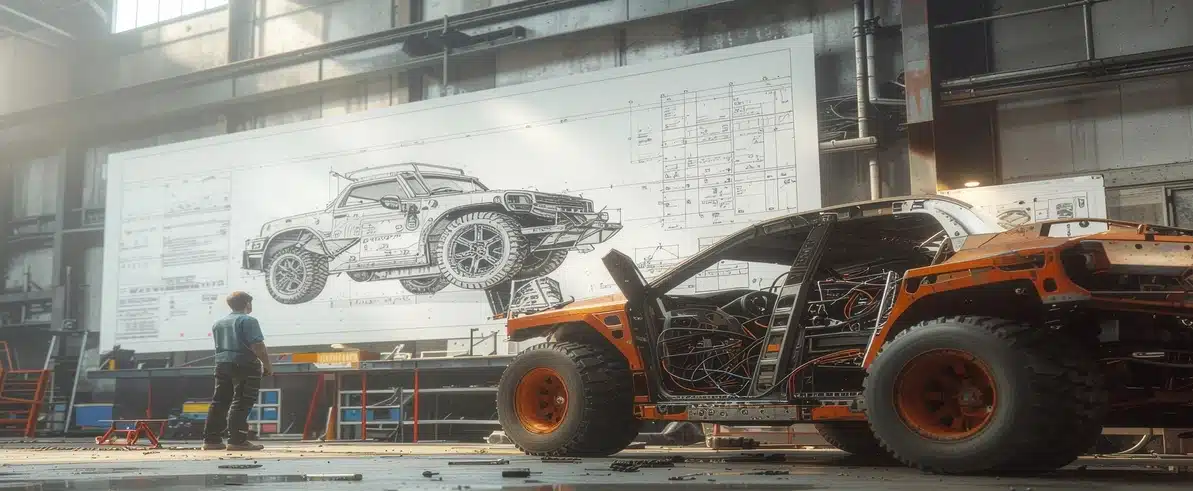
Preparing a vehicle for minesite access is rarely a simple checklist exercise. While all mine sites share a common foundation of safety requirements, the specific systems that need to be installed, the way those systems must be configured, and the documentation required to support access approval all vary between operators, sites, and vehicle types. Getting it right demands a structured design process, experienced technicians, and a quality assurance framework that produces the evidence needed to move vehicles through approval efficiently. This is the work that EIG carries out every day across both light and heavy vehicle platforms.
What Custom Minespec Systems Involve
A custom minespec system is a fitout that is designed and built around the specific requirements of a defined mine site or fleet of vehicles, rather than a generic template applied uniformly across all jobs. The distinction matters because mine operators in different states, with different operating environments and risk profiles, impose requirements that diverge in meaningful ways.
A surface mine in the Pilbara may require a different lighting specification to an underground operation in Queensland. A fleet of light vehicles used for personnel transport will have different electrical load requirements to a service truck carrying a hydraulic crane. Custom vehicle systems are the result of working through these differences systematically, starting with the site requirements and working backwards to determine what needs to be installed, how it needs to be configured, and what needs to be documented.
At a high level, minespec systems for both light and heavy vehicles typically include fire suppression, battery isolation, communications equipment, lighting, proximity detection pre-wiring, reflective decals, and first aid and safety equipment mounts. Beyond this common core, the specifics are determined by the site and the vehicle.
Light Vehicle Minespec Fitouts
Common Light Vehicle Requirements
Light vehicles, primarily utes, 4WDs, and crew cab variants, are the most common vehicle type requiring minespec preparation in the Australian resources sector. They are used for personnel transport, site supervision, maintenance runs, and a wide range of support functions. Their high volume makes efficient, repeatable fitout processes especially important.
Standard minespec requirements for light vehicles across most Australian mine sites include fire suppression systems, battery isolation switches accessible from outside the vehicle, amber beacons, reverse cameras and sensors, UHF radio and antenna, first aid kit mounts, safety equipment storage, bull bars, underbody protection, and load-rated tow hitches where towing is required. Tyres must meet minimum load and speed ratings for the operating conditions.
Payload and tow rating requirements have a direct bearing on fitout design. Each piece of equipment added to a vehicle contributes to its gross vehicle mass (GVM). Where GVM upgrades are required to accommodate the additional weight of fitout equipment, these must be engineered, certified, and documented before the vehicle is used on site. This is particularly relevant for utes used as dual-cab personnel carriers with a full fitout, where the combined weight of passengers, equipment, and safety gear can approach or exceed standard GVM ratings.
Designing for Light Vehicle Electrical Architecture
Light vehicles typically operate on 12V electrical systems. This architecture has finite capacity, and a full minespec fitout adds a significant electrical load through beacons, radios, lighting, reverse cameras, and auxiliary systems. Good design starts with a load calculation that confirms the vehicle’s standard electrical system can support the additional demand, and identifies where supplementary power management is required.
Wiring protection is a critical design consideration in light vehicle fitouts. Mine-spec vehicle fitout work in the resources sector must account for the vibration, heat, and contamination exposure that mine vehicles experience. Conduit, loom protection, and correct cable sizing are not optional extras, they are the difference between a system that performs reliably over a multi-year service life and one that generates intermittent faults and field failures.
Common failure points in light vehicle minespec fitouts include undersized wiring that overheats under sustained load, inadequate earthing that causes intermittent faults in communications and lighting systems, and poorly secured harnesses that chafe against chassis components and cause short circuits. Proper design at the outset addresses all of these risks.
Heavy Vehicle Minespec Fitouts
Heavy Vehicle System Complexity
Heavy vehicles, service trucks, lube trucks, water carts, crane trucks, and light towers, present a significantly more complex fitout challenge than light vehicles. Their 24V electrical systems, larger physical footprint, and the specialist equipment they carry all add layers of complexity to the design and installation process.
Heavy vehicle minespec fitouts often involve the integration of hydraulic systems, pneumatic systems, and specialist equipment packages alongside the standard minespec requirements. A service truck, for example, may carry a welding generator, tyre inflation equipment, fluid dispensing systems, and a workshop module, all of which need power, control wiring, and safety interlocks integrated into the vehicle’s overall electrical architecture.
The engineering rigour required for heavy vehicle fitouts is proportionally greater. Electrical load calculations must account for the simultaneous operation of multiple high-current systems. Wiring harnesses must be designed and routed to accommodate the vehicle’s service access requirements without creating hazards or impeding maintenance. Earth fault protection and isolation systems must be designed to meet the specific requirements of 24V heavy vehicle platforms.
Mine-Spec Vehicle Fitout for Specialised Applications
Some heavy vehicles require fitouts that go beyond standard minespec requirements due to the nature of their payload or operating environment. Explosives carriers, fuel tankers, and underground vehicles are subject to hazardous area classifications that prescribe specific equipment standards for electrical systems, lighting, and fire suppression.
In these applications, equipment selection must comply with the relevant hazardous area classifications under AS/NZS 60079 and related standards. Intrinsically safe equipment, explosion-proof enclosures, and zone-rated wiring systems are all relevant considerations depending on the specific hazard classification of the vehicle’s operating environment.
Certification for these specialised applications requires formal engineering assessment and documentation that goes beyond a standard minespec sign-off. EIG’s capability in custom vehicle systems extends to these complex applications, working with certifying engineers to produce the documentation required to support hazardous area approval.
The EIG Design Process
Site Requirement Assessment
Every fitout begins with a thorough assessment of the site requirements the vehicle must meet. This involves reviewing the mine operator’s equipment approval documentation, site safety management plan, and any specific technical requirements issued by the site’s engineering or safety team. Where site-specific documentation is not available, EIG draws on its knowledge of the standards and requirements common to each major mining region.
This assessment drives the design of the fitout. System selection, wiring architecture, mounting arrangements, and documentation structure are all determined by what the site requires, not by what is easiest to install. This approach is what distinguishes genuinely custom vehicle systems from standardised template fitouts.
Minesite-Ready Vehicle Preparation and Documentation
The documentation produced during and after a fitout is as important as the physical installation. Mine operators assess vehicles against their approved equipment lists using the documentation provided by the fitout team. Incomplete or inaccurate documentation is a common cause of access delays, even when the physical fitout is correct.
EIG’s minesite-ready vehicle preparation process produces a documentation package that includes the fitout specification, wiring diagrams, system descriptions, component data sheets, compliance certifications, and a completed pre-delivery inspection record. This package is structured to align with the documentation requirements of major mine operators, reducing the time and effort required to complete the access approval process.
Installation: Workshop and Field Capability
EIG’s Perth facility provides a fully equipped workshop environment for vehicle preparation. The workshop installation services available through the Perth facility give the team access to hoists, specialised tooling, electrical test equipment, and the workspace needed to carry out complex fitouts efficiently and to a consistently high standard.
For vehicles that cannot be brought to Perth, whether due to deployment constraints, fleet size, or operational timelines, on-site installation support provides the same technical capability in a mobile format. Field installation teams carry the equipment and documentation needed to complete fitouts at remote sites, staging areas, and operational mine locations across Australia.
Both delivery models follow the same quality assurance process. Every installation is subject to pre-work inspection, mid-installation checks, and a final sign-off inspection before the vehicle is released for site access assessment.
On-Site Commissioning Support
On-site commissioning support is the process of verifying that installed systems function correctly in the vehicle’s operating environment and that operators understand how to use them. It involves systematic testing of each installed system against its specification, followed by a handover process that covers operator responsibilities for pre-start checks, system activation, and fault reporting.
Commissioning is particularly important for integrated systems such as fire suppression and emergency shutdown, where incorrect operation in an emergency could have serious consequences. Operators who understand how these systems work and how to activate them correctly are significantly better prepared for emergency situations than those who have simply been handed a manual.
On-site commissioning support also provides an opportunity to identify and resolve any issues that arise during initial operation before they become field failures. Early identification of wiring faults, component failures, or configuration errors is far less costly to address than the same issues discovered during a shift on a remote mine site.
Quality Assurance and Certification
EIG’s quality assurance process is designed to produce consistent, documented outcomes that support both operational reliability and minesite access approval. Every fitout follows a structured process that begins with a pre-installation vehicle condition assessment, progresses through staged installation milestones with documented checks, and concludes with a final inspection and sign-off.
Certifying engineers are engaged where the fitout scope requires formal engineering certification, including GVM upgrades, structural modifications, hazardous area installations, and any modification that affects the vehicle’s original certification status. The resulting certification documents are included in the fitout documentation package and form part of the vehicle’s compliance history.
Engineered Installations Group structures its documentation to meet the requirements of major Australian mine operators, drawing on extensive experience with the approval processes used by operators in WA, QLD, and the NT. The capability statement provides procurement managers and fleet engineers with a detailed overview of EIG’s qualifications, service scope, and project experience.
Conclusion
Designing and installing minespec systems for light and heavy vehicles is a technically demanding process that requires deep knowledge of both the regulatory environment and the practical realities of mining operations. A fitout that looks complete on paper but fails to account for site-specific requirements, vehicle-specific constraints, or documentation standards will generate delays, rejection, and in-service failures. The investment in working with an experienced provider from the outset pays dividends at every stage of the process, from design through installation to first gate inspection. To discuss a minespec fitout for your light or heavy vehicle fleet, call +61 (08) 9419 7318 to speak with the EIG team.



Leave A Comment