
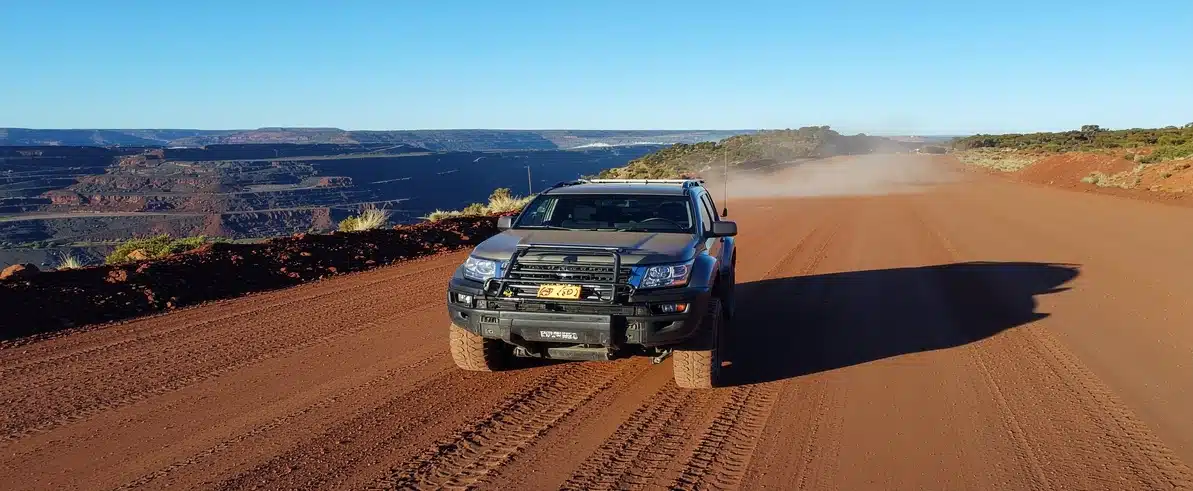
Every vehicle that enters an Australian mine site must meet a defined set of safety and equipment standards before it is permitted to operate. These standards, collectively referred to as “minespec,” exist to protect workers, safeguard equipment, and ensure that every mobile asset on a mine site is fit for one of the most demanding operating environments on earth. For fleet managers, contractors, and procurement teams working in the resources sector, understanding what minespec means, what it requires, and why compliance is non-negotiable is fundamental to safe and efficient operations.
What Does Minespec Mean?
The term “minespec” refers to the suite of modifications, systems, and equipment that must be installed on a vehicle before it is approved for use on a mine site. Unlike standard road-registered vehicles, minespec vehicles are purpose-built or purpose-modified to withstand the unique hazards present in mining environments, from high dust concentrations and uneven terrain to heavy plant traffic and the risk of fire or explosion.
Minespec is not a single national standard with a fixed list of requirements. Instead, it is a combination of state and territory legislation, industry codes of practice, and mine operator-specific requirements that collectively define what a compliant vehicle looks like. This means that a vehicle approved for one mine site may require additional modifications before it is accepted at another.
The term is used interchangeably across the industry to describe both the standard itself and the process of preparing a vehicle to meet it. When a site manager refers to a “minespec vehicle,” they mean a vehicle that has been assessed, modified, and documented to comply with the relevant requirements for that specific site and operation.
Mining vehicle standards in Australia are enforced seriously. Sites operate under strict safety management plans, and vehicles that do not meet the required specifications are turned away at the gate, regardless of how urgently they are needed on site.
The Regulatory Framework Behind Minespec Vehicles
State and Territory Legislation
The legal foundation for minespec compliance varies by jurisdiction, but the underlying intent is consistent across all Australian states and territories: mobile equipment operating in mining environments must be safe for operators, bystanders, and the broader site population.
In Western Australia, the primary legislative instrument is the Mines Safety and Inspection Act 1994, supported by the Mines Safety and Inspection Regulations 1995. These instruments place duties on mine operators to identify hazards, implement controls, and ensure that all plant and equipment, including vehicles, is fit for purpose in the mining environment.
In Queensland, the Coal Mining Safety and Health Act 1999 and the Mining and Quarrying Safety and Health Act 1999 establish similar obligations. The relevant regulations prescribe detailed requirements for mobile plant, including lighting, braking, rollover protection, and fire suppression.
In the Northern Territory, the Work Health and Safety (National Uniform Legislation) Act 2011 governs mining safety alongside the NT Mines Regulations. Each jurisdiction’s regulatory framework ultimately requires mine operators to develop and enforce site-specific standards, which are where minespec requirements become most detailed and prescriptive.
Industry Codes and Standards
Beyond legislation, minespec vehicles must often comply with a range of Australian and international standards that govern specific systems and components. Relevant standards include AS/NZS 2080 (safety of machinery), AS/NZS 3000 (wiring rules for electrical installations), and various ISO standards that govern fire suppression, proximity detection, and communications equipment.
Industry bodies such as the Minerals Research Institute of Western Australia (MRIWA) and state-based mining councils publish guidance documents and codes of practice that inform mine-spec compliance requirements. These documents are regularly updated as new technologies, incident analyses, and best practice guidelines emerge. Fitout providers working in this space must remain current with these standards to ensure that every vehicle they prepare continues to meet evolving requirements.
Why Mine-Spec Compliance Requirements Cannot Be Compromised
The mining environment presents a combination of hazards that do not exist in conventional road transport or industrial settings. Underground mines introduce the risk of flammable gas accumulation, low-clearance travel ways, and limited escape routes. Surface operations involve heavy plant moving at speed across terrain that is unpredictable and often unmarked.
Mine-spec compliance requirements exist to address these specific hazards. A vehicle without a functional fire suppression system poses a fire risk in a potentially explosive atmosphere. A vehicle without a working amber beacon is invisible to heavy equipment operators who rely on visual cues to avoid collisions. A vehicle without a properly installed battery isolation system cannot be safely de-energised in an emergency.
The consequences of non-compliance extend beyond the vehicle itself. Site managers and principal contractors carry a duty of care under workplace health and safety legislation that makes them directly liable for incidents involving non-compliant equipment. If a vehicle that has not been properly prepared for a mine environment is involved in an incident, the legal, financial, and reputational consequences for all parties involved can be severe.
Heavy vehicle safety certification is a formal expression of this duty of care. When a fitout provider certifies that a vehicle meets the required standards, they are providing documented assurance that the vehicle has been assessed, modified, and tested against the relevant specifications. That documentation forms part of the vehicle’s compliance history and is presented during site access assessments.
What Makes a Vehicle Minespec?
The specific requirements that define a minespec vehicle vary by site and operation, but a common set of systems and modifications applies across most Australian mining environments. These requirements cover electrical and power systems, structural and mechanical modifications, and communications and visibility equipment.
Electrical and Power Systems
Electrical systems are among the most critical components of any minespec vehicle. The mining environment places extreme demands on electrical equipment, vibration, dust, moisture, and temperature cycling all accelerate wear and create failure risk.
Key electrical requirements for minespec vehicles typically include:
- Fire suppression system integration: Automatic and manual fire suppression systems must be installed and correctly wired to the vehicle’s electrical system, with activation accessible from inside the cabin and externally.
- Battery isolation and emergency shutdown: A battery isolation switch, accessible from outside the vehicle, must be installed to allow rapid de-energisation in an emergency. This is a standard requirement across virtually all Australian mine sites.
- Secondary and emergency lighting: Additional lighting beyond standard road-going requirements is needed to ensure visibility in low-light and dusty conditions. Amber beacons, reverse lights, and undercarriage lighting may all be required depending on the site.
- Auxiliary power management: Many mine sites require auxiliary power systems to support communications equipment, monitoring devices, and safety systems without placing excessive load on the vehicle’s standard electrical architecture.
Structural and Mechanical Modifications
Beyond electrical systems, minespec vehicles typically require structural and mechanical modifications to withstand the physical demands of the mining environment.
Bull bars and underbody protection are standard requirements on most mine sites, providing protection against rock strikes and debris damage. Tow ratings must be confirmed and certified where vehicles are used to move trailers or equipment. Suspension upgrades may be required to handle the additional payload of fitout equipment and the rough terrain conditions common on mine haul roads.
Heavy vehicle safety certification considerations extend to any modification that affects the vehicle’s structural integrity or load-bearing capacity. Modifications to chassis, suspension mounts, or body structure must be assessed and certified by a qualified engineer to confirm that the vehicle remains safe under the loads it will encounter on site.
Roll-over protection and cab reinforcement requirements apply on sites where there is a risk of rollover due to terrain gradient or instability. These requirements are particularly common in underground mining environments and on sites with steep haul road grades.
Communications and Visibility
Communications and visibility equipment requirements are site-specific but consistently important. At minimum, minespec vehicles must be equipped with a UHF radio and antenna configured to the site’s communication channels. More complex sites may require integration with vehicle tracking systems, two-way data communications, or proximity detection pre-wiring.
Reflective decals and site identification markings are mandatory on virtually all mine sites. These ensure that vehicles are immediately recognisable as site vehicles, reducing the risk of confusion with contractor or visitor vehicles and improving overall site visibility.
Minesite access requirements related to communications are enforced strictly. A vehicle that arrives on site without a functioning UHF radio or with the wrong channel configuration may be refused access until the issue is resolved.
Minesite Access Requirements and the Pre-Start Process
Before a vehicle is approved for use on a mine site, it must pass through a formal assessment process. This process varies by operator, but typically includes a physical inspection of the vehicle by a site safety officer or equipment inspector, a review of documentation including fitout certificates and service records, and confirmation that the vehicle meets all site-specific requirements.
Documentation is a critical part of this process. A vehicle may be physically compliant in every respect, but if the documentation to support that compliance is incomplete or missing, access will be refused. Fitout certificates, compliance plates, and installation records must be present and accurate.
Common reasons vehicles fail minesite access checks include missing or non-functioning fire suppression systems, absent or incorrectly configured battery isolation switches, inadequate lighting, non-compliant tyre ratings, and missing reflective markings. All of these failures are preventable with thorough pre-delivery inspection and documentation review.
The Cost of Getting It Wrong
The consequences of deploying a non-compliant vehicle on a mine site go well beyond an inconvenient turn-away at the gate. If a non-compliant vehicle is involved in an incident, the financial, legal, and safety consequences can be significant for everyone in the chain of responsibility, from the vehicle owner to the contractor deploying it, the mine operator, and the individuals directly involved.
From a financial perspective, the costs include potential fines and penalties under workplace health and safety legislation, civil liability for damages arising from incidents, and the cost of remediation, which may include the removal, repair, and re-certification of the affected vehicle. Project delays caused by vehicle non-compliance can also generate substantial indirect costs, particularly on time-sensitive shutdowns or mobilisation schedules.
From an insurance perspective, non-compliant vehicles may not be covered under standard fleet or commercial vehicle insurance policies. If an incident occurs and it can be demonstrated that the vehicle did not meet the required standards, insurers may decline to pay out, leaving the vehicle owner exposed to the full cost of any damages.
The reputational consequences of non-compliance are also significant in a sector where contractor approvals and ongoing relationships with major mining companies are hard-won. A contractor with a history of deploying non-compliant equipment is unlikely to be invited back.
How Professional Fitout Services Support Minespec Compliance
Preparing a vehicle to meet minespec requirements is a technically demanding process that requires knowledge of both the relevant standards and the practical realities of mining operations. Attempting to manage this process without specialist support increases the risk of omissions, incorrect installations, and documentation failures, all of which can result in access refusal or, worse, an in-service failure.
Working with a professional fitout provider gives fleet managers and procurement teams access to technicians who understand mining vehicle standards from the ground up. A qualified fitout team will assess the vehicle against the specific requirements of the target mine site, identify all required modifications, and carry out installations to the documented standard. Pre- and post-installation quality checks provide a documented record of compliance that supports the minesite access assessment process.
EIG brings a depth of experience in preparing both light and heavy vehicles for Australian mine sites. The team works across a range of site-specific requirements and maintains current knowledge of the standards and codes of practice that govern minespec compliance in Western Australia, Queensland, and beyond.
The workshop installation services available through EIG’s Perth facility allow vehicles to be prepared efficiently in a controlled environment, with full access to the tools, equipment, and expertise needed to carry out complex fitouts to the required standard. For vehicles that need to be prepared at a remote location or are already deployed on site, field installation services provide the same level of technical rigour in a mobile format.
Understanding the Minespec Vehicle Approval Ecosystem
Minespec compliance does not exist in isolation. It is part of a broader vehicle approval ecosystem that includes manufacturer specifications, OEM modification requirements, insurance obligations, and mine operator management of change processes. Understanding how these elements interact is important for anyone responsible for managing a mining fleet.
Manufacturer specifications define the limits within which modifications can be made without voiding the vehicle’s warranty or affecting its structural certification. Modifications that exceed these limits must be assessed and certified by a qualified engineer, with documentation retained as part of the vehicle’s compliance history.
Mine operators manage changes to their approved equipment list through formal management of change processes. When a new vehicle type or modification is introduced, it must be reviewed and approved before it is permitted on site. This process can take time, and fleet managers who plan ahead by engaging their fitout provider early in the procurement process are better placed to meet deployment deadlines.
Engineered Installations Group supports clients through this process, providing documentation, certification support, and technical advice that helps move vehicles through the approval process efficiently. The team understands the documentation requirements of major mine operators and structures fitout records accordingly.
The capability statement available from EIG provides a detailed overview of the team’s qualifications, experience, and service capability, a useful reference document for procurement managers assessing fitout providers.
Conclusion
Minespec compliance is the standard that separates a vehicle that can enter a mine site from one that cannot. It reflects decades of accumulated knowledge about the hazards present in mining environments and the systems required to manage those hazards effectively. For fleet managers, contractors, and procurement teams operating in the Australian resources sector, understanding mine-spec compliance requirements is not optional, it is a core operational competency.
The investment in proper minespec preparation pays dividends in safety, operational continuity, and risk management. Vehicles that are correctly prepared arrive on site ready to work, pass inspection without issue, and perform reliably in demanding conditions. Those that are not face delays, rejection, and the potential for serious incidents. To discuss minespec vehicle preparation for your fleet, call +61 (08) 9419 7318 to speak with the EIG team.



Leave A Comment