
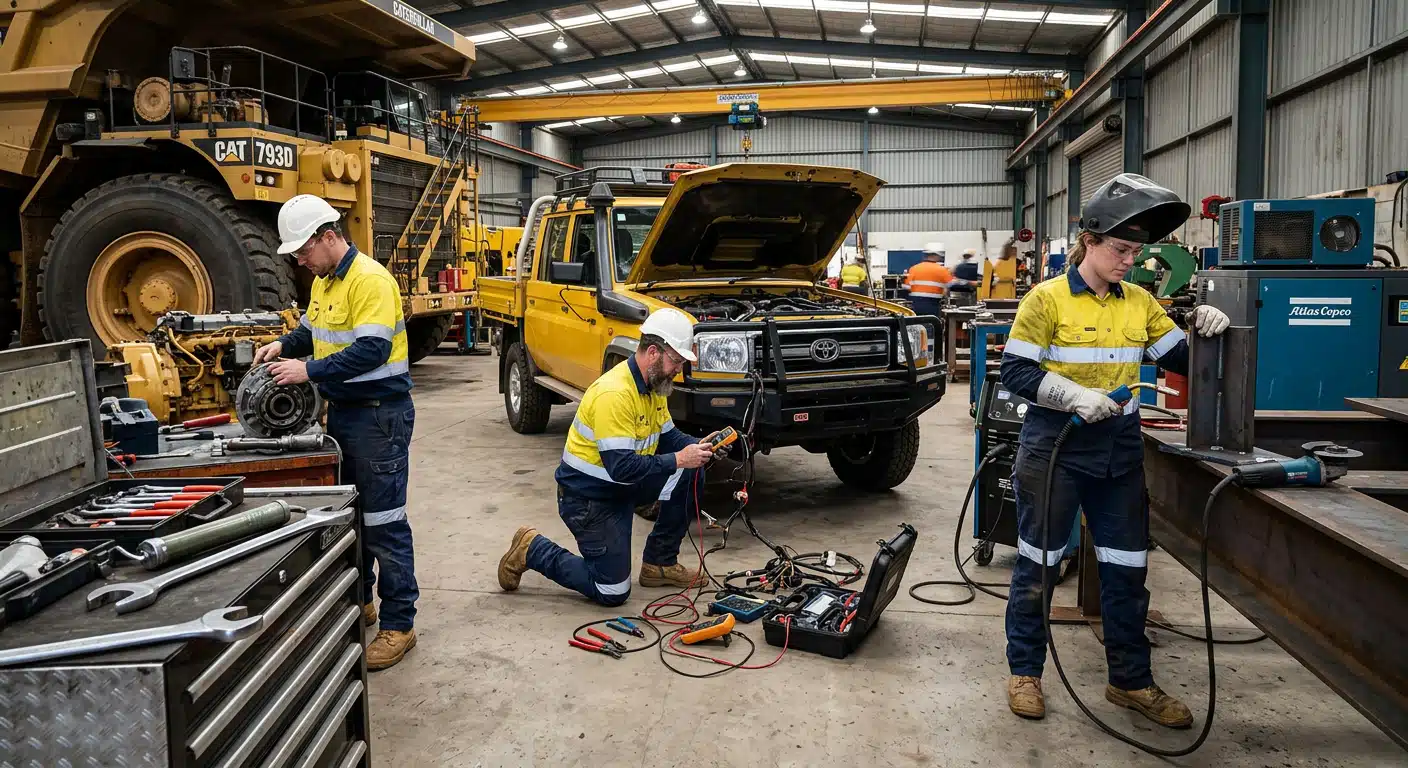
Mining projects depend on technicians who can operate safely, efficiently, and without delay from the moment they arrive on site. This requires more than technical qualifications,it requires real site readiness aligned with project conditions, safety requirements, and task-specific demands.
Auto electrical, HD mechanical, and boilermaker work each involve different risks, tooling requirements, and operational constraints, which means technician selection must be matched carefully to the actual work scope.
Site-Ready Technicians Need More Than a Trade Label
A site-ready technician model is based on capability matching, not just trade classification. Each technician must align with the asset type, job scope, site rules, and project timeframe to check safe and efficient execution.
In practice, the engineering team provides labour hire for skilled industrial and technical personnel. That matters when mining project labour needs practical readiness.
A broad trade label is not enough for remote mining work. The task may need specific systems knowledge, permits, tooling or shutdown experience.
Auto electrical cover is a trade on that list, not a generic technician title.
Mining Project Labour Must Match the Actual Work Pack
Site-ready trade crews are booked against the task list, not a blank call.
In practice, mining project labour should be planned against a clear work pack. That work pack should define task scope, access, documentation and quality checks.
On-site services can support installation, commissioning and maintenance. That field context helps labour planning stay tied to delivery.
Auto electrical work may involve harness routing, fault finding or safety system installation. HD mechanical work may involve service access and heavy equipment constraints.
Workshop Support Can Improve Field Readiness
Field crew deployment is what happens once site-ready technicians leave Forrestdale or Paget.
Field crews work better when workshop planning has already resolved avoidable uncertainty. Parts, drawings and tooling should not be guessed on site.
For Perth-linked work, metro services can support preparation and technical coordination. This can reduce pressure before remote mobilisation.
Preparation also helps supervisors understand the crew mix. A site may need one technician, or a blended team across electrical and mechanical tasks.
Electrical Tasks Need Engineering Backing
Perth crew staging can happen before the regional leg.
Some labour requests carry design risk. Electrical integration, schematics and harness changes may need engineering input before field work begins.
Electrical engineering solutions can support schematics and harness design. That reduces the risk of labour being sent without enough technical direction.
A technician should not have to solve unclear architecture alone during a shutdown. Better planning protects time, safety and quality.
The Engineering Team Connects Labour With Practical Delivery
Engineered Installations Group supports mining, heavy vehicle and industrial environments. Its labour model sits beside design and field support services.
That connection is useful when a project changes quickly. It gives the crew a stronger base for decisions, escalation and documentation.
In practice, site-ready technicians are most effective when they arrive with the right task brief, parts plan and support pathway.
Trade Coordination Before Site Arrival
Auto electrical, HD mechanical and boilermaker support should not be planned in separate silos. Each trade can affect the same asset during the same work window.
Parts that have to travel with those trades can be staged as crew parts kits.
A wiring change may alter access to guards or storage. A mechanical task may expose the need for cable protection or revised brackets.
This is why site-ready technicians need a shared work pack. The work pack should show responsibilities, handover points and inspection requirements.
Supervisors also need a clear escalation path. If a technician finds a design issue, the project should not stall while ownership is debated.
Practical Readiness Checks for Mining Project Labour
Engineered Installations Group can stage those trades from the Forrestdale or Paget workshop.
In practice, mining project labour should be checked against the real site context. The site may need inductions, access permits, VOC evidence and plant-specific experience.
Tooling is another readiness factor. A qualified technician still needs the right equipment, parts and test gear for the job.
Communication also matters during remote work. Crews should know who approves changes, who records completion and who receives close-out notes.
The goal is simple. A technician should arrive ready to complete a defined task, not discover the task for the first time.
Close-Out Quality After Technician Supply
Supplying technicians is only part of the job. The close-out record should show what was completed, what changed and what still needs attention.
For auto electrical work, this may include test results, routing notes and remaining access issues. For mechanical work, it may include component condition and service notes.
Boilermaker tasks may need inspection comments, photographs or measurements. These details help the client understand whether the asset can return to service.
What the crew is booked to do should be read as a crew scope list before the shift is locked.
A strong close-out process also protects the next job. Future crews can see what was done instead of reopening the same questions.
When a Blended Crew Is the Better Option
Some mining jobs need more than one trade on the same asset. A blended crew can reduce handover gaps when tasks overlap.
For example, a tray change may expose electrical routing needs. A wiring upgrade may need bracket changes or guard modifications.
Planning those roles together can reduce duplicated site visits. It can also improve accountability during short project windows.
FAQ
Why Does Site-Ready Technician Planning Matter for Mining Projects?
Mining projects often have tight access windows. Site-ready planning helps align skills, documentation and tools before work starts.
What Trades Are Often Needed for Mining Support?
Common roles include auto electrical technicians, HD mechanical technicians and boilermakers. The exact mix depends on the asset and task scope.
How Does Workshop Preparation Help Field Crews?
Workshop preparation can confirm parts, drawings and work sequence. It reduces avoidable uncertainty once the crew reaches site.
Where electrical and mechanical trades meet on the same asset, that is a trade interface plan.
What Evidence Should Be Checked Before Mobilisation?
The task owner should check competencies, inductions, tooling needs and technical documentation. These records help protect the work window.
What to Settle Before the Job Moves
The site-ready technician’s decision is easier when the asset, the site rule and the access limit are written down first. A verbal brief tends to drop the one constraint that changes the fit.
Pair that note with mining project labour. The field step should use the same names for parts, mounts and records, or the workshop file and the site file drift apart.
Records That Should Travel With the Asset
A useful site-ready technicians pack names of what was checked, what was fitted and what still needs a site look. It is a work record, not a promise that the asset will perform a certain way.
Photos of access, a parts list and the open questions on mining project labour are more useful than a slogan on the cover sheet.
Where Workshop Work Stops and Field Work Starts
Preparation for site-ready technicians can be done before travel. The site still has to confirm access, the people and the task on the day. This is not bench fabrication.
That is why mining project labour still needs a named handoff. The person who booked the crew and the person who sees them on site should be looking at one list.
Questions Worth Asking Before Fabrication
Ask where the site-ready technicians work will be inspected, who signs the site record, and which part has to stay reachable. Those answers change the job more than a generic label.
ID marks on the crew vehicle, when that vehicle is in the same job, are crew vehicle marks, not part of the labour title.
Use mining project labour as the second check, not as a new topic. If the second check disagrees with the first sketch, stop and revise the sketch before metal or film is cut.
If the shutdown needs auto electrical or boilermaker cover, speak with us and send the shift dates.
Site-ready technicians are only useful if the work pack is real. The pack should name the task, the access, the records and the quality check before anyone is booked. Auto electrical, heavy mechanical and boilermaker cover are different jobs. Sending the wrong trade because the title sounded close is how a shutdown loses the first shift. Confirm the asset, the shift dates and who supervises before travel is locked.



Leave A Comment