
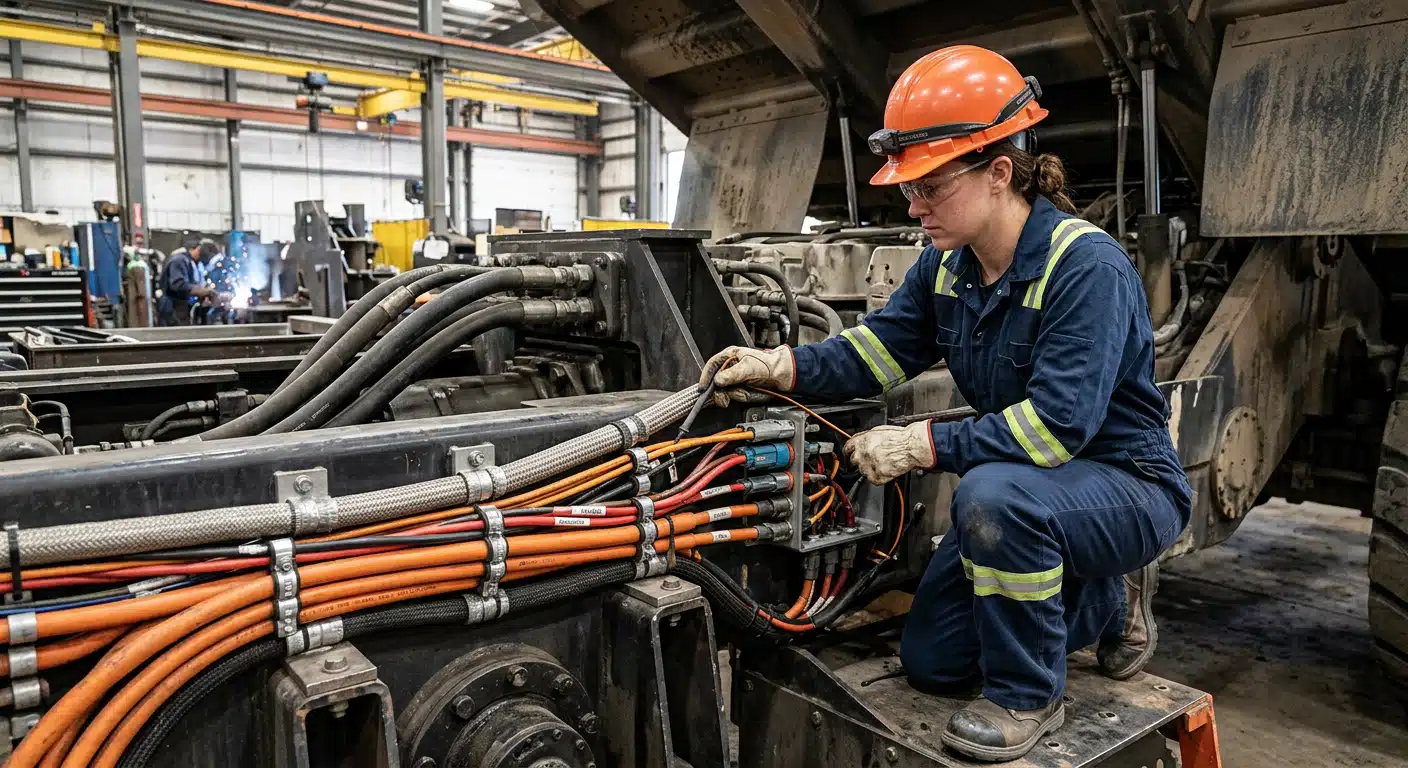
In practice, high-voltage harness routing changes the risk profile of electrified mining machinery. Cable paths must protect people, energy systems, control signals and service access.
Mining assets also face heat, dust, vibration, washdown exposure and tight packaging. Those conditions make harness routing an engineering task, not a neat wiring exercise.
High-Voltage Harness Routing Starts With the Whole Machine Layout
In practice, high-voltage harness routing needs a full view of the machine. A safe route must account for battery location, drive components, service panels and moving structures.
A cable path that looks tidy on paper can fail in the field. It may sit too close to heat, abrasion, pinch points or hydraulic movement.
Engineered routing starts by mapping the electrical loads and physical constraints. Engineered Installations Group’s electrical engineering solutions support that planning through schematics and harness design.
Repeat loom parts for the same machine class can be held as harness repeat kits.
Why Electrified Mining Machinery Creates New Routing Pressure
In practice, electrified mining machinery carries higher energy density than many legacy auxiliary systems. That makes separation, protection and inspection access more important.
Routing also needs future service logic. A technician should not need to disturb high-voltage runs for routine access to low-voltage controls.
Poor routing can create heat build-up, vibration fatigue or unclear isolation paths. Each of those is a risk to plan for, not a promised result.
Electrical Separation Matters for Safety and Signal Reliability
Harness design sets the loom path before high-voltage harness routing is treated as finished.
High-voltage, low-voltage and communication circuits should not be treated as one cable bundle. They carry different risks and need different protection logic.
Separation helps reduce electrical noise and accidental contact risk. It also helps maintenance teams understand which systems require isolation before work starts.
On complex machines, system design should define the architecture before installation. That makes routing a controlled design decision rather than a late site workaround.
Avoiding Heat, Abrasion and Interference
Mining machinery often has hydraulic lines, rotating components and hot surfaces near available cable pathways. Those areas need strict routing discipline.
Protective conduit can help, but it cannot fix a poor path. The more controlled route keeps harnesses away from damage sources wherever practical.
Signal cables also need protection from interference. Sensor readings, control signals and safety functions can suffer when routing ignores electrical noise.
Harness Routing Should Support Inspection and Isolation
Integrated routing joins the structure and the electrical path so the fit is not left to the last hour.
Mining operators need electrical systems that can be inspected, isolated and maintained. A hidden high-voltage route may look clean but create service problems.
Access points should support planned checks without exposing technicians to unnecessary hazards. Labelling, documentation and clear connection points matter.
On-site services can support installation and commissioning where machinery cannot be moved easily. Field execution still needs strong design control.
Service Access Is Part of the Design
A route should allow technicians to see clamps, sleeves, connectors and vulnerable bends. Those details can reveal wear before a fault appears.
Service access also affects shutdown planning. A difficult harness path can make an inspection longer than expected during a limited maintenance window.
Good design considers the whole maintenance life of the asset. That approach suits equipment expected to operate in harsh mine environments.
Structural and Mounting Checks Reduce Long-Term Harness Damage
In practice, high-voltage harness routing depends on the structure around it. Brackets, penetrations, guards and mounting points must suit real machine movement.
Where routing passes through a frame or enclosure, design validation can help identify stress points. This is important when battery systems or power electronics add weight.
If the mount question is structural load rather than cable path, that is harness mount loads.
Engineered Installations Group provides finite element analysis for structural simulation. That can support safer mounting decisions on heavy vehicle and industrial systems.
Vibration Must Be Treated as a Design Input
Engineered Installations Group can route that harness work from the Forrestdale or Paget workshop.
Vibration can loosen clamps, fatigue terminals and wear through protective sleeving. Mining machinery often creates vibration that ordinary road equipment does not see.
Harness routing should include bend radius, support spacing and movement allowance. These details help protect high-voltage connections from repeated stress.
For difficult machinery, vibration data analysis can help identify dynamic risks. That evidence can inform better mounting and dampening choices.
Custom Harness Work Helps Avoid Field Compromises
Mount shock checks come before a high-voltage harness routing mount is treated as ready for site duty.
In practice, electrified mining machinery rarely leaves enough space for generic harness assumptions. Cable length, connector type, protection and routing all need asset-specific decisions.
Custom harness planning can reduce rework. It can also keep the installation clearer for future upgrades or fault finding.
For heavy vehicle and mining applications, Engineered Installations Group works across design, manufacture and installation support. That service mix helps keep routing decisions connected to practical field delivery.
Documentation Should Match the Installed Asset
A safe harness installation should be supported by accurate documentation. Drawings should reflect final routing, connection points and isolation details.
That documentation becomes useful during inspections, modifications and fault diagnosis. It also helps new technicians understand the system without guesswork.
Without accurate records, even a good installation can become harder to manage later.
FAQ
3D route capture is the check when a clash is hard to see on a sketch.
Why Is High-Voltage Harness Routing Different From Standard Wiring?
High-voltage systems carry greater energy and safety risk. They need controlled separation, protection, isolation planning and service access.
What Causes Harness Damage on Mining Machinery?
Common causes include vibration, abrasion, heat exposure, sharp edges, poor clamping and movement near hydraulic or mechanical systems.
Should Routing Be Planned Before Installation Starts?
Yes. Routing should be part of electrical architecture and mechanical layout planning. Late routing decisions often create service or safety compromises.
Can Existing Machinery Be Upgraded Safely?
Upgrades can be safe when the system is assessed properly. The machine layout, power loads, protection, access and documentation all need review.
What to Settle Before the Job Moves
A field harness check covers what the Forrestdale or Paget workshop cannot see.
The high-voltage harness routing decision is easier when the asset, the site rule and the access limit are written down first. A verbal brief tends to drop the one constraint that changes the fit.
Pair that note with electrified mining machinery. The field step should use the same names for parts, mounts and records, or the workshop file and the site file drift apart.
Records That Should Travel With the Asset
A useful high-voltage harness routing pack names what was checked, what was fitted and what still needs a site look. It is a work record, not a promise that the asset will perform a certain way.
Photos of access, a parts list and the open questions on electrified mining machinery are more useful than a slogan on the cover sheet.
Where Workshop Work Stops and Field Work Starts
Some preparation for high-voltage harness routing can be finished at Forrestdale or Paget. What remains depends on the asset as it sits on the day, not on a generic bench claim.
That is why electrified mining machinery still needs a named handoff. The person who did the workshop work and the person who sees the asset on site should be looking at one list.
Questions Worth Asking Before Fabrication
Ask where the high-voltage harness routing work will be inspected, who signs the site record, and which part has to stay reachable. Those answers change the job more than a generic label.
What the harness job includes should be read as a harness scope list before a task is assumed.
Use electrified mining machinery as the second check, not as a new topic. If the second check disagrees with the first sketch, stop and revise the sketch before metal or film is cut.
When the harness route still needs an access check, reach out to us with the machine layout.
High-voltage harness routing still has to be drawn against the real machine, not a generic loom sketch. Note the battery location, the moving joints and the service panels before the route is called finished. Separation, protection and a way to inspect the path matter more than a neat diagram. Brackets and penetrations have to suit the movement the machine actually makes. Write the route down so the next fitter is not reconstructing it from memory.



Leave A Comment