
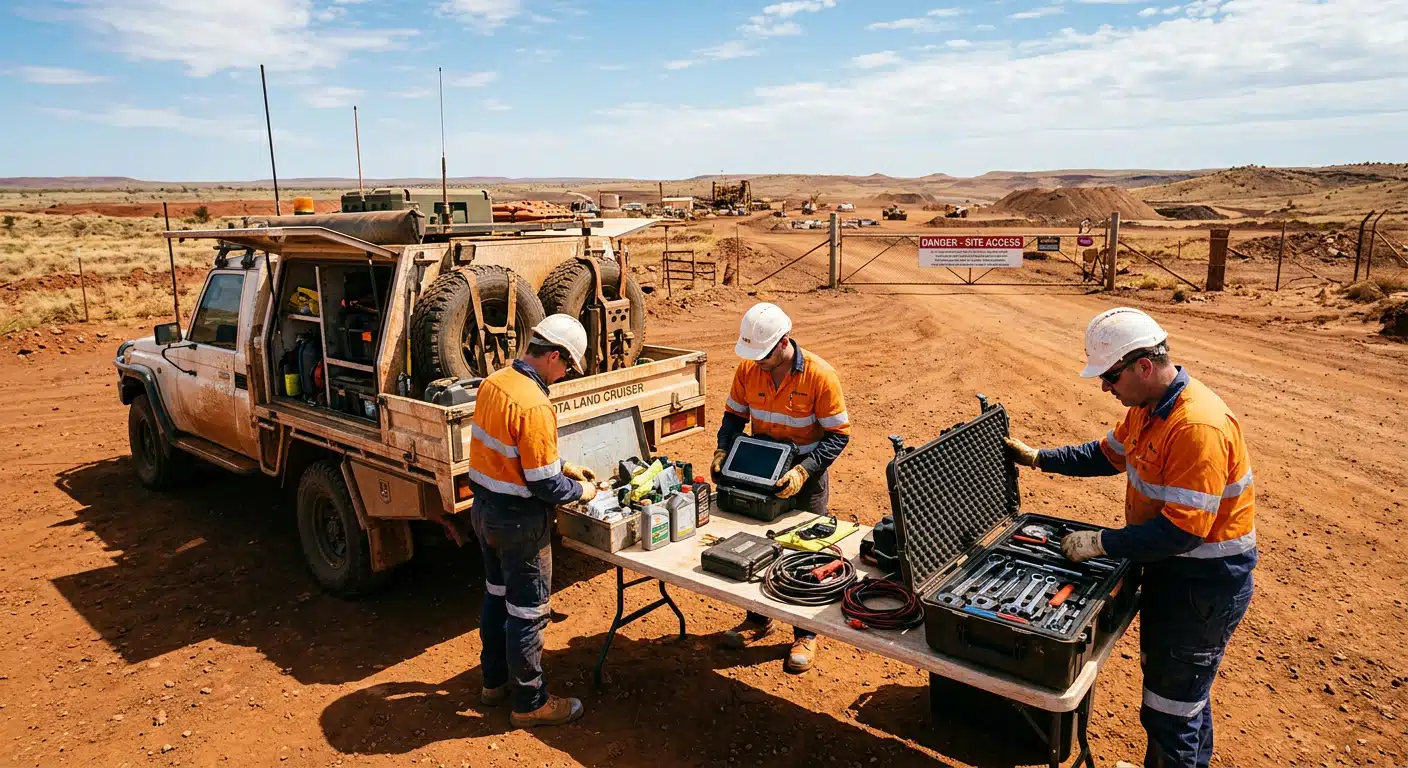
In practice, field mobilisation is one of the hardest parts of remote site work. The technical task may be clear. The job can still fail if labour, parts, documents, travel and site access are not aligned before mobilisation.
In practice, remote site resourcing across Western Australia and Queensland needs disciplined planning. Mining and heavy vehicle projects often operate in locations where missed details create expensive delays.
Field Mobilisation Begins Before a Technician Leaves Base
In practice, field mobilisation should start with a clear understanding of the asset, the site and the reason support is needed. A vague request for labour can lead to the wrong skills, missing parts or unclear expectations on arrival.
Good mobilisation planning asks practical questions early. What equipment is involved? What work can be prepared off site? What site access rules apply? What drawings, tools or parts must travel with the technician?
Engineered Installations Group supports mining, transport and heavy vehicle environments where these questions matter. Remote work needs planning that connects technical capability with site reality.
If the mobilised job includes a loom, that pack is a mobilisation loom pack, staged before travel.
Why Remote Work Punishes Loose Planning
Remote sites leave little room for improvisation. If a part is missing or a document is incomplete, the delay may involve travel, accommodation, production windows and other mobilisation.
That is why field planning should be treated as part of the technical job. The checklist is not only administration. It protects the installation, the technician and the client’s schedule.
A strong mobilisation process reduces preventable rework before the site visit begins.
Remote Site Resourcing Requires the Right Skills and Evidence
Remote field work is the point of field mobilisation once the crew leaves Forrestdale or Paget.
In practice, remote site resourcing is not just about headcount. A mine site may need an auto electrical technician, a heavy duty mechanical technician, a boilermaker, a field installer or a combination of roles.
The skill mix should match the job scope. Electrical architecture, harness routing, mechanical fitment, safety signage and storage installations each create different requirements.
Engineered Installations Group’s labour hire services support clients that need skilled industrial and technical personnel. This can include project work, site support and labour gaps.
Matching Competence to the Task
A technician sent to site should be matched to the asset and the risk. For example, high voltage related routing needs a different review from a toolbox fitment. Signage installation creates different quality checks from a braking or suspension upgrade.
The mobilisation plan should capture those differences. It should also confirm what can be resolved by the field technician and what needs engineering review before work continues.
This avoids placing too much judgement pressure on site personnel when the issue should have been designed or clarified earlier.
WA and Queensland Bases Help Stage Work for Regional Sites
Metro staging can happen before the remote leg, and it is not the workshop.
Western Australia and Queensland are large operating regions with major mining and industrial corridors. A support model that uses bases in those regions can stage work more sensibly than a single point of response.
A regional base can help with pre-packing parts, checking tools, reviewing drawings and confirming whether equipment needs workshop inspection before field mobilisation.
Engineered Installations Group’s on-site services are relevant when equipment needs field installation, commissioning or maintenance. They also support technical work that cannot be handled remotely.
Parts that have to travel with the crew are mobilisation parts kits, not a loose box of spares.
Workshop Preparation Supports Field Crews
Field crews perform better when the base has already done the right preparation. Components can be labelled, installation notes can be checked and missing information can be chased before travel.
Preparation also gives the client a clearer expectation of what will happen on site. If a task depends on access, weather, isolation requirements or production timing, that should be known before the technician arrives.
Remote site work becomes safer and more predictable when preparation is treated as a technical discipline.
Mobilisation Planning Should Include Documentation and Site Records
Extra hands for that window are shutdown crew supply, booked against the task list.
Mining sites usually require documentation before a technician can begin work. That may include inductions, permits, competency records, job safety information and proof that the person is suitable for the site.
The mobilisation process should check these requirements early. It should also confirm whether lockout, isolation or equipment access rules affect the timing of the work.
For technical tasks, documentation should include drawings, installation notes, parts lists and change records where relevant. This helps the field team understand the approved scope.
Site Records Is Part of Delivery Quality
Engineered Installations Group plans mobilisation from the Forrestdale or Paget workshop before travel.
Site records should not be treated as a final gate after the job is planned. It should shape the plan from the start.
If the site requires specific documentation or task sequencing, the field programme needs to account for it. If equipment access is limited to a shutdown window, all materials and instructions need to be ready before that window opens.
A field team can only deliver well when it has the right authority, information and resources.
Technical Design and Field Delivery Need to Stay Connected
Remote site mobilisation often exposes the gap between a design idea and practical equipment access. A drawing may look correct, but the asset may have space constraints, vibration exposure or routing challenges that need field judgement.
That is why technical design and field delivery should stay connected. A field technician should be able to raise a design concern without creating confusion about authority or scope.
Engineered Installations Group’s system design services support structured review before installation. Electrical engineering solutions can also support architecture, routing and integration decisions.
What the mobilisation includes should be checked against a mobilisation scope list before travel is booked.
Feedback From Site Improves the Next Mobilisation
Remote work creates useful feedback. If the same access issue appears across several vehicles, the design or kit preparation may need to change.
That feedback should return to the workshop and engineering process. It can improve the next mobilisation by refining parts, drawings, storage layouts, cable routes or installation steps.
A good field support model learns from site conditions rather than treating every job as isolated.
Scaling Resources Without Losing Control
Scaling resources is necessary during shutdowns, project backfill and peak workload periods. The risk is that speed can dilute quality if the provider sends people without enough structure behind them.
The safer approach is to scale around defined scopes, role requirements and preparation steps. Extra labour should fit into a controlled delivery model, not replace one.
For heavy vehicle and mining work, this may include kit preparation, tool checks, supervisory review and a clear escalation path for unexpected site findings.
FAQ
What Does Field Mobilisation Include?
In practice, field mobilisation includes labour selection, travel planning, site access, parts staging, documentation, tools, drawings and confirmation of the work scope before technicians arrive on site.
Where structure and electrics meet on the asset, that is a field interface plan, not a decision left to the first shift.
Why Is Remote Site Resourcing Difficult?
Remote sites have limited flexibility. A missing part, unclear drawing or unsuitable technician can create delays that are expensive to fix after mobilisation.
When Should Workshop Work Happen Before Site Work?
Workshop work should happen when equipment inspection, parts preparation, fabrication, wiring review or kit assembly can reduce uncertainty before field installation.
How Can Mining Clients Reduce Mobilisation Risk?
Clients can reduce risk by confirming the scope, providing site requirements early, checking technician competency needs and allowing time for parts and documentation review.
What to Settle Before the Job Moves
The field mobilisation decision is easier when the asset, the site rule and the access limit are written down first. A verbal brief tends to drop the one constraint that changes the fit.
Pair that note with remote site resourcing. The field step should use the same names for parts, mounts and records, or the workshop file and the site file drift apart.
Records That Should Travel With the Asset
A useful field mobilisation pack names what was checked, what was fitted and what still needs a site look. It is a work record, not a promise that the asset will perform a certain way.
Photos of access, a parts list and the open questions on remote site resourcing are more useful than a slogan on the cover sheet.
Where Workshop Work Stops and Field Work Starts
Some preparation for field mobilisation can be finished at Forrestdale or Paget. What remains depends on the asset as it sits on the day, not on a generic bench claim.
A clash that is hard to see before travel can be captured as a pre-travel fit scan.
That is why remote site resourcing still needs a named handoff. The person who booked the crew and the person who sees them on site should be looking at one list.
Before a remote crew is mobilised, contact us with the parts and induction list.



Leave A Comment