
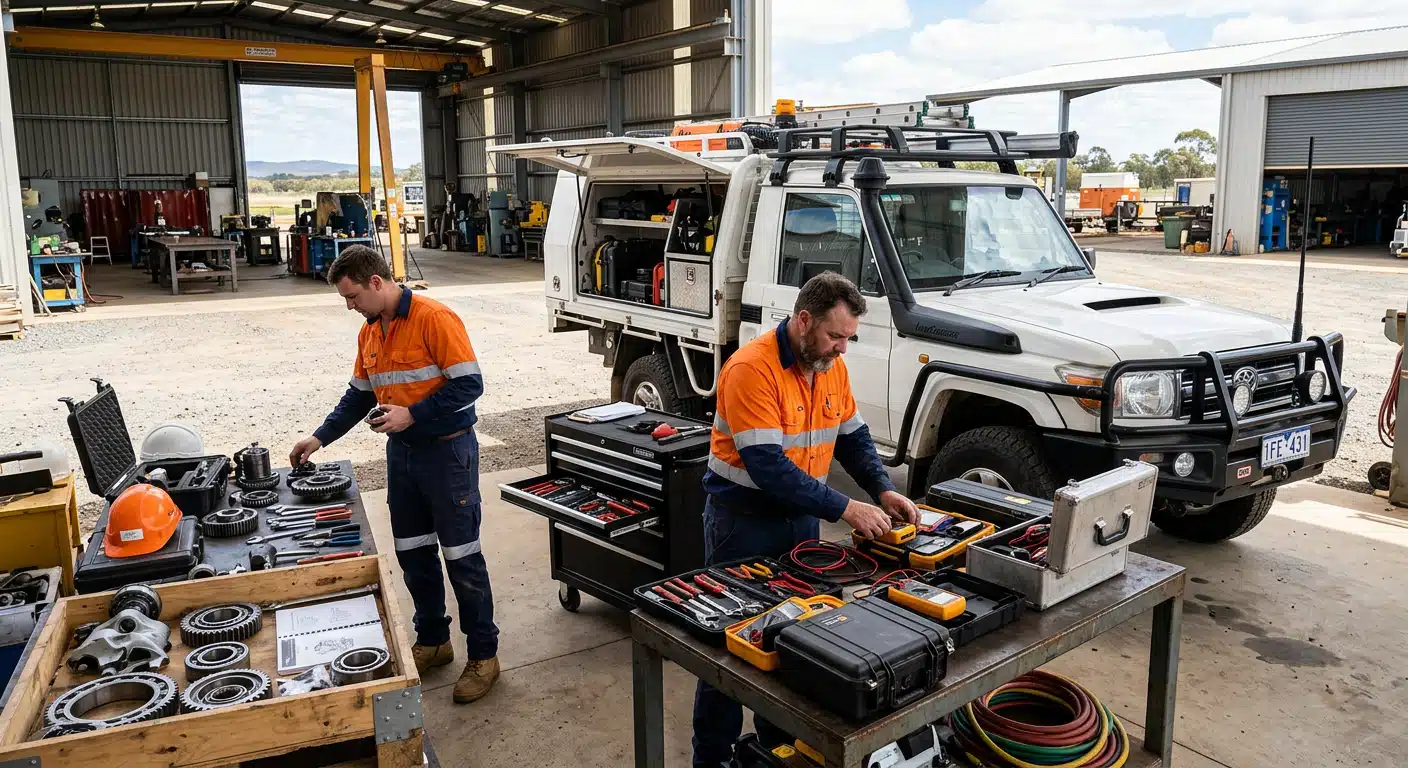
Australia-wide engineering support needs more than a willingness to travel. It needs practical bases, repeatable systems, clear technical handover and the ability to scale field support without losing control of quality.
For mining, transport and industrial clients, the location of those bases matters. Western Australia and Queensland both support major resource, heavy vehicle and industrial activity, which makes them useful anchors for national work.
Australia-Wide Engineering Support Starts With Strong Regional Bases
Australia-wide engineering support works best when national coverage is built from real operating locations. A mobile team still needs places where equipment can be inspected, parts can be staged and project information can be coordinated.
Western Australia and Queensland operations give a service provider access to two important mining and transport regions. They also help reduce dependence on a single workshop or a purely remote management model.
Engineered Installations Group operates in heavy vehicle, mining, transport and industrial settings. That service mix suits clients that need support across multiple operating areas rather than one local job.
Extra hands for a shutdown in either state, when needed, are national crew cover booked against the task list.
Why a National Model Still Needs Local Detail
A national support model can fail when it treats every site as the same. Mine specifications, vehicle use, climate exposure, access rules and shutdown windows can change from one region to another.
Local detail helps prevent generic decisions. A Western Australian asset may need a different mobilisation plan from a Queensland asset because freight, site access and available labour differ.
A useful national provider should keep enough structure to be consistent and enough flexibility to fit the actual site.
WA Queensland Operations Help Balance Workshop and Field Work
Australia-wide engineering support still needs multi-site field work when the asset is not at Forrestdale or Paget.
WA Queensland operations can support both workshop preparation and field delivery. This is important because not every task belongs on site and not every task can be solved in a workshop.
Some jobs need pre-fitment, fabrication checks, wiring review or storage layout planning before a vehicle moves. Other jobs need technicians to work around live site conditions, commissioning requirements or equipment that cannot be brought to a metro base.
Engineered Installations Group’s metro services and on-site services show that distinction. Metro work can support planned inspections and preparation, while field work supports installation, maintenance and site based requirements.
Matching the Delivery Mode to the Job
The delivery mode should be chosen by the asset and the risk, not by convenience. A wiring harness route might need workshop review before site installation. A maintenance issue might need field access because the machine cannot leave the site.
The same applies to tray fitment, safety signage, electrical architecture and mechanical support. Each task needs a practical decision about where the work can be completed properly.
Regional bases make that decision easier because they provide more than one path to delivery.
National Support Depends on Repeatable Technical Documentation
The Perth side of that coverage is a Perth metro base, not a second workshop.
Engineering support across Australia depends on documentation. Without drawings, installation notes, parts records and agreed standards, each new region can become a fresh interpretation of the same problem.
For heavy vehicle and mining clients, that creates risk. A fleet may operate across multiple sites but still need consistent wiring, signage, storage and safety layouts.
A loom that has to match in both states is cross-site loom work, drawn before the cable is cut.
Engineered Installations Group’s system design services are relevant here because integrated mechanical and electrical architectures need structured thinking. A design decision made for one asset should be clear enough to support future fit-outs or revisions.
Documentation Protects Future Maintenance
Good documentation helps the next technician understand what was changed and why. It also helps the client check whether a future fault is related to the original installation, a later modification or normal site wear.
This is especially important for national fleets. Vehicles may move between regions, and maintenance teams may not have direct access to the person who completed the original work.
Clear records reduce guesswork. They also support safer and faster follow-up work.
Australia-Wide Work Often Needs Multiple Disciplines
A national mining or transport project rarely sits inside one discipline. It may involve electrical engineering, mechanical fitment, field labour, storage systems, decals, vibration review or structural validation.
That means the provider must understand how disciplines interact. Electrical changes can affect maintenance access. Storage layouts can affect weight distribution and operator workflow. Signage placement can affect site visibility and identification.
Structures and electrics that have to agree across sites are a cross-site system fit, not a last-hour guess.
Electrical engineering solutions support complex decisions around power, control and routing. Finite element analysis can also support structural questions where design integrity matters.
Avoiding Fragmented Delivery
Engineered Installations Group uses the Forrestdale and Paget workshops as the two bases for this work.
Fragmented delivery happens when one part of the job is completed without understanding the next part. A harness may be routed neatly but placed where future service access becomes difficult. A toolbox may be strong but poorly matched to the vehicle’s use.
A connected engineering support model reduces that problem. It encourages early discussion between the people designing, fitting, inspecting and maintaining the equipment.
For national clients, this reduces the chance that different regions produce different standards.
Labour Capacity Must Scale Without Losing Site Readiness
Australia-wide support also depends on labour capacity. A client may need short term technicians, project backfill, shutdown support or crews for remote site work.
Scaling labour is not only a numbers exercise. The people sent to site need the right trade background, documents, inductions and understanding of the work scope.
Engineered Installations Group’s labour hire capability supports this part of the model. It gives clients a pathway for technical personnel when an internal team cannot cover the workload alone.
Site Readiness Matters More Than Availability
An available technician is not automatically the right technician. Mining and transport work may require site familiarity, safety documentation, relevant experience and the ability to work under tight access windows.
Site readiness should be checked before mobilisation. This includes role requirements, travel timing, permits, equipment access and any site specific site records documents.
A clash that is hard to see on a sketch can be captured as a cross-site fit scan before metal is cut.
A national support partner should be able to manage these details without pushing the administrative burden back onto the client.
What Clients Should Expect From a National Engineering Partner
Clients should expect a partner to explain how national support is delivered in practice. Broad coverage claims are not enough. The delivery model should show how workshops, field teams, labour capacity and documentation fit together.
They should also expect honesty about constraints. Some work may need site access. Some work may need workshop inspection. Some work may need additional engineering review before installation.
The best Australia-wide engineering support is practical, not vague. It gives clients clear pathways for planning, mobilisation, delivery and follow-up.
FAQ
Why Are Western Australia and Queensland Useful Bases for National Support?
Both regions connect to major mining, transport and industrial activity. They provide practical anchors for field mobilisation, workshop preparation and technical coordination.
Can National Engineering Support Be Managed From One Office?
Some coordination can be centralised, but practical delivery still needs access to equipment, labour, parts and regional site knowledge. Strong local bases reduce that gap.
The same fitting, repeated across sites, is easier to hold as repeat national kits.
What Makes National Support Different From Local Workshop Support?
National support must maintain consistency across regions. It needs documentation, repeatable work standards and a clear process for site and workshop decisions.
How Can Clients Reduce Risk in Multi-Site Engineering Work?
Clients should insist on clear scopes, documented changes, consistent fit-out standards and early checks around site access, labour readiness and parts availability.
What to Settle Before the Job Moves
The Australia-wide engineering support decision is easier when the asset, the site rule and the access limit are written down first. A verbal brief tends to drop the one constraint that changes the fit.
Pair that note with WA Queensland operations. The field step should use the same names for parts, mounts and records, or the workshop file and the site file drift apart.
Records That Should Travel With the Asset
A useful Australia-wide engineering support pack names what was checked, what was fitted and what still needs a site look. It is a work record, not a promise that the asset will perform a certain way.
Photos of access, a parts list and the open questions on WA Queensland operations are more useful than a slogan on the cover sheet.
Where Workshop Work Stops and Field Work Starts
Some preparation for Australia-wide engineering support can be finished at Forrestdale or Paget. What remains depends on the asset as it sits on the day, not on a generic bench claim.
The limit of that national cover should be read as a national scope list before a task is assumed.
That is why WA Queensland operations still need a named handoff. The person who did the workshop work and the person who sees the asset on site should be looking at one list.
Once the WA or Queensland base is chosen, reach out to us with the asset list.



Leave A Comment