
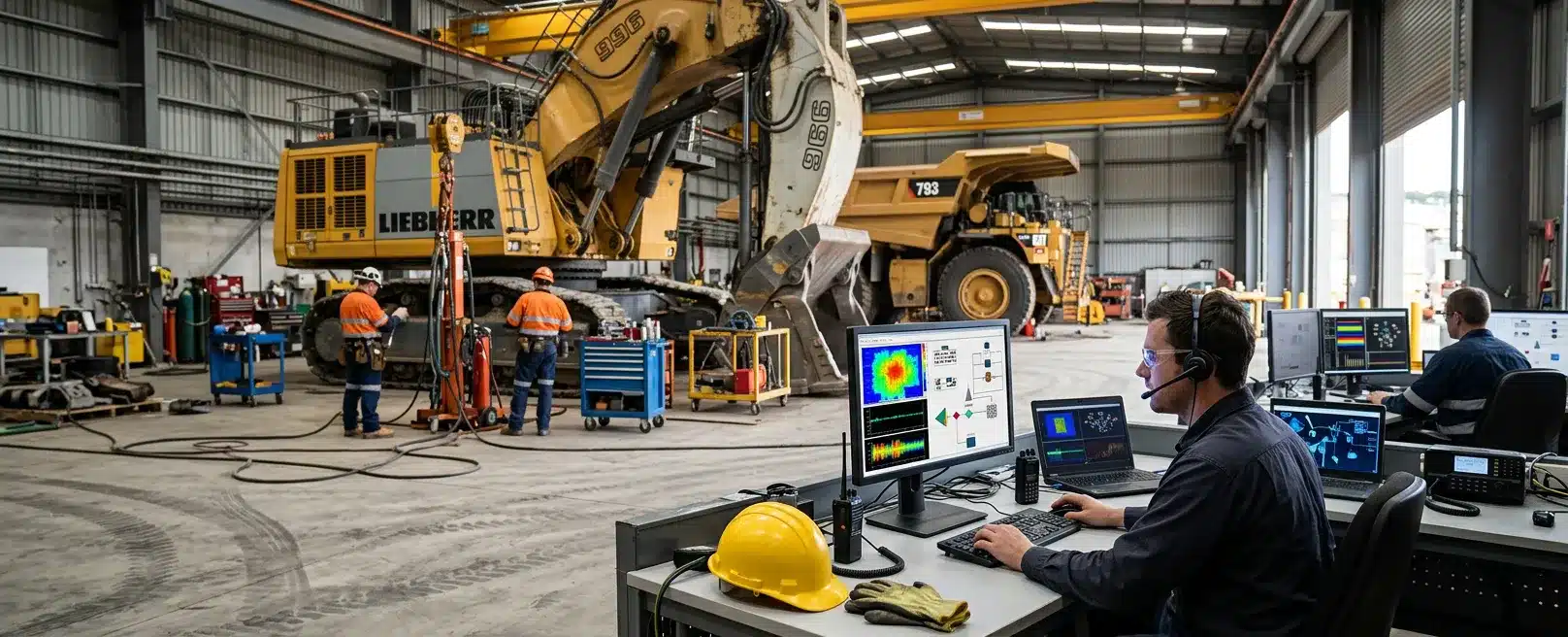
A condition event is only useful when it lands on the right asset ID, with the right sensor point, and opens a work order the planner can actually execute. Mine-site equipment already produces vibration, temperature, pressure and hours data. The decision is not whether to collect more of it. The decision is which events are valid, which CMMS record they belong to, and which workflow they are allowed to start.
The engineering team brings that mapping work together with the engineering team when the plant item, the sensor layout and the work-order rules have to match on the same sheet. Automated creation of a work order is a maintenance instruction. It does not stop or restart authority for the machine.
Map Condition Events to the Named Asset
CMMS platforms already hold work orders, parts, operating hours and equipment history. Condition monitoring systems hold the live readings. If those two records do not share a stable identity, automation writes the wrong job. A haul-truck wheel-end alarm that opens against a sister unit wastes a crew and leaves the failing bearing on the road.
Why Sensor Points Must Match Asset IDs
Each sensor point needs a named parent asset, a mounting location and a parameter that the CMMS already understands. Vendor tags, local radio names and workshop nicknames are not enough. The integration layer has to translate those labels into the asset ID the planner uses, with units and timestamps aligned, before any threshold can raise a task.
Mine sites often run more than one monitoring vendor. Vibration loggers, oil labs and thermal routes rarely share a schema. Standardising that feed is a mapping job. Until the same bearing is the same bearing in both systems, automated work orders will split history and hide the trend the planner needs.
When a final drive is swapped, the truck asset ID may stay put while the vibrating object is a different unit. If the work-order history and the vibration baseline still point at the old serial, the next automated job compares new metal with old signatures. Record the component change in both systems before thresholds run again.
What a Valid Event Contains Before It Becomes a Work Order
A valid event is more than a red flag. It should carry the asset ID, the sensor point, the measured value against its band, the time of the reading, and enough fault language for a technician to start diagnosis. If the payload cannot name the component, the CMMS should not invent a job.
Baselines belong to the actual duty, not a brochure curve. A machine on rough haul roads and high load will not sit on the same vibration band as the same model on a light shift. Manufacturer defaults are a starting point. Site operating hours and load cases still have to sit in the alarm logic, or the first week of automation will either flood the board or stay silent.
A single sample above a band is not the same decision as a rising trend that is still inside the band. Snapshot alarms catch step changes. Trend logic catches slow wear. Mix them without saying which one opened the job, and technicians cannot tell whether they are chasing a spike or a developing fault.
Condition feeds are not all live. Vibration can stream. Oil results and some thermal routes arrive in batches. Work-order rules should wait for a complete, time-stamped result on batch channels rather than treating a missing daily file as a healthy machine. Live channels need a freshness limit. Batch channels need a due time.
Control the Work-Order Workflow, Not the Machine
Once the event is valid, the question is which controlled workflow it may enter. Advisory bands can log without raising a job. Warning bands can open a scheduled work order with a planned window. Critical bands can raise an urgent work order with a named priority. That graduation keeps inspection noise off the urgent board.
Priority, Parts and Technician Assignment
A useful work order tells the crew what to inspect, which parts lead time to check, and whether the job waits for a shutdown. Mapping a vibration event to inspect a wheel end is different from mapping it to replace a final drive. The first is a diagnostic task. The second spends inventory. Until the fault class is reliable, keep the automated job at inspection or trending, then let a planner convert it.
Assignment still needs a human rule set. Remote pits, permit windows and parts on a different site all change who can take the job. Automation can propose a trade and a window. It should not pretend the CMMS owns production.
Isolation and OEM Inspection Stay Outside Automation
Required OEM and statutory inspections remain on their own calendar. Condition events can add a job beside them. They do not cancel a scheduled strip or a compliance check because a sensor looks quiet. Quiet data can mean a healthy machine. It can also mean a dead channel.
Creating the work order does not isolate the plant, prove isolation, or authorise a restart. Those remain site procedures. The CMMS record should say what to do after isolation is proved. It should never be read as permission to run.
Test Suppression, Stale Signals and Escalation Before You Scale
Do not expand coverage until a small critical fleet has been through four tests: duplicate suppression, stale-signal handling, human escalation, and feedback from closed jobs. Prove those four on named assets before you copy the rules to the rest of the pit.
Duplicate Alarms on the Same Fault
A bearing in the alarm will keep alarming on every sample until someone works it. Without suppression, each sample becomes another work order. The board then shows several jobs for one fault, and the real new event is easy to miss.
Suppression should key on asset ID, sensor point and fault class for a defined window, and it should reopen or escalate if severity steps up. Closing the work order, or logging a deferral with a reason, should be the only clean ways out. Leaving duplicates of live trains crews to ignore the queue.
Stale or Interrupted Mine-Site Data
Mine networks drop. Fibre, wireless and satellite links all have gaps. A last-good reading from yesterday is not a live condition. If the integration treats stale data as current, it can raise jobs on old peaks or stay green while the machine is already in trouble.
Plan for local buffering and retry, and mark the channel stale when the age of the sample exceeds the limit you agree for that asset.
Apply channel-specific physical and sensor limits, then review values that sit outside those limits rather than treating every fast step or steady reading as bad data. Impacts and genuine transients can be real faults. A constant reading can be a healthy duty. Keep the raw event and escalate a possible critical fault for diagnosis instead of sending every suspicious sample away from automation.
Human Review for Ambiguous Events
Not every excursion is a fault. Variable speed, changing load and rough terrain all move vibration. The engineering team uses vibration data analysis to separate a genuine bearing or gear mesh change from process noise. That work supports remaining useful life estimates, CMMS integration and automated work orders when the signature is clean enough to act on.
When the signature is unclear, escalate to a person before the CMMS spends a shutdown. The planner still needs the spectra, the operating hours and the last repair note. Feedback from the closed job, whether false alarm, confirmed fault or a different component, is what returns bands. Without that loop, thresholds drift and trust falls.
After the job, take an acceptance reading on the same sensor point before you clear the fault class. Compare it under matched duty and the same sensor configuration, and check the asset ID mapping independently.
A lower reading alone does not prove the repair or the map. Lower load, a different operating point, or a still-wrong sensor can also drop the number. If the reading stays high under matched conditions, the work order may have hit the wrong component, or the sensor point may never have been on the part you thought.
Engineered Installations Group holds that process against the named asset.
Condition Data That Can Actually Drive Planning
Predictive maintenance uses current conditions, not a fixed calendar, to time work. That only holds when the signal is comparable to the baseline you stored. Change the sensor, the mounting, the damping or the load case, and you may need a new baseline before you trust automated jobs again. Not every modification invalidates history. The ones that change the measurement path or the duty do.
Vibration Signatures, Remaining Useful Life and Work Orders
Early fault detection on wheel ends, final drives, gear mesh, fans, alternators, pumps and hydraulics is a practical use of vibration work on mobile plants. Route-based or continuous monitoring can both feed the CMMS if the asset map is clean. Remaining useful life estimates help parts and crew planning. They are estimates under stated conditions, not a promised run-hours figure.
Train technicians on mounting and on separating process noise from machine noise. A logger that rattles on a weak bracket will raise work orders that describe the bracket, not the bearing. Fit quality is a condition input, not a later excuse when the CMMS looks busy.
When Structure and Mounts Need Analysis Instead of Another Alarm
If the question is whether a bracket, frame or sensor mount can survive the duty, another alarm band will not answer it. The engineering team uses finite element analysis to quantify stress, deflection, vibration and fatigue under mapped load cases, with material, geometry, contact and boundary judgment, then correlate where tests exist.
Raw acceleration is not a force. Do not convert a spike into a replacement interval or an arbitrary factor. FEA can support a design change or a retrofit. It does not set the CMMS calendar by itself. If the mount is the weak item, fix the mount, then re-baseline the sensor.
When the face that has to be modelled is hidden by a guard or a tray, 3D scanning gives geometry the engineering team can use in that model instead of guessing the as-built. The same scan can confirm the sensor still sits on the component you intend to trend.
Electrical Integrity of the Monitoring Path
Poor power, noisy returns and weak terminations corrupt the same channels the CMMS will trust. The electrical engineering work on machinery and heavy vehicles is the schematics, harness documentation and termination detail that keep those channels repeatable. Without that documentation, field repairs invent a second wiring state the historian cannot see.
If the monitoring system shares a vehicle with controls, lighting or safety circuits, system design is how mechanical mounting, power distribution and communication are laid out so the extra load does not harm the circuitry that already runs the machine. Emergency stops and interlocks stay on their own functional safety design. A condition alert does not rewrite them.
Physical fit still decides data quality. Where the machine cannot come off site, the engineering team handles on-site installation of sensors, harnesses and related systems with operations on isolation and commissioning. That fit is what keeps the sensor point on the named component the CMMS will later trust.
Where the vehicle can be booked into Forrestdale, workshop installation is the controlled bay for the same fit-out, with pre and post checks before it returns to duty. Use those checks to confirm the asset ID and sensor point still match before automated work orders resume.
Keep Light-Ute Fleet Records Separate From Mine Plant
When Australian light-ute fleets sit in the same company CMMS as heavy plant, they should not share alarm logic, asset classes or work-order templates. A ute GVM and tray duty is a different maintenance problem from a haul truck final drive.
If those light vehicles take braking and suspension upgrades for load and harsh roads, treat that as its own category. New spring rates and damper valving change ride and load support. They do not automatically void every historical reading.
Comparability checks are needed when sensor locations move, when body or axle duty clearly changes the measurement, or when the upgrade alters the load the vehicle actually carries. Take a new baseline on the affected channels after the work lands. Leave unrelated channels on their existing history unless the configuration that produced them has changed.
What to Send Before You Expand Coverage
Bring the named asset records, not a generic fleet list. Expansion copies whatever mapping you proved on the first machines. If those records open duplicate, stale or orphan jobs, a wider rollout will only multiply the noise. The four tests only mean something if they run against the same IDs the CMMS will use in production.
For each candidate machine, send:
- CMMS asset ID and parent hierarchy
- Sensor points, parameters and current alarm bands
- Recent operating hours and known load cases
- Last closed work orders against those assets
- Known logger, power or network gaps
- Geometry or scans if a mount or hidden face is in doubt
The engineering team then maps valid events to that asset and to a controlled workflow: log, inspect, schedule or urgent. The engineering team tests duplicate suppression, stale-signal flags, human escalation and closed-job feedback on that set before anyone copies the rules across the pit.
If that pack is ready, discuss the project with the asset IDs and sensor list in hand. That is enough to start the mapping and the four tests. Expansion waits until those tests hold on the named machines.



Leave A Comment