
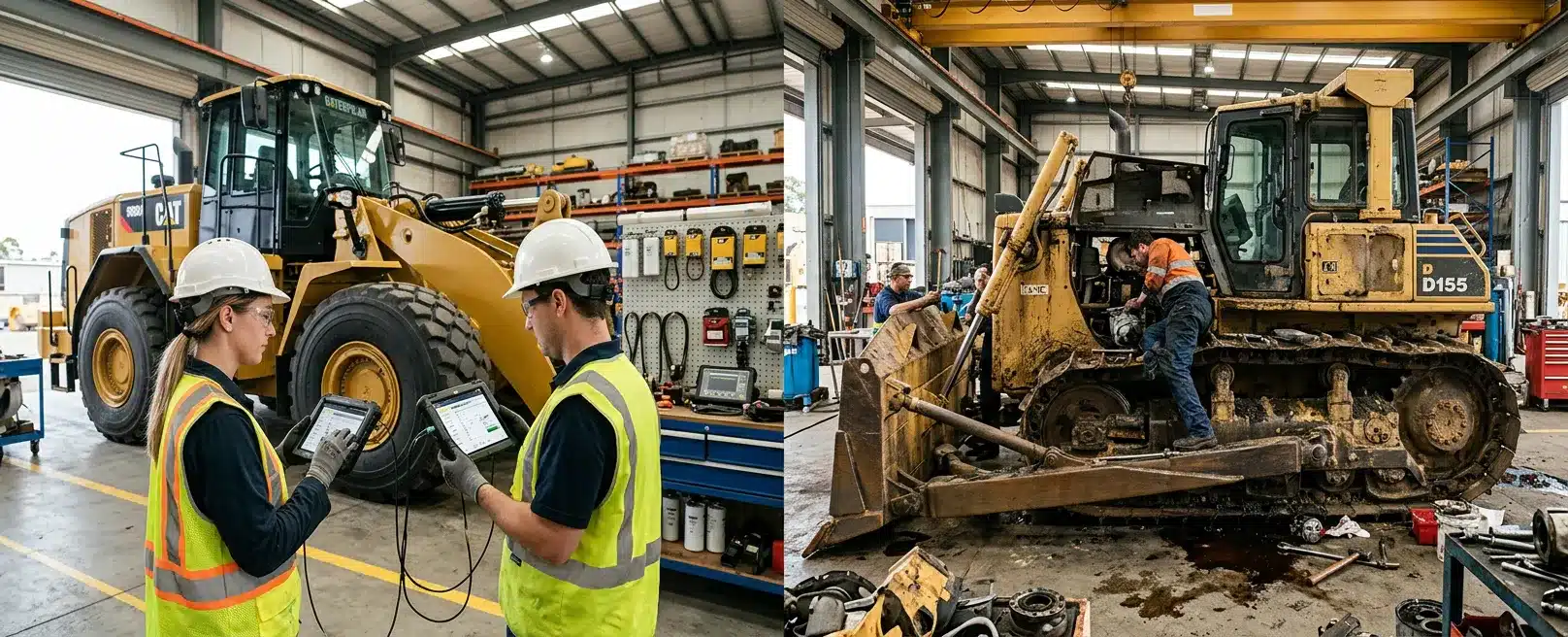
When a final drive, pump or gearbox fails mid-shift, the repair invoice is only the first line. The useful decision is whether that full reactive cost is higher than monitoring plus a planned intervention on the same asset.
Use site records for both ledgers: asset ID, operating hours, work orders, parts lead time and what production actually stopped. The engineering team brings the engineering and the install together at the engineering team for named heavy equipment, using that pack rather than a borrowed industry ratio.
A reactive event looks cheap only if you stop at labour hours and the replacement part. Callouts, after-hours labour, air freight and a second visit after a rushed first repair belong on that side of the sheet. So does secondary damage when a failed bearing or seal wrecks the housing around it. Take those figures from invoices and job cards for that asset ID, not from a rule of thumb.
What The Reactive Ledger Must Include
Unplanned stoppages also burn isolation time, recovery towing or cranage, and the crew standing by while the machine is dead. Safety follow-up after a violent shutdown is a real cost when it happens. OEM and statutory inspections still apply after a failure; they are not optional because the breakdown already occurred. Record them as part of the event, not as a separate morality tale.
Direct Repair Versus Secondary Damage
The primary failed item and the damage it caused are different lines. A wheel-end, gear mesh, fan, pump or hydraulic drive that seizes can score housings, contaminate oil and shock the next component in the driveline. If the job card shows both, cost both. If it shows only the first part, do not invent the cascade. The comparison stays honest when secondary damage is evidenced, not assumed for every fault.
Production Loss Counted Once
Lost output belongs in the reactive total only once. Use the production or dispatch record for the hours that asset was actually unavailable, at the rate your site already uses for that machine.
Do not add the same tonnes again as a downtime multiplier on the workshop invoice. Do not add a sister machine’s idle time unless that idle time is written in the shift report. Double counting makes monitoring look cheaper than the records support.
Workforce overtime on the repair is a labour cost. Production not moved is an output cost. Keep them on separate lines so a planner can see which one actually moved the total. If the machine was already off for an unrelated shutdown, do not charge that window again as failure downtime.
What Monitoring And Planned Work Actually Cost
The other ledger is not “monitoring” as a slogan. It is sensor hardware and mounting, data capture, analysis time, planned parts, planned labour and the window you choose. Condition monitoring uses operating data to show when an asset is departing from a healthy range, so work can be timed from condition rather than from a calendar alone or from a breakdown.
That still costs money before any fault appears. Route-based or continuous capture, rugged sensors on mobile plants, and the labour to keep sensor points clean and comparable are recurring lines. Planned intervention then adds parts at ordinary lead time, labour at ordinary rates and a booked window. Put those actual quotes and work orders on the sheet. Do not offset them with a promised payback.
Sensor Points, Baselines And Comparability
A reading is only useful against a baseline for that asset, that sensor point and that duty. Variable speed, changing load and rough terrain are normal on mobile equipment; they are reasons to define alarm bands carefully, not reasons to skip the baseline. Start with a critical plant, then scale. Train technicians on mounting and on separating machine noise from a real change in the signature.
Not every configuration change wipes history. A sensor relocated, a mounting stiffness change, a harness reroute that alters a running mode, or a new load case that the machine did not see when the baseline was taken, each needs a comparability check. A like-for-like part swap at the same point often does not. Say on the record what changed, then decide whether the old trend can still be read.
Remaining Useful Life And Work Orders
The engineering team uses vibration data analysis to detect early faults in bearings, gears and drivelines, and to manage imbalance and misalignment before they write a breakdown work order. That work supports remaining-useful-life estimates, CMMS integration and automated work orders so planners can pull parts and crew against a condition trend.
A created work order is planning information. It is not authority to stop or restart the machine; isolation, permit and operations still own that.
Oil condition, temperature and electrical readings can sit beside vibration when the failure mode needs them. The point of the mix is to time a planned job while the asset still runs, not to claim a fixed number of hours from first squeak to seizure. If the trend is unclear, the honest line on the sheet is “inspect and re-baseline,” not an invented intervention date.
Engineering That Changes The Intervention
Sometimes the cheap planned job is the wrong job. A repeating mechanical mode may need a stiffener, a damper or a relocated mount rather than another bearing. A cracked bracket may need geometry and load mapping rather than a heavier plate guessed in the bay. Those choices change both ledgers: they can cut repeat reactive spend, and they can raise the first planned-work cost.
Load Cases Before Replacement Intervals
The engineering team applies finite element analysis when the question is how a frame, bracket, enclosure or mount takes real loads. That means mapping the load case, using sound material and geometry data, setting boundaries that match how the part is held, and judging the result against test or field evidence.
Raw acceleration is not a force. Fatigue output can inform a planned inspection or replacement discussion. It does not authorise an automatic interval or an arbitrary safety factor.
When a component has already failed, the same method can reverse-engineer the event and show whether the next planned action should be a local repair, a redesign or a fleet-wide check of the same joint. That recommendation still sits under OEM and statutory inspection rules for the vehicle or machine.
Electrical Integrity And Mechanical Mounting
Unplanned electrical faults have the same split as mechanical ones: the failed connector or loom, plus any controller, harness or downtime they take with them. The engineering team uses electrical engineering when the records show ambiguity in schematics, cut lists or terminations that slows troubleshooting and invites repeat field failures. Clear documentation cuts diagnostic hours on the reactive side only if you actually use it on the next job.
If the mechanical and electrical systems fight each other, the planned cost should include one coherent package. The system design work sits on that decision: mounts and protection under shock and vibration, power and communication that do not starve the rest of the machine, and safety circuits that remain under the site’s functional-safety and isolation rules. A sensor that cannot survive the mount will generate false alarms and junk the comparison.
Guards, trays and tight bays often hide the face that has to be measured before a sensor boss or bracket is made. The engineering team uses 3D scanning when as-built geometry is the missing input, so the planned install fits the machine you have rather than the drawing you hoped for.
Engineered Installations Group holds that process against the named asset.
Scan cost belongs on the monitoring and intervention ledger. Capture the geometry before fabrication so the planned parts are made to the machine on site.
Light Ute Fleets Need Their Own Comparison
Australian light-ute fleets are a separate duty class from heavy equipment. Do not fold ute workshop invoices into a haul-truck or excavator comparison. If you also run utes hard under load, build a second ledger with their own asset IDs, operating hours and job cards.
For that ute ledger, braking and suspension upgrades are relevant when the records show fade, poor holding on grade or a ride that will not stay level under a higher GVM and heavier tray loads. A rough ride or a long pedal is a reason to inspect, not proof that a specification has failed.
After a conversion or revalve, check whether sensor points, loading or running height changed enough to need a new baseline. Do not assume every upgrade invalidates every historical reading.
Site Work, Workshop Work And The Records Pack
Where the planned job happens changes its cost. If the machine cannot come off site, on-site installation carries mobilisation, site induction and the shutdown window operations will actually give you.
The engineering team also captures vibration in the field, supports breakdowns and component changeouts, and runs condition and performance audits when that is the evidence the ledger still lacks. Preventive servicing and OEM inspections stay on the calendar the manufacturer and the regulator already set.
If the vehicle or assembly can be booked into Forrestdale, workshop installation can take the same fit-out, audit or aftercare with workshop controls instead of a pit-wall window. Choose the location from access, isolation and schedule, then put the real mobilisation difference on the planned side. Do not credit workshop convenience as a production gain you have already counted in downtime avoided.
Named Asset Inputs Needed
A fair comparison is a pack, not a feeling. Before the engineering team sizes monitoring, analysis or an install, gather the following for each named asset:
- Asset ID, make, model and the duty it actually works
- Operating hours or meter reading at the last event and now
- Work orders for the failure and for any planned jobs in the same period
- Parts invoices, freight method and parts lead time
- Production or dispatch hours lost, counted once
- Existing sensor points, last baseline and any configuration or load changes since
- Isolation, permit and OEM or statutory inspection status
- Clear photographs of the mount, harness path or failed joint
With that pack the engineering team can separate a true reactive total from a planned monitoring and intervention total on the same machine. If a line is missing, leave it blank rather than filling it with a typical percentage.
The practical answer is to cost both paths from the same site records, once. Put every evidenced reactive line on one side. Put capture, analysis, planned parts, planned labour and the real install location on the other. Leave out ratios, payback stories and production money you have already counted.
If the named pack is ready, discuss the project and the engineering team will use those records to scope the engineering and the install the comparison actually supports.



Leave A Comment