
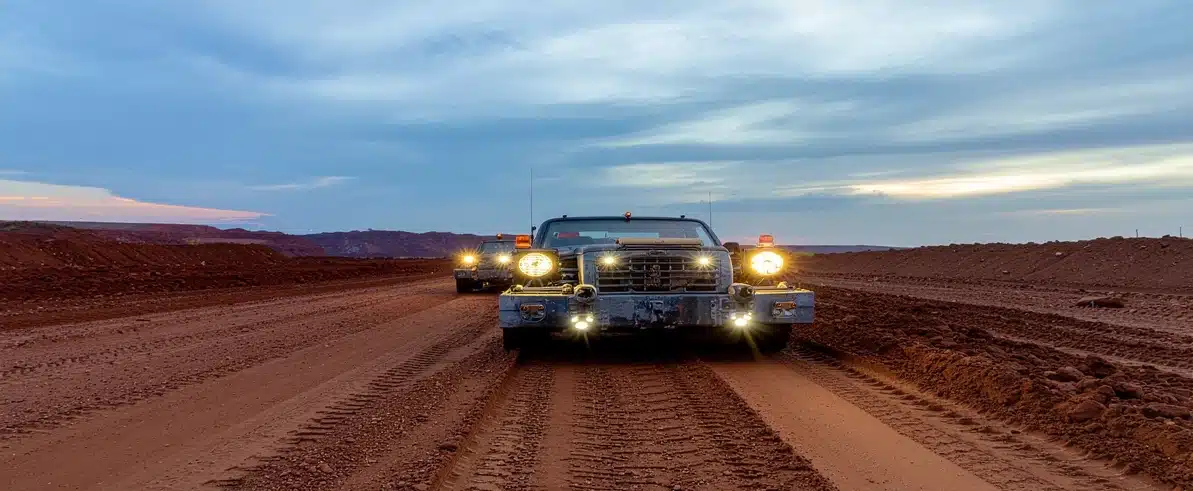
Visibility is a fundamental safety requirement in any operating environment. On a mine site, where heavy plant and light vehicles share access roads, loading areas, and maintenance zones in conditions that include dust, darkness, and restricted sight lines, the standard lighting fitted to road-registered vehicles falls well short of what is required. Vehicle lighting systems for mine-site applications must meet specific compliance standards, perform reliably in demanding physical conditions, and be installed in a way that supports both safe operation and minesite access approval. For fleet managers and site safety officers, getting lighting right is not a secondary consideration, it is a front-line safety measure.
Why Vehicle Lighting Is a Minespec Priority
Collision between light vehicles and heavy plant is one of the most serious and persistent hazards in surface mining operations. Heavy equipment operators have restricted visibility from their elevated cabs, and the blind spots around large mining trucks can extend for many metres in multiple directions. Light vehicles that are not clearly visible to heavy equipment operators, whether due to insufficient lighting, absent beacons, or inadequate reflective markings, are at serious risk in areas where heavy plant is operating.
The operating conditions of a mine site compound this risk. Dust clouds generated by haul roads and blasting operations reduce visibility across the site. Night operations, which are common in continuous mining environments, further reduce the contrast between vehicles and their surroundings. Low-angle sunlight at dawn and dusk creates glare conditions that make standard vehicle profiles difficult to see at distance.
Mining vehicle lighting failures are not just a compliance issue, they create immediate and tangible safety risk. A beacon that stops functioning during a shift removes the most visible indicator of a light vehicle’s presence in heavy plant areas. A work light failure during a maintenance task on a haul road leaves the vehicle and its crew exposed in a low-visibility environment. These failures need to be prevented through correct initial installation and reliable product selection, areas where EIG brings both the technical knowledge and the quality assurance processes to deliver consistently compliant outcomes.
Mine-Site Lighting Compliance Standards
Vehicle lighting requirements on Australian mine sites are governed by a combination of state workplace health and safety legislation, Australian standards, and site-specific equipment requirements issued by mine operators. The specific requirements vary by site, but a consistent set of minimum standards applies across most operations.
Amber beacon requirements are near-universal. All light vehicles operating in areas where heavy plant is present must be fitted with an approved amber warning beacon, typically mounted at the highest practicable point on the vehicle and visible through a full 360 degrees. Beacon brightness, flash pattern, and mounting height requirements are specified by some operators and implied by the relevant standards in others.
Mine-site lighting compliance extends to working lights, reverse lights, and in some cases undercarriage lighting. Documentation of installed lighting systems, including product specifications, mounting positions, and wiring configurations, is typically required as part of the vehicle’s fitout record for minesite access approval. The capability statement from Engineered Installations Group outlines the QA documentation framework EIG applies to every lighting upgrade, giving mine operators the compliance evidence they need to approve vehicles efficiently.
Types of Vehicle Lighting Systems for Mine Applications
Working and Task Lighting
Work lights provide illumination for maintenance tasks, loading operations, and site activities carried out outside standard daylight hours or in areas where ambient light is insufficient. Effective task lighting requires the right combination of beam pattern, lumen output, and mounting position for the specific work being performed.
Flood beam patterns provide wide-area illumination suitable for general maintenance and working around the vehicle. Spot beam patterns provide focused long-range illumination for navigation and obstacle detection. Combination beam patterns, which incorporate both flood and spot elements, are the most commonly specified configuration for general-purpose mine-site work lights.
Integration of work lighting with the vehicle’s electrical system requires careful attention to load management. High-output work lights can draw significant current, and multiple lights operating simultaneously can place a substantial load on the vehicle’s alternator and battery system. Load calculations that account for work lighting as part of the total auxiliary load are an essential part of fitout design.
Warning and Beacon Systems
Amber beacons are the most universally recognised mine-site warning system. Their function is simple: to make a vehicle continuously and unmistakably visible to operators of heavy plant and other vehicles across the site. The technology used to achieve this has evolved significantly, with LED strobe beacons now largely replacing the rotating halogen beacons that were standard equipment in earlier decades.
LED strobe beacons offer significant advantages over their rotating counterparts in mine-site applications. They produce a higher-intensity flash with lower current draw, have no moving parts to fail, and are more resistant to vibration damage. Their lower thermal output also reduces the risk of heat-related failures in high-ambient-temperature environments, which is a common failure mode for rotating beacon motors.
Wiring and integration of beacon systems must account for the beacon’s operating voltage, current draw, and any required interfaces with the vehicle’s electrical system. Some beacons require a dedicated circuit; others can be wired into existing auxiliary circuits if the circuit rating is adequate. Correct fusing and wiring protection are essential for reliable operation.
LED Light Bar Installation
LED light bars have become the preferred working and driving light solution for mine-site vehicles due to their combination of high lumen output, low current draw, compact form factor, and resistance to vibration damage. LED light bar installation for mine-site applications must account for the specific requirements of the operating environment, requirements that exceed those of standard automotive or recreational four-wheel drive applications.
Mounting solutions for mine-site LED light bars must be rigid and vibration-resistant. Light bars that are not correctly mounted will loosen over time, changing their aim and eventually failing due to fatigue at the mounting interface. Mine haul roads and exploration tracks subject vehicles to sustained vibration that would dislodge or damage inadequately mounted light bars within a short period of operation.
Wiring for LED light bars must be sized for the light bar’s current draw with appropriate allowance for ambient temperature derating, protected with correctly rated fuses or circuit breakers, and routed away from heat sources and areas of mechanical abrasion. Waterproof connectors rated to IP67 or better should be used at all connection points exposed to dust and moisture ingress.
Auxiliary Lighting Fitout Considerations
Auxiliary lighting fitout covers the full range of supplementary lighting systems fitted to mine-site vehicles beyond the standard minespec lighting requirements. This includes reverse lighting upgrades to improve safety during reversing manoeuvres in confined or low-visibility areas, under-vehicle lighting for maintenance access in low-light conditions, and cab interior lighting for documentation, communications, and personal safety.
Reverse lighting upgrades typically involve the replacement of standard OEM reverse lights with higher-output LED alternatives, combined in some cases with a reverse camera system that provides a direct view of the reversing path on a cab-mounted display. Where vehicles regularly reverse in areas with pedestrian traffic or limited sight lines, this combination provides significantly better protection than a standard lighting and warning configuration.
Auxiliary lighting fitout also covers the integration of all installed lighting systems into the vehicle’s total electrical load calculation. Every additional light adds to the load that the vehicle’s alternator and battery system must support. Correct load management design ensures that the vehicle can sustain all installed loads simultaneously without overloading the charging system or causing battery discharge. For vehicles that need lighting upgrades completed at a remote location, on-site installation support allows the work to be carried out without requiring the vehicle to travel to a workshop.
Mining Vehicle Lighting for Underground Applications
Underground mining environments present lighting challenges and compliance requirements that differ substantially from surface operations. Limited ambient light, confined spaces, and the presence of flammable gases in some underground environments all affect both the specification of lighting systems and the products that are approved for installation.
Vehicles operating in areas classified as hazardous under AS/NZS 60079 must be fitted with lighting equipment rated for the relevant hazardous area zone classification. Zone 1 and Zone 2 classified areas require lighting equipment that cannot ignite flammable gases under normal operation or under defined fault conditions. This requirement significantly narrows the range of products that can be installed and requires formal documentation of the equipment’s zone classification and installation standard.
For non-hazardous area underground applications, the primary additional requirement is high-intensity, all-round illumination that allows the vehicle to be seen in the confined and often dusty conditions of underground access roads and working areas.
Durability and Mine-Site Lighting Performance
Standard automotive lighting products are not designed for the conditions present on Australian mine sites. Products that perform adequately on paved roads and in moderate climates will often fail prematurely when exposed to the vibration, heat, dust, and chemical contamination typical of a mine operating environment.
Ingress protection ratings are a primary selection criterion for mine-site lighting products. IP67 and IP69K rated products provide protection against dust ingress and high-pressure water washing, which are relevant to most mine-site environments. Products with lower IP ratings are prone to moisture and dust contamination that causes premature failure of LED drivers, connectors, and optical assemblies.
Vibration resistance is equally important. Mine-site vehicles traverse surfaces that generate sustained vibration across a broad frequency range. Lighting products with inadequate vibration ratings will develop internal fatigue failures, broken solder joints, cracked PCBs, and failed LED connections, that cause premature and often intermittent failure.
EIG’s Approach to Lighting System Upgrades
Engineered Installations Group approaches vehicle lighting upgrades as an integrated engineering task, not a product procurement exercise. System design begins with the site requirements and vehicle constraints, product selection is based on performance and durability specifications that match the operating environment, and installation is carried out to documented quality standards with a post-installation inspection that verifies compliance before the vehicle is submitted for site access approval.
The workshop installation services available at EIG’s Perth facility allow lighting upgrades to be carried out efficiently in a controlled environment, with access to the tooling and test equipment needed to verify electrical connections, beam aim, and system function. Documentation for lighting system upgrades covers product specifications, mounting positions, wiring configurations, and test results, the information required by mine operators to assess a vehicle’s lighting compliance during the access approval process.
Conclusion
Vehicle lighting systems are among the most visible and immediately safety-critical elements of any mine-site vehicle fitout. Compliant, high-performance lighting makes vehicles visible to heavy plant operators, improves the safety of maintenance tasks and night operations, and satisfies the documentation requirements needed for minesite access. The combination of correct product selection, professional installation, and thorough documentation is what makes a lighting upgrade genuinely effective rather than merely cosmetically complete. To discuss vehicle lighting upgrades for your mine-site fleet, call +61 (08) 9419 7318 to speak with the EIG team.



Leave A Comment